




Genetic Variant Analysis in 10 Patients with Polycystic Kidney Disease
-
摘要:
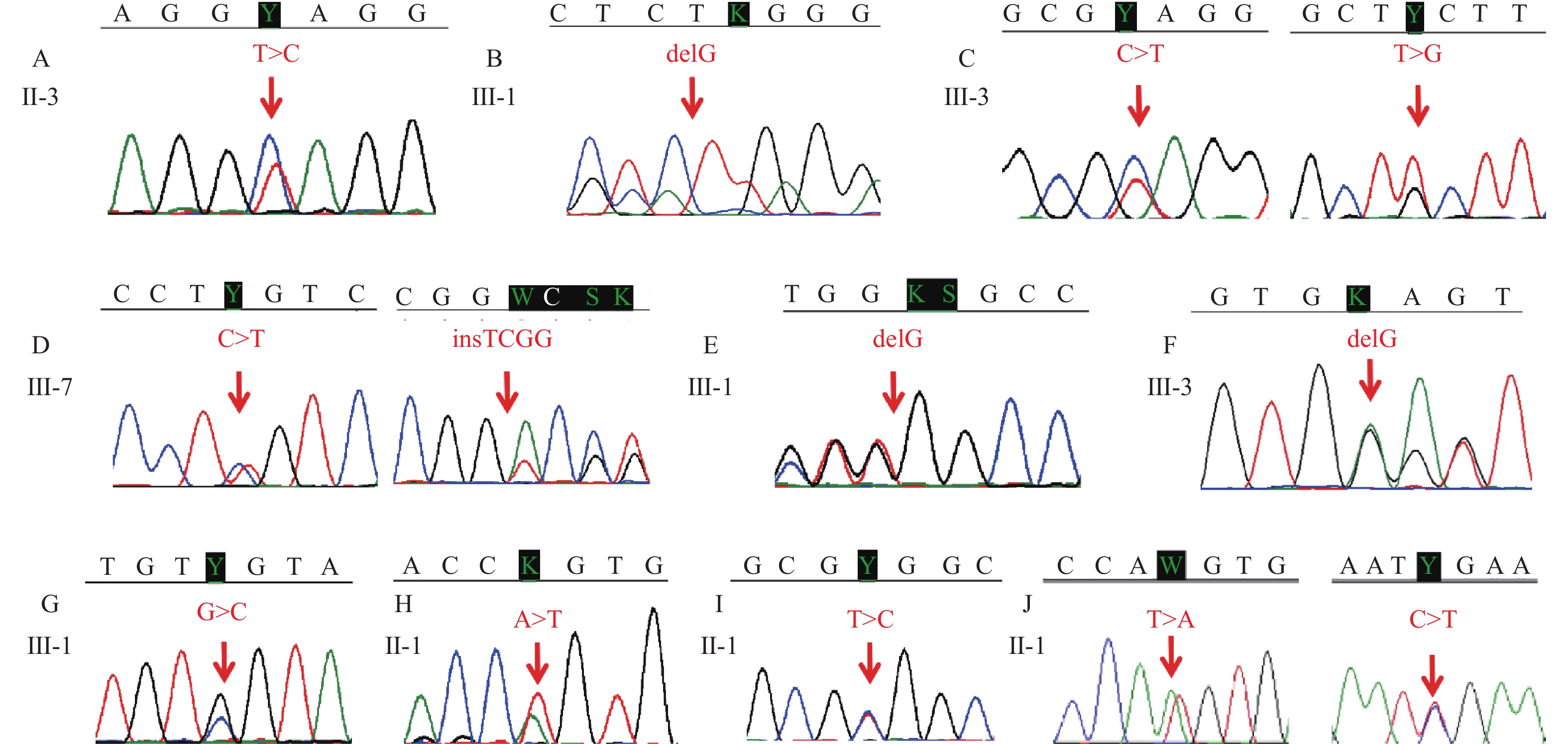
目的 对10例多囊肾病(polycystic kidney disease ,PKD)家系进行基因变异分析,明确家系先证者及其他成员的分子诊断。 方法 收集10例PKD家系患者的临床资料,采集先证者及部分家系成员的外周血,提取基因组DNA行二代测序(next generation sequencing ,NGS),对候选变异进行生物信息学分析,并对先证者行Sanger测序验证及家系成员变异分析。 结果 10个家系共发现8种PKD1变异,3种PKD2变异,2种PKHD1变异。其中PKD1基因c.3416_3417delTG、c.10264_10265insTCGG、c.10762T>C以及PKD2基因c.602delG、c.1548G>C,查阅HGMD数据库、ClinVar数据库及国内外文献均未见报道。根据美国医学遗传学与基因组学学会(the American College of Medical Genetics and Genomics ,ACMG)遗传变异分类标准及指南,PKD1基因c.3416_3417delTG、c.10264_10265insTCGG及PKD2基因c.602delG被归类为可能致病(likely pathonegic,LP),PKD1基因c.10762T>C及PKD2基因c.1548G>C被归类为临床意义未明变异(variantsof uncertain significance ,VUS)。 结论 本研究通过基因诊断明确了10个PKD家系患者的发病原因,并首次报道了3种PKD1和2种PKD2基因新变异,拓展了PKD的基因突变谱。 Abstract:Objective To identify the pathogenic gene variants in ten polycystic kidney disease (PKD)pedigrees, to clarify the molecular diagnosis of the probands and other family members. Methods Clinical data of 10 PKD pedigrees was collected, genomic DNA was extracted from peripheral blood samples of the probands and family members, and sequenced by next generation sequencing (NGS), candidate variants wereanalyzed by bioinformatics and confirmed by Sanger sequencing. Results A total of 8 PKD1 variants and 3 PKD2 variants and 2 PKHD1 variants were found in the 10 pedigrees. Among these, PKD1: c.3416_3417delTG, c.10264_10265insTCGG, c.10762T>C and PKD2: c.602delG, c.1548G>C variants have not been reported in HGMD database, ClinVar database or previous literature.According to the American College of Medical Genetics and Genomics (ACMG) standards and guidelines for the interpretation of sequence variants, PKD1: c.3416_3417delTG, c.10264_10265insTCGG and PKD2: c.602delG were classified as likely pathogenic (LP), PKD1: c.10762T>C and PKD2: c.1548 G>C were classified as variantsof uncertain significance (VUS). Conclusion In this study, the cause of PKD in 10 pedigrees was identified by molecular diagnosis, and three novel PKD1gene variants and two novel PKD2 gene variants were reported for the first time, which expanded the mutation spectrum of PKD. -

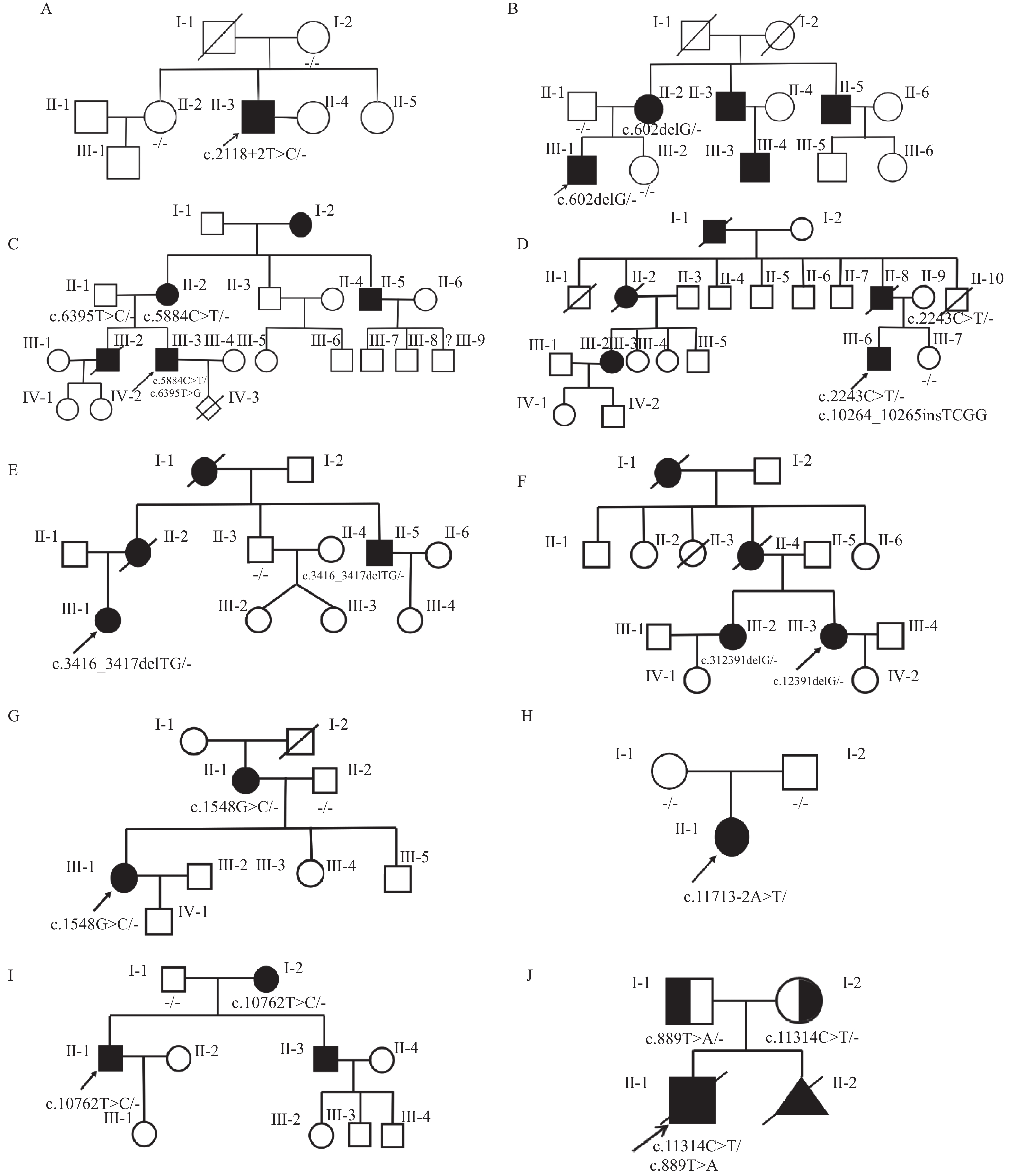
图 1 家系图
A-J:PKD家系1~家系10。注:□○正常人;■男性患者;●女性患者;
Figure 1. Pedigree Chart
表 1 10个家系PCR引物序列
Table 1. PCR primer sequences for the 10 pedigrees
样本名称 基因 引物序列(5'→3') 片段长度(bp) 退火温度(℃) 家系1 PKD2 F:CCTGTGGCATGACTTAACGGAGAA 896 60 R:GTGATGAACCTTCAGCTCAGCTCTTA 家系2 PKD2 F:TTGCCATTCATGAGATTTCTTAA 180 50 R:ACAGATGCACAAGACTATGAG 家系3 PKD1 F:CCAACCCCGAGGTGCTCCCC 202 60 R:GTGAAGTTCCTCTCAGTGCCCGTG 家系4 PKD1 F1:CCTCAAGCCCAGCAGCACGG 214 59 R1:CGTTGGCTTGCAGCACGACG F2:AGGTCACTGTGTCTGGGGT 361 58 R2:GATTTGGCAGGCGAGTAG 家系5 PKD1 F:CTGACCGTGCTGGCATCTAA 156 60 R:AGGCGAGGGCAGCGGGTGCGGGTAGAAGGTGAC 家系6 PKD1 F:CCAGTGGACCCGTTTCGTG 600 60 R:AGCGGCTCCATCCCTTCA 家系7 PKD2 F:GAAGTCTTATTCCTTTGATGGCACAA 650 60 R:GGCTGAGAGCATACTGTAAATACCTC 家系8 PKD1 F:CACCTGGTCGAAGCTAGTGA 491 59 R:CCTCTGCTCACCTCGGTAC 家系9 PKD1 F:ATGGTTGAGACCCAATCATAGTTTGC 4913 60 R:GCCTTGACAGCGGCAGAAAGTAATAC 家系10 PKHD1 F1:TCTGATCCATCTTTTCTAACTTC 182 57 R1:TGCAGATAAAGTGGTAACAG F2:ACACACACACATACATAAATTTCTT 196 58 R2:CCAGCCCATCATGATTAAAGATAT  下载: 导出CSV
表 2 PKD家系1~家系10先证者的临床资料
Table 2. Clinical characteristics of the probands from PKD pedigrees 1~10
家系 性别 年龄/
发现年龄临床表现 家族史 实验室检查 影像学检查 1 男 30/8 多囊肾、不育 无 尿蛋白3+,隐血+,无精子症 彩超:双侧精囊增大伴液性包块,前列腺多发囊肿,前列腺钙化点;CT:1.多囊肾2.左肾下盏铸型结石3.脾大4.肝内多发低密度影 2 男 33/18 多囊肾、高血压、不育 母亲、2个舅舅、表弟均为多囊肾 尿蛋白+,睾酮偏低,少弱精子症 彩超:双肾囊肿(多发)、双肾结石(多发) 3 男 32/30 多囊肾、高血压、不育 外婆、母亲、舅舅、哥哥均为多囊肾 尿蛋白+,血肌酐偏高,无精子症 彩超:双肾多囊肾改变伴部分囊壁钙化;CT:两侧多囊肾伴多发结石 4 男 31/26 多囊肾、不育 爷爷、父亲、姑姑、堂姐均为多囊肾 尿蛋白4+、血肌酐偏高、无精子症 彩超:双肾多囊肾 5 女 32/23 多囊肾 外婆、母亲、小舅均为多囊肾 尿常规及肝肾功能正常 彩超:多囊肝、多囊肾;CT:多囊肝、多囊肾,部分肾囊肿内出血或钙化沉积 6 女 34/24 多囊肾、高血压 外婆、母亲、姐姐均为多囊肾 尿隐血2+、肝肾功能正常 彩超:肝多发囊肿,肝内钙化灶,多囊肾,双肾结石待排,左附件区囊性包块 7 女 38/27 多囊肾、肾结石 母亲为多囊肾 尿常规及肝肾功能正常 彩超:多囊肝、多囊肾、脾大、双肾结石、宫颈潴留性囊肿 8 女 28/28 多囊肾 无 尿常规及肝肾功能正常 彩超:双肾多囊肾 9 男 31/27 多囊肾 母亲为多囊肾 尿常规及肝肾功能正常、精液常规大致正常 彩超:双侧多囊肾、双肾多发结石、前列腺增大伴结石 10 男 死胎 多囊肾 同胞胎儿多囊肾
(引产)无 母亲孕28周产检彩超:胎儿多囊肾,羊水少
下载: 导出CSV
表 3 家系1~10基因检测结果
Table 3. Genetic testing results for pedigrees 1~10
家系 基因 核苷酸变化 氨基酸改变 变异类型 变异来源 ACMG评级 ACMG变异
评级证据项首次报道 1 PKD2 c.2118+2T>C 未知 剪接变异 未知 LP PVS1+PM2 否 2 PKD2 c.602delG p.Trp201Trpfs*32 移码变异 母源 LP PVS1+PM2 是 3 PKD1 c.6395T>G p.Phe2132Cys 错义变异 父源 VUS PM1+PP3 否 c.5884C>T p.Gln1962X 无义变异 母源 LP PVS1+PM2 否 4 PKD1 c.10264_10265insTCGG p.Asp3422Valfs*6 移码变异 父源 LP PVS1+PM2 是 c.2243C>T p.Ser748Leu 错义变异 母源 VUS PM2+PP3 否 5 PKD1 c.3416_3417delTG p.Val1139Glyfs*71 移码变异 母源 LP PVS1+PM2 是 6 PKD1 c.12391delG p.Glu4131Serfs*67 移码变异 母源 P PVS1+PS4+PM2 否 7 PKD2 c.1548G>C p.Val516= 同义变异 母源 VUS PP3+PM2 是 8 PKD1 c.11713-2A>T 未知 剪接变异 新发变异 LP PVS1+PM2 +PS4 否 9 PKD1 c.10762T>C p.Trp3588Arg 错义变异 母源 VUS PM1+PM2 +PP3 是 10 PKHD1 c.889T>A p.Cys297Ser 错义突变 父源 VUS PM3+PM2 +PP3 否 c.11314C>T p.Arg3772X 无义变异 母源 LP PVS1+PM2 否 LP: likely pathogenic; VUS: variant of uncertain significance; P:pathogenic
下载: 导出CSV
-
[1] Bergmann C, Guay-Woodford L M, Harris P C, et al. Polycystic kidney disease[J]. Nat Rev Dis Primers, 2018, 4(1): 50. doi: 10.1038/s41572-018-0047-y [2] Boletta A, Caplan M J. Physiologic mechanisms underlying polycystic kidney disease[J]. Physiol Rev, 2025, 105(3): 1553-1607. doi: 10.1152/physrev.00018.2024 [3] Aung T T, Bhandari S K, Chen Q, et al. Autosomal dominant polycystic kidney disease prevalence among a racially diverse United States population, 2002 through 2018[J]. Kidney360, 2021, 2(12): 2010-2015. doi: 10.34067/KID.0004522021 [4] Gordon C E, Garimella P S, Perrone R D, et al. Autosomal dominant polycystic kidney disease: Core curriculum 2025[J]. Am J Kidney Dis, 2025, 86(4): 525-542. [5] Chebib F T, Hanna C, Harris P C, et al. Autosomal dominant polycystic kidney disease: A review[J]. Jama, 2025, 333(19): 1708-1719. doi: 10.1001/jama.2025.0310 [6] Chang A R, Moore B S, Luo J Z, et al. Exome sequencing of a clinical population for autosomal dominant polycystic kidney disease[J]. Jama, 2022, 328(24): 2412-2421. doi: 10.1001/jama.2022.22847 [7] Guay-Woodford L M. Autosomal recessive polycystic kidney disease: update on pathogenesis and emerging therapies[J]. Curr Opin Nephrol Hypertens, 2025, 34(2): 89-96. [8] Goggolidou P, Richards T. The genetics of Autosomal Recessive Polycystic Kidney Disease (ARPKD)[J]. Biochim Biophys Acta Mol Basis Dis, 2022, 1868(4): 166348. [9] Jdiaa S S, Mustafa R A, Yu A S L. Treatment of autosomal-dominant polycystic kidney disease[J]. Am J Kidney Dis, 2025, 85(4): 491-500. doi: 10.1053/j.ajkd.2024.08.008 [10] Stenson P D, Mort M, Ball E V, et al. Human Gene Mutation Database (HGMD)[DB/OL]. Cardiff: Institute of Medical Genetics, Cardiff University, (2020)[2026-04-27]. https://www.hgmd.cf.ac.uk. HGMD® [11] Landrum M J, Benson M, Brown G R, et al. ClinVar[DB/OL]. Bethesda: National Center for Biotechnology Information (NCBI), (2025)[2026-04-27]. https://www.ncbi.nlm.nih.gov/clinvar/. [12] Richards S, Aziz N, Bale S, et al. Standards and guidelines for the interpretation of sequence variants: A joint consensus recommendation of the American College of Medical Genetics and Genomics and the Association for Molecular Pathology[J]. Genet Med, 2015, 17(5): 405-424. doi: 10.3410/f.725378375.793543190 [13] Borghol A H, Bou Antoun M T, Hanna C, et al. Autosomal dominant polycystic kidney disease: An overview of recent genetic and clinical advances[J]. Ren Fail, 2025, 47(1): 2492374. doi: 10.1080/0886022X.2025.2492374 [14] Cadnapaphornchai M A, Dell K M, Winyard P J D. Polycystic kidney disease in children: the current status and the next horizon[J]. Adv Clin Exp Med, 2025, 86(3): 383-392. [15] Alshriem L A, Buqaileh R, Alorjani Q, et al. Ciliary ion channels in polycystic kidney disease[J]. Cells, 2025, 14(6): 459. doi: 10.3390/cells14060459 [16] Burgmaier K, Brinker L, Erger F, et al. Refining genotype-phenotype correlations in 304 patients with autosomal recessive polycystic kidney disease and PKHD1 gene variants[J]. Kidney Int, 2021, 100(3): 650-659. doi: 10.1016/j.kint.2021.04.019 [17] Petit C, Cantarovich D, Langs V, et al. Genetic screening is essential in polycystic kidney disease: It is never too late![J]. Nephrol Ther, 2022, 18(2): 144-147. [18] Authors N. KDIGO 2025 clinical practice guideline for the evaluation, management, and treatment of autosomal dominant polycystic kidney disease (ADPKD)[J]. Kidneys, 2025, 14(1): 7-16. doi: 10.22141/2307-1257.14.1.2025.494 [19] Hwang Y H, Conklin J, Chan W, et al. Refining genotype-phenotype correlation in autosomal dominant polycystic kidney disease[J]. J Am Soc Nephrol, 2016, 27(6): 1861-1868. doi: 10.1681/ASN.2015060648 [20] Carrera P, Calzavara S, Magistroni R, et al. Deciphering variability of PKD1 and PKD2 in an Italian cohort of 643 patients with autosomal dominant polycystic kidney disease (ADPKD)[J]. Sci Rep, 2016, 6: 30850. doi: 10.1038/srep30850 [21] Chang M Y, Chen H M, Jenq C C, et al. Novel PKD1 and PKD2 mutations in Taiwanese patients with autosomal dominant polycystic kidney disease[J]. J Hum Genet, 2013, 58(11): 720-727. doi: 10.1038/jhg.2013.91 -

 点击查看大图
计量
- 文章访问数: 383
- HTML全文浏览量: 245
- PDF下载量: 107
- 被引次数: 0
