




Expression of PSMB5 in Bladder Urothelial Carcinoma and Its Clinicopathological Significance
-
摘要:
目的 探讨PSMB5在膀胱尿路上皮癌中的表达及临床病理意义。 方法 纳入TCGA-BLCA队列414例肿瘤组织和19例癌旁/正常膀胱组织(其中19对为配对样本),表达量统一为TPM并进行log2(TPM+1)转换;采用ROC曲线、Kaplan-Meier法和单因素Cox比例风险模型评价其探索性区分能力及预后相关性,并进行GO、KEGG和GSEA富集分析。另回顾性纳入2020年1月至2023年12月昆明医科大学第二附属医院接受根治性膀胱切除的膀胱尿路上皮癌患者61例,采用免疫组织化学检测PSMB5蛋白表达,以改良H-score中位数140分为界分组,分析其与临床病理特征及随访结局的关系。 结果 TCGA分析显示,PSMB5 mRNA在肿瘤组织中高于癌旁/正常组织,ROC曲线AUC为0.837(95%CI:0.759~0.915);按约登指数最大原则确定最佳截断值为 7.4516 [log2(TPM+1)],对应敏感度为86.2%(95%CI:82.5%~89.2%)、特异度为84.2%(95%CI:62.4%~94.5%)。PSMB5高表达与病理分期、治疗反应、组织学分级、肿瘤亚型、总生存和疾病特异性生存事件相关(均P < 0.05)。单因素Cox分析显示PSMB5高表达与总生存不良相关(HR = 1.526,95%CI:1.135~2.051)。本院队列中位随访44个月(范围27~68个月),PSMB5高表达31例、低表达30例。PSMB5高表达与高级别、pN/pM分期、AJCC III/IV期、神经侵犯、肿瘤坏死、复发、进展/转移及死亡事件相关(均P < 0.05);按非肌层浸润性与肌层浸润性分层时差异无统计学意义(P = 0.369)。功能富集和GSEA的探索性结果提示PSMB5相关基因与蛋白酶体及Wnt相关通路有关。结论 PSMB5在膀胱尿路上皮癌中表达升高,并与部分侵袭性临床病理特征和不良结局事件相关;其独立预后价值及与Wnt/β-catenin通路的关系仍需进一步验证。 Abstract:Objective To investigate PSMB5 expression in bladder urothelial carcinoma and its clinicopathological significance. Methods The TCGA-BLCA cohort comprising 414 tumor tissues and 19 adjacent/normal bladder tissues was included, of which 19 pairs were matched samples. Expression levels were uniformly converted to TPM and then transformed as log2(TPM+1). Receiver operating characteristic (ROC) curve analysis, the Kaplan–Meier method, and univariable Cox proportional hazards models were used to evaluate the exploratory discriminatory ability and prognostic associations of PSMB5, and GO, KEGG, and GSEA enrichment analyses were performed. In addition, 61 patients with bladder urothelial carcinoma who underwent radical cystectomy at The Second Affiliated Hospital of Kunming Medical University between January 2020 and December 2023 were retrospectively included. PSMB5 protein expression was evaluated by immunohistochemistry. Patients were stratified using a median modified H-score of 140 as the cutoff, and the relationships between PSMB5 expression and clinicopathological characteristics and follow-up outcomes were analyzed. Results TCGA analysis showed that PSMB5 mRNA expression was higher in tumor tissues than in adjacent/normal tissues, with an ROC curve AUC of 0.837 (95%CI: 0.759~0.915). The optimal cutoff value, determined by maximizing the Youden index, was 7.4516 [log2(TPM+1)], corresponding to a sensitivity of 86.2% (95%CI: 82.5%~89.2%) and a specificity of 84.2% (95%CI: 62.4%~94.5%). High PSMB5 expression was associated with pathological stage, treatment response, histological grade, tumor subtype, overall survival, and disease-specific survival events (all P < 0.05). Univariable Cox analysis showed an association between high PSMB5 expression and poor overall survival (HR = 1.526, 95%CI: 1.135~2.051). The median follow-up of the institutional cohort was 44 months (range, 27~68 months); 31 cases showed high expression and 30 showed low expression. High PSMB5 expression was associated with high histological grade, pN/pM stage, AJCC stage III/IV, perineural invasion, tumor necrosis, recurrence, progression/metastasis, and death events (all P < 0.05). After stratification by non-muscle-invasive and muscle-invasive disease, the difference was not statistically significant (P = 0.369). Exploratory functional enrichment and GSEA results suggested associations of PSMB5-related genes with proteasome- and Wnt-related pathways.Conclusion PSMB5 expression is elevated in bladder urothelial carcinoma and is associated with certain aggressive clinicopathological features and adverse outcome events. Its independent prognostic value and relationship with the Wnt/β-catenin pathway require further validation. -
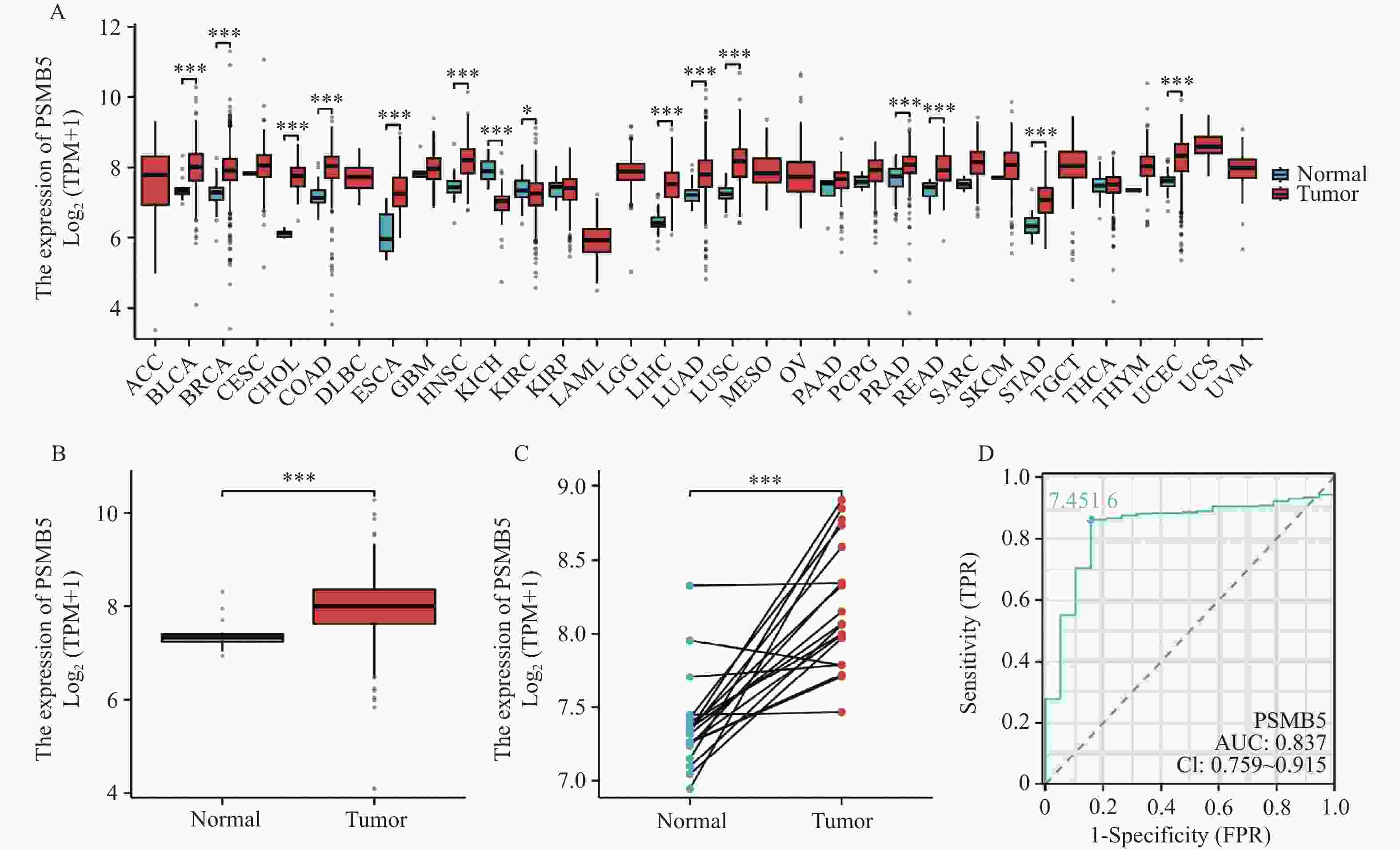
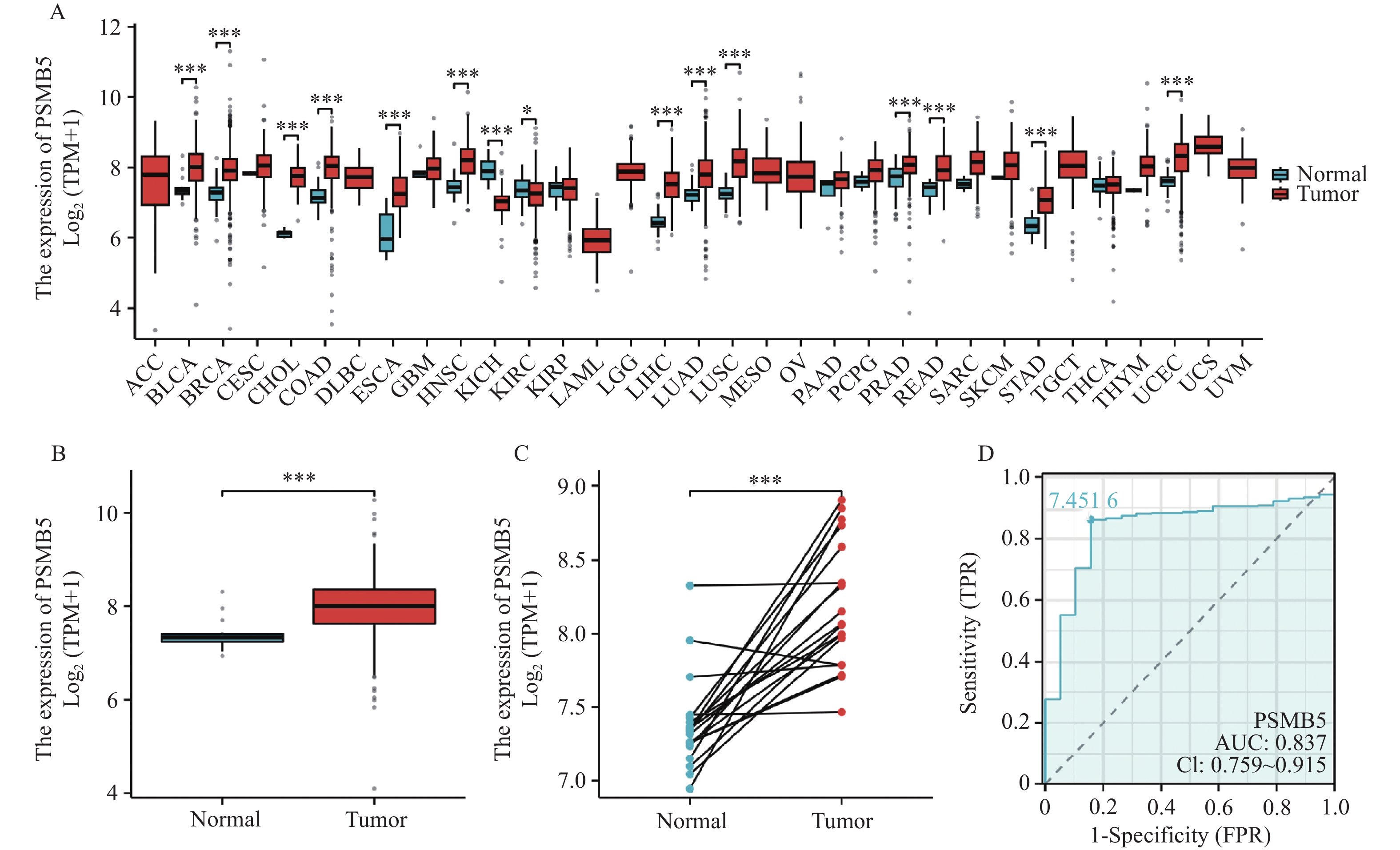
图 1 PSMB5在不同肿瘤及膀胱尿路上皮癌中的表达和ROC曲线
A:TCGA数据中不同肿瘤的PSMB5表达水平;B:PSMB5在膀胱癌组织与癌旁/正常组织中的表达差异;C:19对配对癌组织与癌旁组织中的表达差异;D:PSMB5在膀胱癌中的ROC曲线(AUC=0.837,95%CI:0.759~0.915;探索性最佳截断值按约登指数最大原则确定,为7.4516[log2(TPM+1)],敏感度=86.2%〔95%CI:82.5%~89.2%〕,特异度=84.2%〔95%CI:62.4%~94.5%〕)。
Figure 1. PSMB5 expression in different tumors and bladder urothelial carcinoma,and the ROC curves
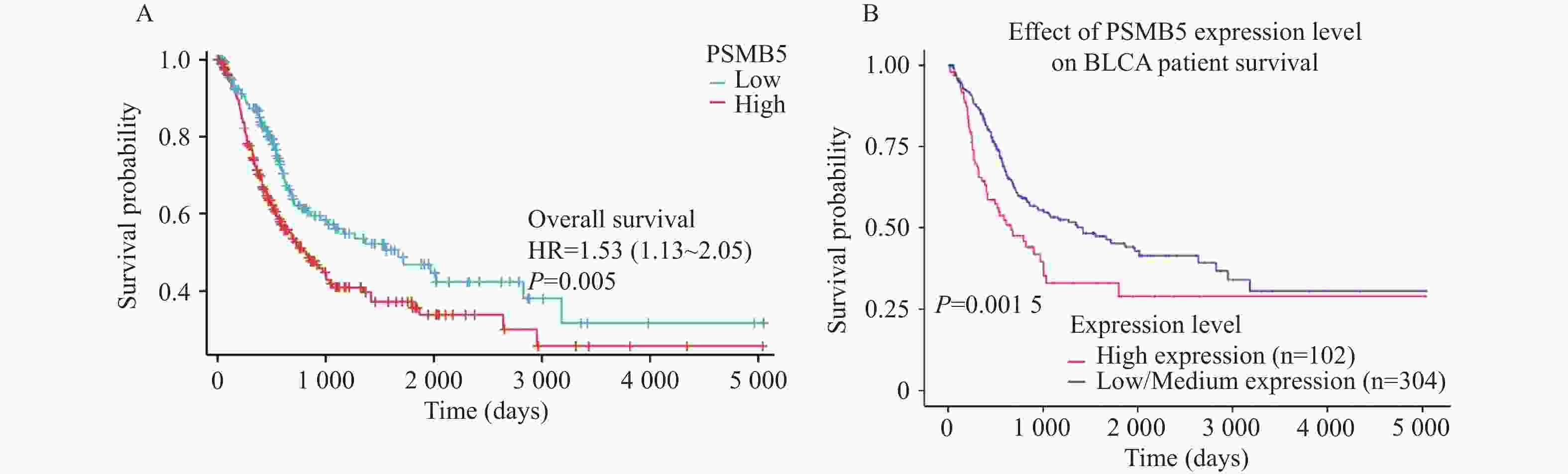
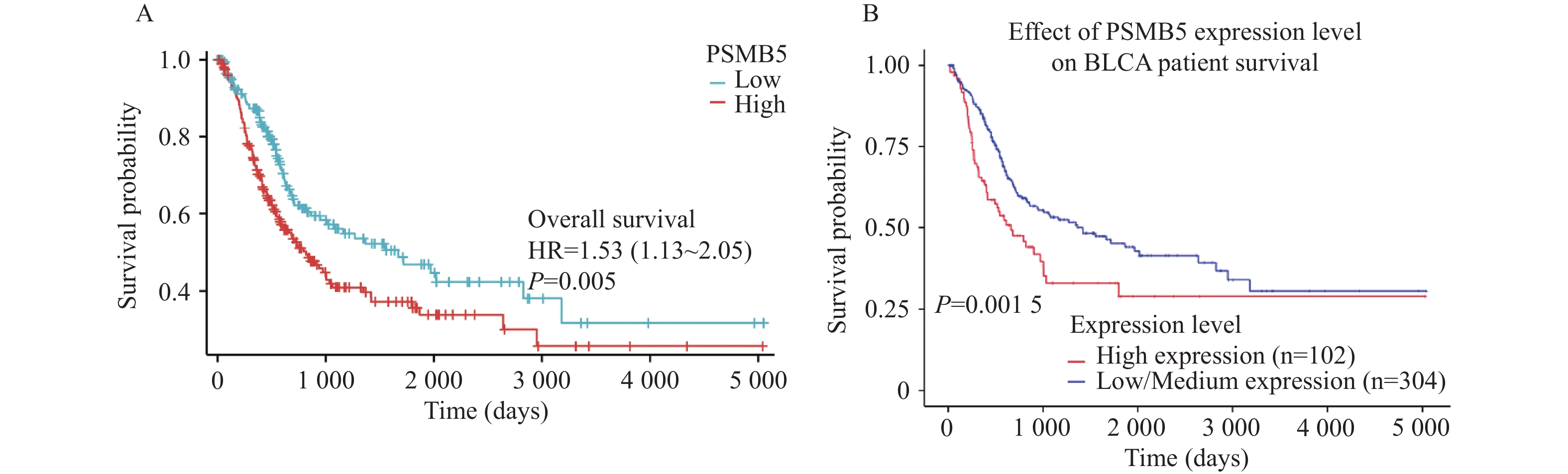
图 2 PSMB5高、低表达组膀胱尿路上皮癌患者Kaplan-Meier生存曲线
A~B:TCGA-BLCA队列中PSMB5高、低表达组的总生存曲线。
Figure 2. Kaplan-Meier survival curves of patients with bladder urothelial carcinoma stratified by PSMB5 expression
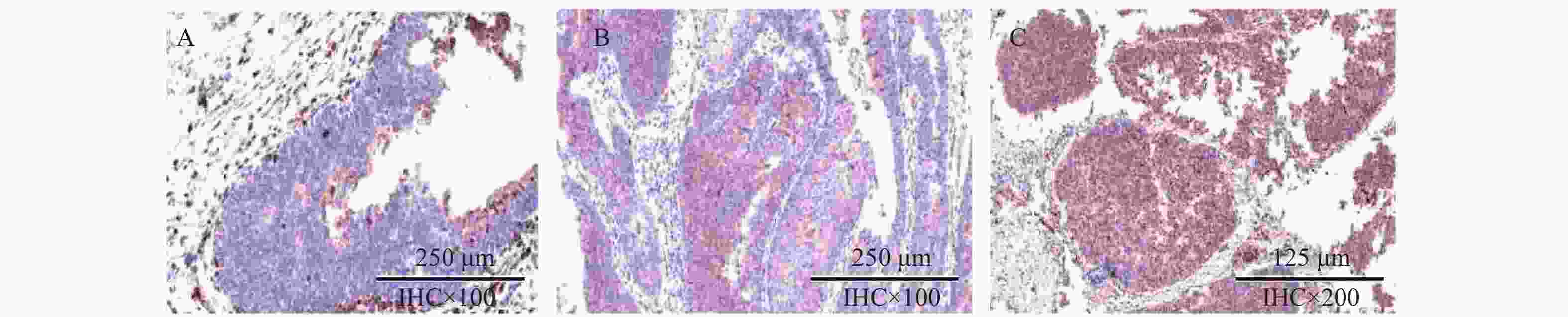
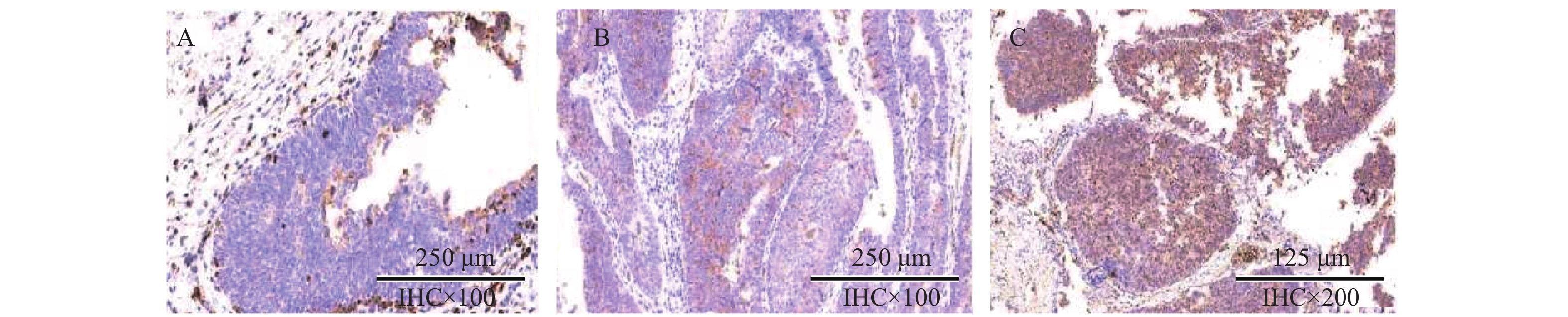
图 3 PSMB5在本院临床样本中的免疫组织化学表达
A:癌旁组织中PSMB5表达(IHC×100);B:膀胱尿路上皮癌组织中PSMB5低表达(IHC×100);C:膀胱尿路上皮癌组织中PSMB5高表达(IHC×200)。
Figure 3. Immunohistochemical expression of PSMB5 in clinical specimens from our institution
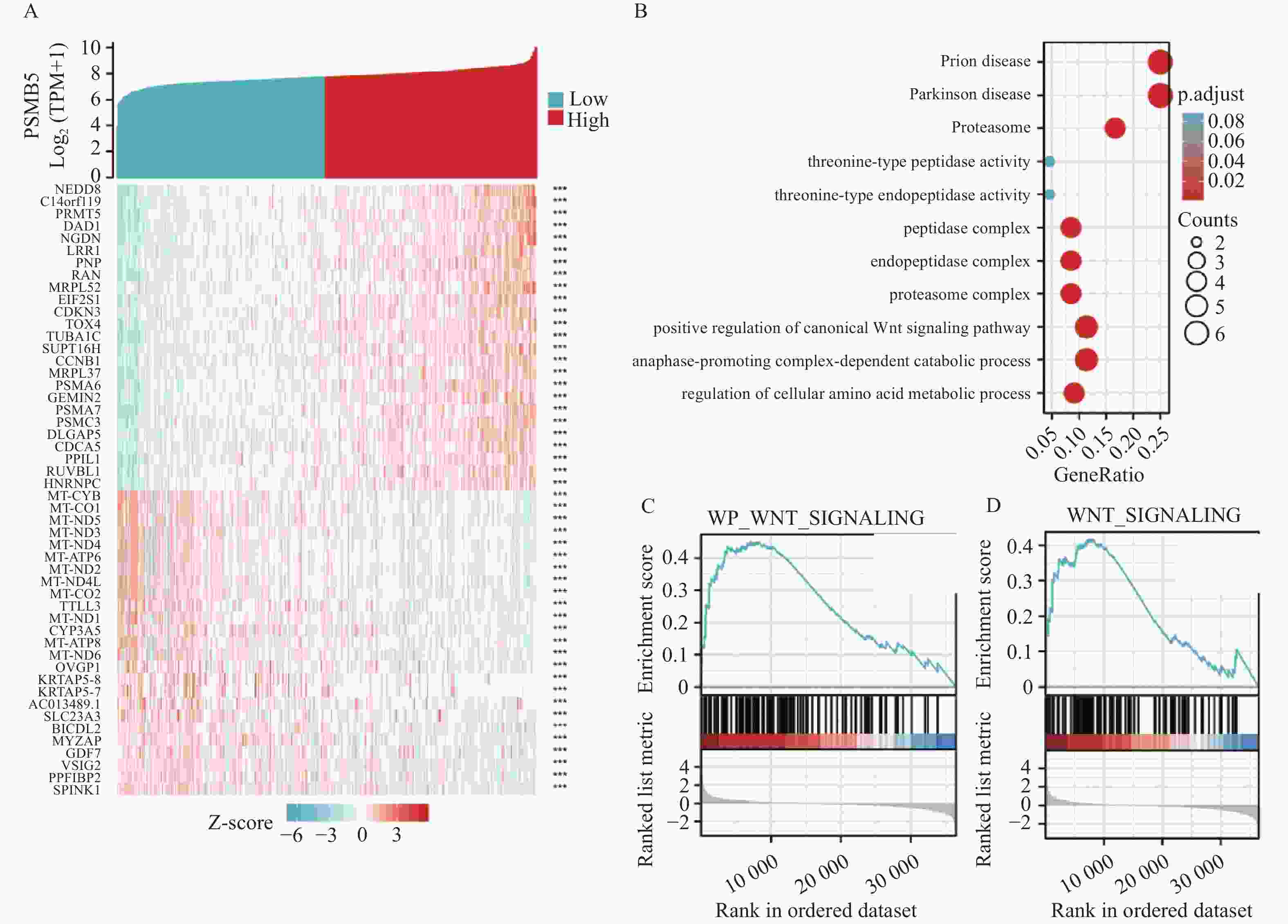
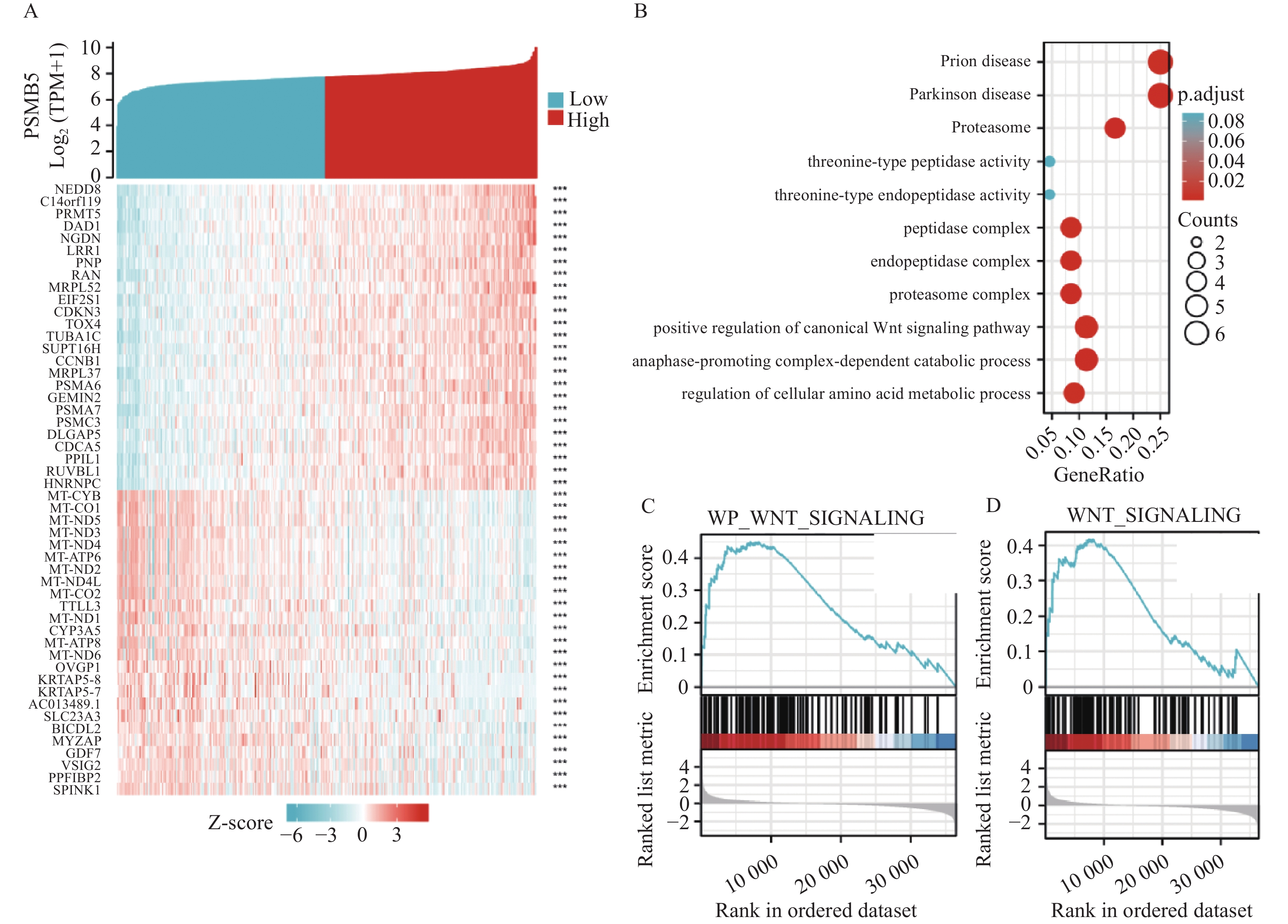
图 4 PSMB5相关基因功能富集和GSEA分析
A膀胱癌中与PSMB5呈正相关和负相关的基因表达热图,分别展示前25个基因,共50个;B:PSMB5相关基因的GO/KEGG富集分析(按在线平台输出展示);C~D:Wnt相关基因集的GSEA探索性可视化。由于当前未保留完整可追溯的GSEA多重比较校正输出,本文不报告无法核实的具体NES、adjusted P或FDR q值。
Figure 4. Functional enrichment and GSEA of PSMB5-related genes
表 1 TCGA队列中PSMB5表达与膀胱尿路上皮癌临床病理特征的关系[n(%)]
Table 1. Association between PSMB5 expression and clinicopathological features of bladder urothelial carcinoma in the TCGA cohort [n(%)]
临床病理特征 分层 低表达 高表达 χ2 P T分期 T1/T2 68(36.0) 55(29.1) 2.037 0.154 T3/T4 121(64.0) 134(70.9) N分期 N0/N1 142(76.3) 142(78.0) 0.147 0.701 N2/N3 44(23.7) 40(22.0) M分期 M0 117(97.5) 84(91.3) — 0.060 M1 3(2.5) 8(8.7) 病理分期 I/II期 76(37.1) 57(27.8) 4.018 0.045* III/IV期 129(62.9) 148(72.2) 治疗反应 PD/SD 37(20.1) 63(36.8) 12.265 <0.001* PR/CR 147(79.9) 108(63.2) 性别 女 43(20.9) 65(31.6) 6.074 0.014* 男 163(79.1) 141(68.4) 年龄(岁) ≤70 126(61.2) 106(51.5) 3.946 0.047* >70 80(38.8) 100(48.5) 分级 高级别 185(90.7) 203(99.0) 14.595 <0.001* 低级别 19(9.3) 2(1.0) 肿瘤亚型 非乳头状 122(59.5) 151(74.8) 10.701 0.001* 乳头状 83(40.5) 51(25.2) OS事件 生存 130(63.1) 100(48.5) 8.858 0.003* 死亡 76(36.9) 106(51.5) DSS事件 无 150(74.6) 123(62.4) 6.863 0.009* 有 51(25.4) 74(37.6) 注:TCGA数据库部分临床变量存在缺失,各变量均采用完整病例分析且未进行缺失值插补;不同变量有效例数见各分层数据,百分比以相应PSMB5表达组内该变量的有效例数为分母。理论频数均≥5时采用Pearson χ2检验并报告χ2值;M分期最小期望频数<5,采用Fisher确切概率法(P = 0.060),故不报告χ2值;*P < 0.05。  下载: 导出CSV
表 2 TCGA队列中膀胱尿路上皮癌总生存相关因素的单因素Cox回归分析[HR(95%CI)]
Table 2. Univariable Cox regression analysis of factors associated with overall survival in bladder urothelial carcinoma in the TCGA cohort [HR (95%CI)]
变量 分层 n 单因素HR(95%CI) T分期 T1/T2 123 Reference T3/T4 254 2.157(1.485~3.132) N分期 N0/N1 284 Reference N2/N3 83 2.228(1.605~3.093) M分期 M0 201 Reference M1 11 3.112(1.491~6.493) 年龄(岁) ≤70 231 Reference >70 180 1.424(1.064~1.906) 性别 女 108 Reference 男 303 0.868(0.629~1.198) 治疗反应 PD/SD 100 Reference PR/CR 255 0.229(0.164~0.320) 分级 高级别 387 Reference 低级别 21 0.338(0.084~1.365) PSMB5 低表达 205 Reference 高表达 206 1.526(1.135~2.051) 注:HR为风险比,CI为置信区间;Reference表示参照类别。不同变量存在缺失,各单因素Cox模型纳入相应变量资料完整的病例。本表仅报告HR及95%CI。
下载: 导出CSV
表 3 61例膀胱尿路上皮癌患者PSMB5蛋白表达与临床病理特征的关系[n(%)]
Table 3. Association between PSMB5 protein expression and clinicopathological features in 61 patients with bladder urothelial carcinoma [n(%)]
临床病理特征 分层 n 低表达 高表达 χ2 P 年龄(岁) ≤70 44 21(47.7) 23(52.3) 0.133 0.715 >70 17 9(52.9) 8(47.1) 性别 男 42 20(47.6) 22(52.4) 0.132 0.717 女 19 10(52.6) 9(47.4) 最大径(cm) ≤3 34 19(55.9) 15(44.1) 1.380 0.240 >3 27 11(40.7) 16(59.3) 肿瘤数目 单发 43 20(46.5) 23(53.5) 0.415 0.519 多发 18 10(55.6) 8(44.4) 组织学类型 尿路上皮癌 40 22(55.0) 18(45.0) 1.575 0.210 尿路上皮癌伴分化 21 8(38.1) 13(61.9) 分级 低级别 24 16(66.7) 8(33.3) 4.841 0.028* 高级别 37 14(37.8) 23(62.2) 浸润分层 非肌层浸润性 31 17(54.8) 14(45.2) 0.807 0.369 肌层浸润性 30 13(43.3) 17(56.7) pN分组 N0 40 24(60.0) 16(40.0) 5.442 0.020* N1~N3 21 6(28.6) 15(71.4) pM分期 M0 52 29(55.8) 23(44.2) — 0.026* M1 9 1(11.1) 8(88.9) AJCC分期 0/I/II期 39 24(61.5) 15(38.5) 6.608 0.010* III/IV期 22 6(27.3) 16(72.7) 脉管侵犯 无 37 21(56.8) 16(43.2) 2.160 0.142 有 24 9(37.5) 15(62.5) 神经侵犯 无 39 24(61.5) 15(38.5) 6.608 0.010* 有 22 6(27.3) 16(72.7) 原位癌成分 无 27 11(40.7) 16(59.3) 1.380 0.240 有 34 19(55.9) 15(44.1) 肿瘤坏死 无 46 29(63.0) 17(37.0) 14.385 <0.001* 有 15 1(6.7) 14(93.3) 复发 无 42 25(59.5) 17(40.5) 5.772 0.016* 有 19 5(26.3) 14(73.7) 进展/转移 无 43 27(62.8) 16(37.2) 12.703 <0.001* 有 17 2(11.8) 15(88.2) 生存状态 生存 54 30(55.6) 24(44.4) — 0.011* 死亡 7 0(0.0) 7(100.0) 注:采用改良H-score〔优势染色强度(0~3)×阳性肿瘤细胞百分比(0~100%)〕,以本队列中位数140分为高、低表达界值。计数资料采用Pearson χ2检验或Fisher确切概率法;Fisher检验不报告χ2值。pT构成为Ta 2例、Tis 13例、T1 16例、T2 16例、T3 11例、T4 3例;表中主要分层采用非肌层浸润性与肌层浸润性;进展/转移变量1例缺失(1.6%),未纳入该变量统计;*P < 0.05。
下载: 导出CSV
-
[1] Bray F, Laversanne M, Sung H, et al. Global cancer statistics 2022: GLOBOCAN estimates of incidence and mortality worldwide for 36 cancers in 185 countries[J]. CA Cancer J Clin, 2024, 74(3): 229-263. [2] Gontero P, Birtle A, Capoun O, et al. European association of urology guidelines on non–muscle-invasive bladder cancer (TaT1 and carcinoma in situ)—a summary of the 2024 guidelines update[J]. Eur Urol, 2024, 86(6): 531-549. doi: 10.1016/j.eururo.2024.07.027 [3] van der Heijden A G, Bruins H M, Carrion A, et al. European association of urology guidelines on muscle-invasive and metastatic bladder cancer: Summary of the 2025 guidelines[J]. Eur Urol, 2025, 87(5): 582-600. doi: 10.1016/j.eururo.2025.02.019 [4] Raspollini M R, Comperat E M, Lopez-Beltran A, et al. News in the classification of WHO 2022 bladder tumors[J]. Pathologica, 2022, 115(1): 32-40. doi: 10.32074/1591-951x-838 [5] Holzbeierlein J, Bixler B R, Buckley D I, et al. Treatment of non-metastatic muscle-invasive bladder cancer: AUA/ASCO/SUO guideline (2017; amended 2020, 2024)[J]. J Urol, 2024, 212(1): 3-10. doi: 10.1097/JU.0000000000003981 [6] Ahangar M, Mahjoubi F, Mowla S J. Bladder cancer biomarkers: Current approaches and future directions[J]. Front Oncol, 2024, 14: 1453278. doi: 10.3389/fonc.2024.1453278 [7] Heard J R, Ahdoot M, Theodorescu D, et al. Biomarkers of treatment response in bladder cancer[J]. Expert Rev Mol Diagn, 2024, 24(10): 957-969. doi: 10.1080/14737159.2024.2428747 [8] Wang X, Zhang Y, Wu Y, et al. The role of E3 ubiquitin ligases and deubiquitinases in bladder cancer development and immunotherapy[J]. Front Immunol, 2023, 14: 1202633. doi: 10.3389/fimmu.2023.1202633 [9] Jin S, Li B, Zhang B, et al. Dihydrocelastrol induces antitumor activity and enhances the sensitivity of bortezomib in resistant multiple myeloma by inhibiting STAT3-dependent PSMB5 regulation[J]. Acta Biochim Biophys Sin, 2023, 55(12): 1884-1891. [10] Chang Z, Wang J, Cao J, et al. Targeting PSMB5-induced PANoptosis in bladder cancer: Multi-omics insights and TCM candidate discovery[J]. Front Immunol, 2025, 16: 1656682. doi: 10.3389/fimmu.2025.1656682 [11] 方三高, 于永娟, 王丛. WHO(2022)泌尿系统和男性生殖器官肿瘤分类[J]. 诊断病理学杂志, 2023, 30(4): 410-416. doi: 10.3969/j.issn.1007-8096.2023.04.035 [12] Paner G P, Kamat A, Netto G J, et al. International society of urological pathology (ISUP) consensus conference on current issues in bladder cancer. working group 2: Grading of mixed grade, invasive urothelial carcinoma including histologic subtypes and divergent differentiations, and non-urothelial carcinomas[J]. Am J Surg Pathol, 2024, 48(1): e11-e23. doi: 10.1097/PAS.0000000000002077 [13] Wen Z, Luo D, Wang S, et al. Deep learning-based H-score quantification of immunohistochemistry-stained images[J]. Mod Pathol, 2024, 37(2): 100398. doi: 10.1016/j.modpat.2023.100398 [14] Wan S, Cao J, Chen S, et al. Construction of noninvasive prognostic model of bladder cancer patients based on urine proteomics and screening of natural compounds[J]. J Cancer Res Clin Oncol, 2023, 149(1): 281-296. doi: 10.1007/s00432-022-04524-x [15] Wang X, Jia Y, Wang D. Cathepsin C promotes tumorigenesis in bladder cancer by activating the Wnt/β-catenin signalling pathway[J]. Front Biosci, 2024, 29(9): 327. doi: 10.31083/j.fbl2909327 [16] Huang P, Wang J, Yu Z, et al. Redefining bladder cancer treatment: Innovations in overcoming drug resistance and immune evasion[J]. Front Immunol, 2025, 16: 1537808. doi: 10.3389/fimmu.2025.1537808 [17] Schwarzova L, Varchulova Novakova Z, Danisovic L, et al. Molecular classification of urothelial bladder carcinoma[J]. Mol Biol Rep, 2023, 50(9): 7867-7877. doi: 10.1007/s11033-023-08689-7 [18] Wu X, Que H, Li Q, et al. Wnt/β-catenin mediated signaling pathways in cancer: Recent advances, and applications in cancer therapy[J]. Mol Cancer, 2025, 24(1): 171. doi: 10.1186/s12943-025-02363-1 [19] Meagher M, Krause H, Elliott A, et al. Characterization and impact of non-canonical WNT signaling on outcomes of urothelial carcinoma[J]. Cancer Med, 2024, 13(7): e7148. doi: 10.1002/cam4.7148 [20] 李晨, 李占恩, 苏宏伟, 等. KRT17调节Wnt/β-catenin信号通路对膀胱癌细胞增殖、凋亡及上皮间质转化的影响[J]. 天津医药, 2025, 53(5): 462-467. doi: 10.11958/20241498 [21] 姜珊, 宋宇轩, 林佳兴, 等. 肿瘤类器官在膀胱癌生物学研究与无创诊疗中的应用进展[J]. 临床泌尿外科杂志, 2024, 39(12): 1061-1066. doi: 10.13201/j.issn.1001-1420.2024.12.006 [22] Viergever B J, Raats D A E, Geurts V, et al. Urine-derived bladder cancer organoids (urinoids) as a tool for cancer longitudinal response monitoring and therapy adaptation[J]. Br J Cancer, 2024, 130(3): 369-379. doi: 10.1038/s41416-023-02494-6 [23] Neuhaus J, Rabien A, Reinhold A, et al. 3D tumor models in urology[J]. Int J Mol Sci, 2023, 24(7): 6232. doi: 10.3390/ijms24076232 [24] Maas M, Todenhöfer T, Black P C. Urine biomarkers in bladder cancer—current status and future perspectives[J]. Nat Rev Urol, 2023, 20(10): 597-614. doi: 10.1038/s41585-023-00773-8 [25] Zheng J, Qin C, Wang Q, et al. Circulating tumour DNA-Based molecular residual disease detection in resectable cancers: A systematic review and meta-analysis[J]. EBioMedicine, 2024, 103: 105109. doi: 10.1016/j.ebiom.2024.105109 [26] Silcock L, Hastings R K, Clokie S, et al. Real-world multicentre evaluation of GALEAS bladder for detecting bladder cancer in UK NHS haematuria clinics[J]. Eur Urol Oncol, 2026: S2588-S9311(26)00233-6. -

 点击查看大图
计量
- 文章访问数: 76
- HTML全文浏览量: 40
- PDF下载量: 1
- 被引次数: 0
