




Core Strategies of Engineered Bacteriophages and Research Progress in Their Application for Disease Treatment
-
摘要: 噬菌体是特异性裂解细菌的天然病毒,在抗菌治疗中具有独特优势,但天然噬菌体存在宿主范围窄、稳定性差及免疫原性高等局限性。合成生物学与基因编辑技术的进步为噬菌体定向改造提供了有力支撑。通过基因编辑、化学修饰和材料包封的工程化策略,能有效拓宽噬菌体的宿主范围、增强其环境稳定性并降低免疫清除,显著提升治疗效果。对工程化噬菌体的核心策略及在抗感染、肿瘤治疗及疫苗开发中的研究进展进行综述,旨在推动工程化噬菌体的深入研究与临床转化,为应对抗生素耐药性问题及拓展精准医学应用提供新的解决方案。Abstract: Bacteriophages are natural viruses that specifically lyse bacteria and possess unique advantages in antimicrobial therapy. However, natural bacteriophages have limitations including narrow host range, poor stability, and high immunogenicity. Recent advances in synthetic biology and gene editing technologies have provided powerful tools for the targeted engineering of bacteriophages. Engineering strategies such as genetic editing, chemical modification, and material encapsulation can effectively broaden the host range, enhance environmental stability, and reduce immune clearance, thereby significantly improving therapeutic efficacy. This review summarizes the core strategies for engineering bacteriophages and their research progress in anti-infection therapy, cancer treatment, and vaccine development, aiming to promote further research and clinical translation of engineered bacteriophages and to provide new solutions for addressing antibiotic resistance and expanding precision medicine applications.
-
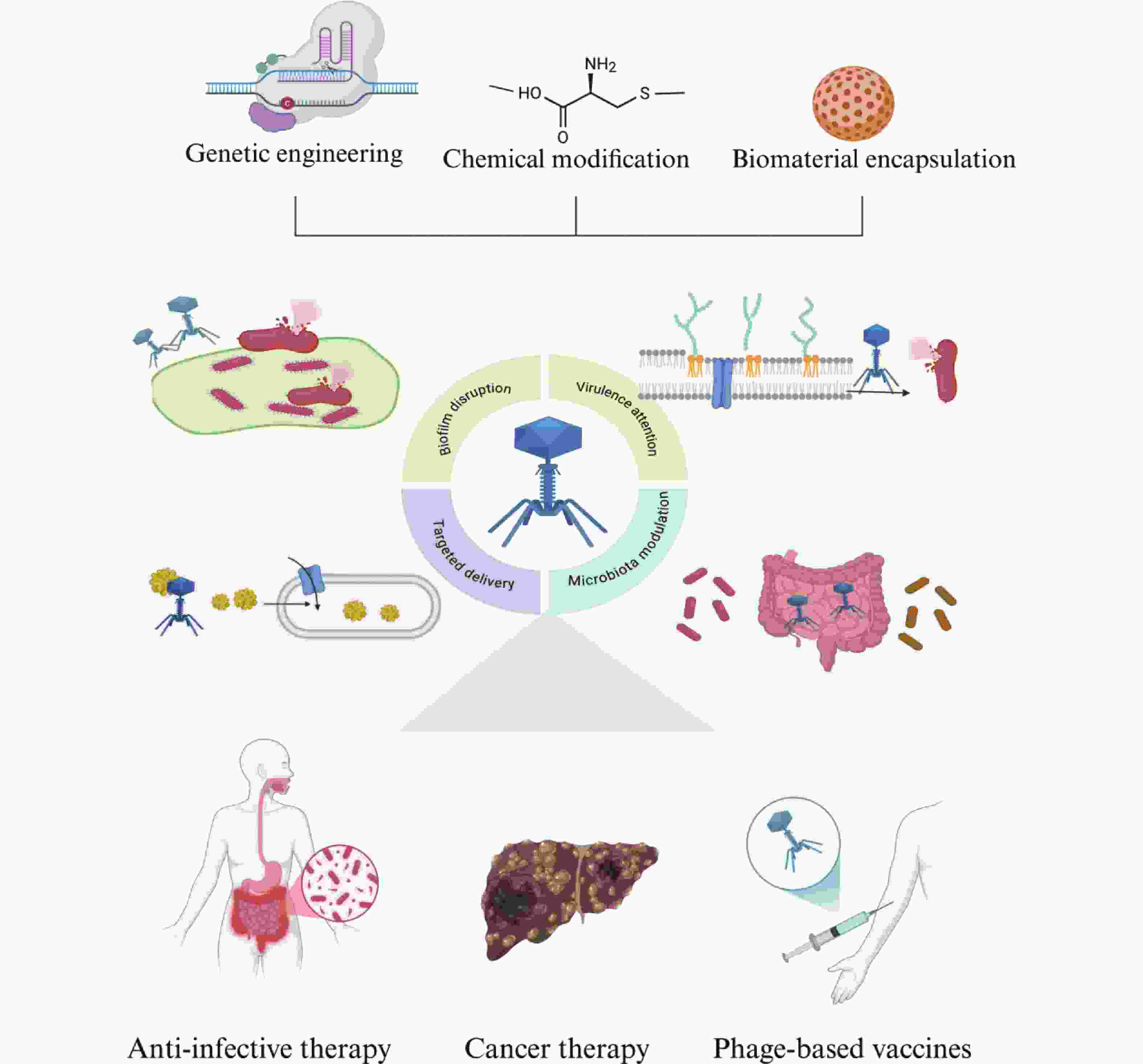
图 1 工程化噬菌体的核心策略和临床应用
注:工程化噬菌体的三大核心策略包括基因工程、化学修饰和生物材料封装;其在体内的作用机制包括生物膜降解、毒力因子抑制、靶向递送和微生物群调节;最终实现抗感染治疗、肿瘤治疗及噬菌体疫苗的临床应用。
Figure 1. Core strategies and clinical applications of engineered bacteriophages
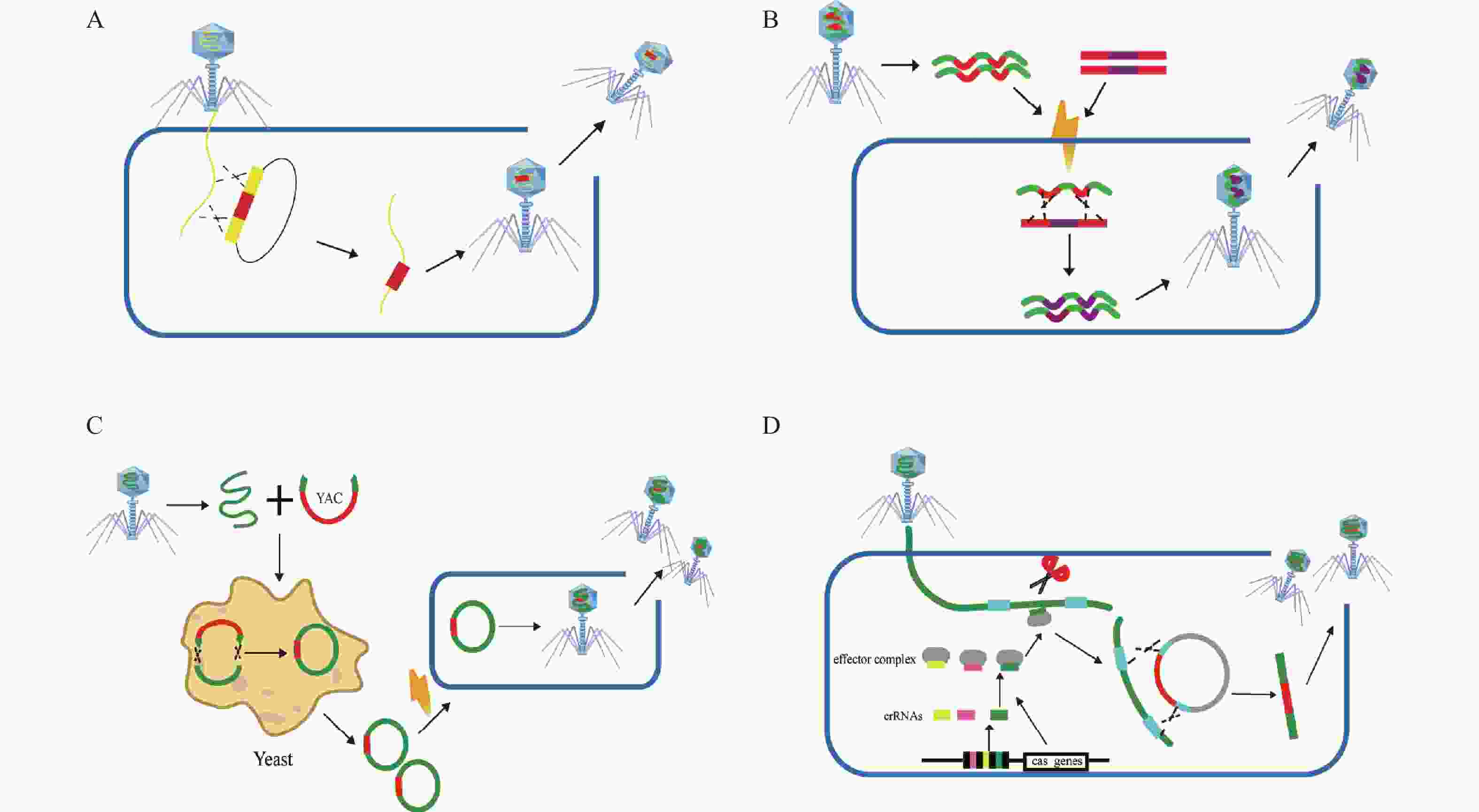
图 2 工程化噬菌体基因组编辑技术机制
A:同源重组:噬菌体感染宿主,供体质粒与噬菌体基因组同源重组,产生重组子代;B:BRED:噬菌体侵染后电转化编辑模板,依靠重组系统修饰基因组;C:酵母噬菌体基因组工程:噬菌体基因组片段与YAC载体导入酵母组装,电转化导入宿主;D:CRISPR-Cas辅助编辑:crRNA-Cas复合物切割野生型DNA,负筛选富集编辑噬菌体。
Figure 2. Mechanisms of engineered bacteriophages genome editing technologies
表 1 四种噬菌体基因组编辑技术的特征比较
Table 1. Comparative characteristics of four bacteriophage genome editing technologies
基因组编辑技术 核心机制 优势 局限性 应用范围 参考文献 同源重组 重组酶催化同源DNA序列间的链交换,通过共感染或供体质粒实现基因整合 操作门槛低,无需引入外源重组系统;可实现精准的基因组修饰 效率低下,缺乏有效的筛选标记,筛选工作量大 基因敲除、敲入及替换 [19−21] 电转化DNA 的噬菌体重组 电转化线性dsDNA模板至噬菌体感染的宿主细胞,λ-Red系统介导高效同源重组 编辑效率显著提升,操作相对简便;可与CRISPR-Cas系统联用作为反筛选工具 受限于宿主细菌的转化效率,大片段编辑能力有限 点突变、基因缺失、标记添加、外源基因嵌入 [22−23] 基于酵母的噬菌体基因组工程 酿酒酵母内源重组机制介导大片段DNA克隆、组装与多位点编辑 支持大片段DNA操作,规避细菌系统对毒性基因的限制 流程复杂、周期较长,YAC转化效率及稳定性不足 大片段基因组装、复杂基因组改造 [24−25] CRISPR-Cas技术 gRNA引导Cas蛋白靶向切割,结合同源重组修复,实现高效负筛选富集重组子 编辑精度高,负筛选高效富集重组子 依赖PAM序列,部分噬菌体对Cas9耐受;需关注CRISPR逃逸突变 精准点突变、多靶点编辑、基因大片段置换 [26]  下载: 导出CSV
-
[1] Netea M G, Schlitzer A, Placek K, et al. Innate and adaptive immune memory: An evolutionary continuum in the host’s response to pathogens[J]. Cell Host Microbe, 2019, 25(1): 13-26. doi: 10.1016/j.chom.2018.12.006 [2] Sahoo K, Meshram S. The evolution of phage therapy: A comprehensive review of current applications and future innovations[J]. Cureus, 2024, 16(9): e70414. doi: 10.7759/cureus.70414 [3] Venkataraman S, Shahgolzari M, Yavari A, et al. Bacteriophages as targeted therapeutic vehicles: Challenges and opportunities[J]. Bioengineering (Basel), 2025, 12(5): 469. doi: 10.3390/bioengineering12050469 [4] Hussain W, Yang X, Ullah M, et al. Genetic engineering of bacteriophages: Key concepts, strategies, and applications[J]. Biotechnol Adv, 2023, 64: 108116. doi: 10.1016/j.biotechadv.2023.108116 [5] Cao X, Yu T, Sun Z, et al. Engineered phages in anti-infection and anti-tumor fields: A review[J]. Microb Pathogen, 2025, 198: 107052. doi: 10.1016/j.micpath.2024.107052 [6] Ding B, Fan M, Shi Y P, et al. Mechanistic roles and therapeutic potential of bacteriophages in inflammatory gastrointestinal diseases[J]. Microbiome Res Rep, 2025, 4(4): 40. doi: 10.20517/mrr.2025.62 [7] Xiang Y, Yang R, Li X, et al. Phage PEf771 for the treatment of periapical periodontitis induced by Enterococcus faecalis YN771[J]. Crit Rev Immunol, 2024, 44(1): 41-53. doi: 10.1615/CritRevImmunol.2023050313 [8] 韩泽华, 杨小燕, 陈昱良, 等. 噬菌体在龋病防治中的研究进展[J]. 昆明医科大学学报, 2026, 47(1): 140-147. doi: 10.12259/j.issn.2095-610X.S20260117 [9] Zhang S, Kim J C, Ahn J. Phage engineering strategies to expand host range for controlling antibiotic-resistant pathogens[J]. Microbiol Res, 2025, 300: 128278. doi: 10.1016/j.micres.2025.128278 [10] Xiang Y, Ma C, Yin S, et al. Phage therapy for refractory periapical periodontitis caused by Enterococcus faecalis in vitro and in vivo[J]. Appl Microbiol Biotechnol, 2022, 106(5-6): 2121-2131. doi: 10.1007/s00253-022-11810-8 [11] Xiang Y, Wang S, Huang H, et al. A novel endolysin from an Enterococcus faecalis phage and application[J]. Microb Pathogen, 2024, 192: 106689. doi: 10.1016/j.micpath.2024.106689 [12] Kim P, Sanchez A M, Penke T J R, et al. Safety, pharmacokinetics, and pharmacodynamics of LBP-EC01, a CRISPR-Cas3-enhanced bacteriophage cocktail, in uncomplicated urinary tract infections due to Escherichia coli (ELIMINATE): The randomised, open-label, first part of a two-part phase 2 trial[J]. Lancet Infect Dis, 2024, 24(12): 1319-1332. doi: 10.1016/S1473-3099(24)00424-9 [13] Yue Y, Xu Z, Soteyome T, et al. Phage encapsulation and delivery technology: A strategy for treating drug-resistant pathogenic microorganisms[J]. Pharmaceuticals (Basel), 2025, 18(11): 1688. doi: 10.3390/ph18111688 [14] Yang Y, Li R, Zhong Q, et al. In situ gut microbiota editing: Enhancing therapeutic efficacy for bacterial colitis by compatible oral hydrogel microspheres with phages[J]. Nat Commun, 2025, 16(1): 9785. doi: 10.1038/s41467-025-65498-1 [15] Ramadan MA, Ali MA, El-Badawy MF, et al. Phage display technology: a promising platform for cancer targeting, drug delivery, and vaccine development[J]. Future J Pharm Sci, 2025, 11: 74. doi: 10.1186/s43094-025-00825-3 [16] Chongchai A, Bentayebi K, Chu G, et al. Targeted treatment of chondrosarcoma with a bacteriophage-based particle delivering a secreted tumor necrosis factor-related apoptosis-inducing ligand[J]. Mol Ther Oncol, 2024, 32(2): 200805. doi: 10.1016/j.omton.2024.200805 [17] Kim S Y, Kim Y J, Kim M S. Protective efficacy of miR-155 encapsulated using MS2 bacteriophage-based virus-like particle (MS2-VLP) against viral hemorrhagic septicemia virus (VHSV) in olive flounder[J]. Fish Shellfish Immunol, 2026, 168: 111000. doi: 10.1016/j.fsi.2025.111000 [18] Lenneman B R, Fernbach J, Loessner M J, et al. Enhancing phage therapy through synthetic biology and genome engineering[J]. Curr Opin Biotechnol, 2021, 68: 151-159. doi: 10.1016/j.copbio.2020.11.003 [19] Mahler M, Costa A R, van Beljouw S P B, et al. Approaches for bacteriophage genome engineering[J]. Trends Biotechnol, 2023, 41(5): 669-685. doi: 10.1016/j.tibtech.2022.08.008 [20] Morrical S W. The bacteriophage T4 homologous recombination system: Mechanism, applications, conservation, and environmental significance[J]. EcoSal Plus, 2025, 13(1): eesp00032025. doi: 10.1128/ecosalplus.esp-0003-2025 [21] Alessa O, Aiba Y, Arbaah M, et al. Synthetic and functional engineering of bacteriophages: Approaches for tailored bactericidal, diagnostic, and delivery platforms[J]. Molecules, 2025, 30(15): 3132. doi: 10.3390/molecules30153132 [22] Payaslian F, Gradaschi V, Piuri M. Genetic manipulation of phages for therapy using BRED[J]. Curr Opin Biotechnol, 2021, 68: 8-14. doi: 10.1016/j.copbio.2020.09.005 [23] Wetzel K S, Guerrero-Bustamante C A, Dedrick R M, et al. CRISPY-BRED and CRISPY-BRIP: Efficient bacteriophage engineering[J]. Sci Rep, 2021, 11: 6796. doi: 10.1038/s41598-021-86112-6 [24] Costa A R, Azeredo J, Pires D P. Synthetic biology to engineer bacteriophage genomes[M]//Bacteriophage Therapy. New York, NY: Springer, 2023: 261-277. [25] Deng W, Li Y, Shao Y, et al. Engineering yeast chromosomal telomeres with a bacteriophage system[J]. Nat Commun, 2026, 17(1): 6571. doi: 10.1038/s41467-026-73335-2 [26] Chaudhary N, Sharma K, Kaur H, et al. CRISPR-Cas-assisted phage engineering for personalized antibacterial treatments[J]. Indian J Med Microbiol, 2025, 53: 100771. doi: 10.1016/j.ijmmb.2024.100771 [27] Marinelli L J, Piuri M, Hatfull G F. Genetic manipulation of lytic bacteriophages with BRED: Bacteriophage recombineering of electroporated DNA[J]. Methods Mol Biol, 2019, 1898: 69-80. [28] Kakkar A, Kandwal G, Nayak T, et al. Engineered bacteriophages: A Panacea against pathogenic and drug resistant bacteria[J]. Heliyon, 2024, 10(14): e34333. doi: 10.1016/j.heliyon.2024.e34333 [29] Ando H, Lemire S, Pires D P, et al. Engineering modular viral scaffolds for targeted bacterial population editing[J]. Cell Syst, 2015, 1(3): 187-196. doi: 10.1016/j.cels.2015.08.013 [30] Doudna J A, Charpentier E. The new frontier of genome engineering with CRISPR-Cas9[J]. Science, 2014, 346(6213): 1258096. doi: 10.1126/science.1258096 [31] Camara-Wilpert S, Mayo-Muñoz D, Russel J, et al. Bacteriophages suppress CRISPR-Cas immunity using RNA-based anti-CRISPRs[J]. Nature, 2023, 623(7987): 601-607. doi: 10.1038/s41586-023-06612-5 [32] Khambhati K, Bhattacharjee G, Gohil N, et al. Phage engineering and phage-assisted CRISPR-Cas delivery to combat multidrug-resistant pathogens[J]. Bioeng Transl Med, 2023, 8(2): e10381. doi: 10.1002/btm2.10381 [33] Huss P, Raman S. Engineered bacteriophages as programmable biocontrol agents[J]. Curr Opin Biotechnol, 2020, 61: 116-121. doi: 10.1016/j.copbio.2019.11.013 [34] Souza E B, Pinto A R, Fongaro G. Bacteriophages as potential clinical immune modulators[J]. Microorganisms, 2023, 11(9): 2222. doi: 10.3390/microorganisms11092222 [35] Guan J, Oromí-Bosch A, Mendoza S D, et al. Bacteriophage genome engineering with CRISPR-Cas13a[J]. Nat Microbiol, 2022, 7(12): 1956-1966. doi: 10.1038/s41564-022-01243-4 [36] Hameed M, Hu Y, Khan A, et al. Chemically mediated modification of bacteriophages: Strategies, functionalities and applications in precision medicine[J]. Nanomed Nanotechnol Biol Med, 2026, 74: 102944. doi: 10.1016/j.nano.2026.102944 [37] Peng H, Borg R E, Dow L P, et al. Controlled phage therapy by photothermal ablation of specific bacterial species using gold nanorods targeted by chimeric phages[J]. Proc Natl Acad Sci U S A, 2020, 117(4): 1951-1961. doi: 10.1073/pnas.1913234117 [38] Peng H, Chen I A. Preparation of bioconjugates of chimeric M13 phage and gold nanorods[M]//Phage Engineering and Analysis: Methods and Protocols. New York, NY: Springer US, 2024: 131-141. [39] Brown L, Vidal A V, Dias A L, et al. Proximity-driven site-specific cyclization of phage-displayed peptides[J]. Nat Commun, 2024, 15: 7308. doi: 10.1038/s41467-024-51610-4 [40] Jin L, Cao F, Gao Y, et al. Microenvironment-activated nanozyme-armed bacteriophages efficiently combat bacterial infection[J]. Adv Mater, 2023, 35(30): e2301349. doi: 10.1002/adma.202301349 [41] Ma Y, Pacan J C, Wang Q, et al. Microencapsulation of bacteriophage felix O1 into chitosan-alginate microspheres for oral delivery[J]. Appl Environ Microbiol, 2008, 74(15): 4799-4805. doi: 10.1128/AEM.00246-08 [42] Hsu B B, Plant I N, Lyon L, et al. In situ reprogramming of gut bacteria by oral delivery[J]. Nat Commun, 2020, 11(1): 5030. doi: 10.1038/s41467-020-18614-2 [43] Singla S, Harjai K, Raza K, et al. Phospholipid vesicles encapsulated bacteriophage: A novel approach to enhance phage biodistribution[J]. J Virol Methods, 2016, 236: 68-76. doi: 10.1016/j.jviromet.2016.07.002 [44] Colom J, Cano-Sarabia M, Otero J, et al. Liposome-encapsulated bacteriophages for enhanced oral phage therapy against Salmonella spp[J]. Appl Environ Microbiol, 2015, 81(14): 4841-4849. doi: 10.1128/AEM.00812-15 [45] Meng L, Yang F, Pang Y, et al. Nanocapping-enabled charge reversal generates cell-enterable endosomal-escapable bacteriophages for intracellular pathogen inhibition[J]. Sci Adv, 2022, 8(28): eabq2005. doi: 10.1126/sciadv.abq2005 [46] Dedrick R M, Guerrero-Bustamante C A, Garlena R A, et al. Engineered bacteriophages for treatment of a patient with a disseminated drug-resistant Mycobacterium abscessus[J]. Nat Med, 2019, 25(5): 730-733. doi: 10.1038/s41591-019-0437-z [47] Weiner I, Kahan-Hanum M, Buchstab N, et al. Phage therapy with nebulized cocktail BX004-A for chronic Pseudomonas aeruginosa infections in cystic fibrosis: A randomized first-in-human trial[J]. Nat Commun, 2025, 16(1): 5579. doi: 10.1038/s41467-025-60598-4 [48] Bayat F, Stark M, Rahmani S, et al. AI-assisted phage formulation delivered via injectable hydrogels for localized control of implant-associated infections[J]. Bioact Mater, 2026, 63: 578-595. [49] Walter N, Brochhuasen C, EL Khassawna T, et al. Hydrogel-based local delivery of bacteriophages for infection control: A systematic review of in vivo evidence[J]. Journal of Controlled Release, 2026, 399: 115335. doi: 10.1016/j.jconrel.2026.115335 [50] Kaltenbrunner A, Martino A, Nigro M, et al. Conjugating M13 bacteriophage targeting folate receptor alpha with multiple photosensitizers: A flexible phototheranostic platform against ovarian cancer[J]. J Mater Chem B, 2026, 14(23): 7164-7178. doi: 10.1039/D5TB02844B [51] Mangeat T, Mairaville C, Chentouf M, et al. Generation using phage-display of pH-dependent antibodies against the tumor-associated antigen AXL[J]. Antibodies (Basel), 2025, 14(4): 83. doi: 10.3390/antib14040083 [52] Mustafa B S, Nagalo B M, Tesfay M, et al. Abstract 2155: Phage display discovery of Trop-2 peptide for targeted liposomal chemo-immunotherapy in lung cancer[J]. Cancer Res, 2025, 85(8_Supplement_1): 2155. [53] Bush M, Rajaure M, Gentilucci C, et al. Lambda phage-based antibody-stimulating platform targeting EGFRvIII[J]. Vaccines, 2026, 14(3): 282. doi: 10.3390/vaccines14030282 [54] Zhu J, Sha J, Batra H, et al. A modular bacteriophage T4 nanoparticle platform enables rapid design of dual COVID-19-flu mucosal vaccines[J]. Small Sci, 2025, 5(4): 2400580. doi: 10.1002/smsc.202400580 [55] Wroe J A, Johnson C T, García A J. Bacteriophage delivering hydrogels reduce biofilm formation in vitro and infection in vivo[J]. J Biomed Mater Res A, 2020, 108(1): 39-49. doi: 10.1002/jbm.a.36790 [56] Ghafouri E, Fadaie M, Amirkhani Z, et al. Evaluation of humoral and cellular immune responses against Vibrio cholerae using oral immunization by multi-epitope-phage-based vaccine[J]. Int Immunopharmacol, 2024, 134: 112160. doi: 10.1016/j.intimp.2024.112160 [57] Alessa O, Aiba Y, Arbaah M, et al. Synthetic and functional engineering of bacteriophages: Approaches for tailored bactericidal, diagnostic, and delivery platforms[J]. Molecules, 2025, 30(15): 3132. doi: 10.3390/molecules30153132 [58] International Organization for Standardization. Biotechnology—Bioprocessing—General requirements for bacteriophage preparation for therapeutic use: ISO/TS 20853: 2026[S]. Geneva: ISO, 2026. [59] Zhu J, Tao P, Chopra A K, et al. Bacteriophage T4 as a protein-based, adjuvant- and needle-free, mucosal pandemic vaccine design platform[J]. Annu Rev Virol, 2024, 11(1): 395-420. doi: 10.1146/annurev-virology-111821-111145 [60] Kumar A, Krishan B, Dhiman S, et al. Beyond antibiotics: Innovative and translational strategies to overcome antimicrobial resistance[J]. 3 Biotech, 2026, 16(6): 201. doi: 10.1007/s13205-026-04836-6 -

 点击查看大图
计量
- 文章访问数: 2
- HTML全文浏览量: 5
- PDF下载量: 0
- 被引次数: 0
