




Changes in STT and AHD in Patients with Rotator Cuff Injuries and Their Predictive Value for Prognosis
-
摘要:
目的 探究肩袖损伤患者冈上肌腱厚度(supraspinatus tendon thickness,STT)和肩峰肱骨头间距(acromiohumeral distance,AHD)差异及其对预后的预测价值。 方法 选择2021年1月至2025年1月的肩袖损伤患者,按撕裂程度分为小撕裂组,中等撕裂组,大撕裂组,巨大撕裂组。采用重复测量方差分析、广义相加模型(generalised additive model,GAM)分析STT和AHD与撕裂程度的关系。根据预后分为预后良好组、预后不良组,采用Logistic回归模型、受试者工作特征(receiver operating characteristic,ROC)分析STT和AHD与预后不良的关联及预测价值。 结果 撕裂程度越重,VAS评分越高、术前Constant-Murley评分最低,STT和AHD越小(P < 0.05)。STT和AHD在组间、时间及交互效应均有统计学差异(P < 0.001),且STT和AHD与撕裂程度相关(P < 0.05)。术前STT和AHD均为预后不良的影响因素(P < 0.05);ROC显示STT和AHD联合预测效能最高(AUC = 0.876,95%CI:0.809 ~ 0.923)。 结论 肩袖损伤患者STT和AHD随撕裂程度加重而降低,术前STT和AHD是预测术后预后的有效指标。 Abstract:Objective To investigate the differences in supraspinatus tendon thickness (STT) and acromiohumeral distance (AHD) among patients with rotator cuff injuries and their predictive value for prognosis. Methods Patients with rotator cuff injuries from January 2021 to January 2025 were selected and classified according to the severity of the tear into a minor tear group, a moderate tear group, a major tear group, and a massive tear group. Repeated-measures analysis of variance and a generalised additive model (GAM) were used to analyze the relationships between STT, AHD, and tear severity. Based on prognosis, patients were divided into a favorable-prognosis group and a poor-prognosis group; a logistic regression model and receiver operating characteristic (ROC) analysis were then used to examine the association between STT, AHD, and poor prognosis, as well as their predictive value. Results The greater the degree of tear, the higher the VAS score and the lower the preoperative Constant-Murley score; STT and AHD were also smaller (P < 0.05). STT and AHD showed statistically significant differences between groups, over time, and in interaction effects (P < 0.001); furthermore, STT and AHD were associated with the degree of tear (P < 0.05). Preoperative STT and AHD were both factors associated with poor prognosis (P < 0.05); ROC analysis demonstrated that the combination of STT and AHD provided the highest predictive performance (AUC = 0.876, 95%CI: 0.809-0.923). Conclusions In patients with rotator cuff injuries, STT and AHD decrease as the tear severity increases; preoperative STT and AHD are effective indicators for predicting postoperative prognosis. -
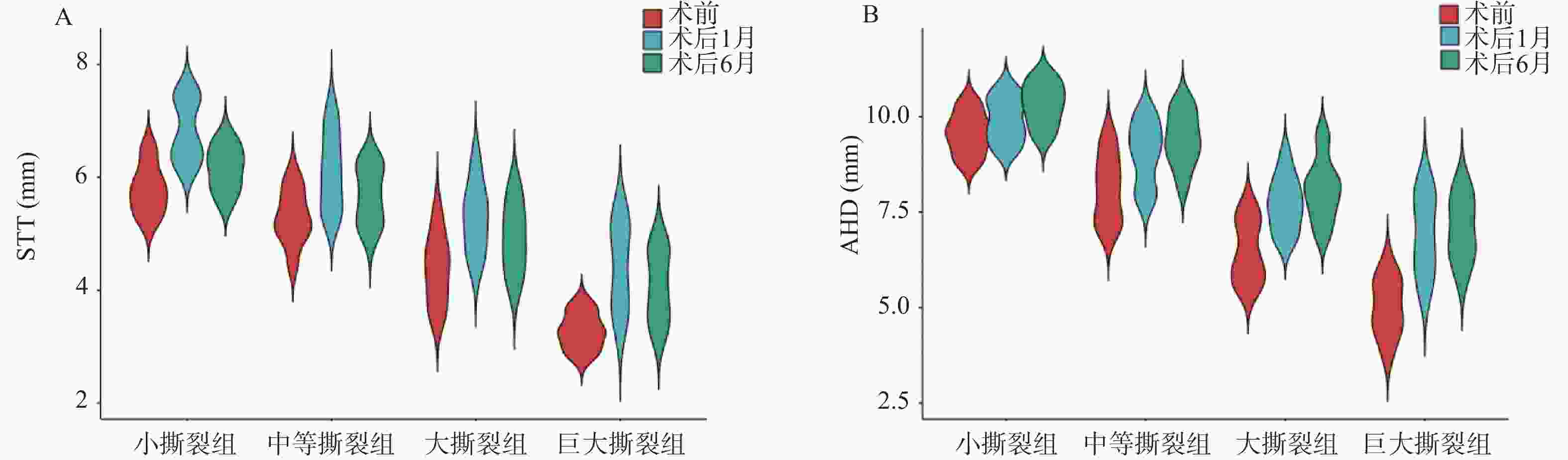
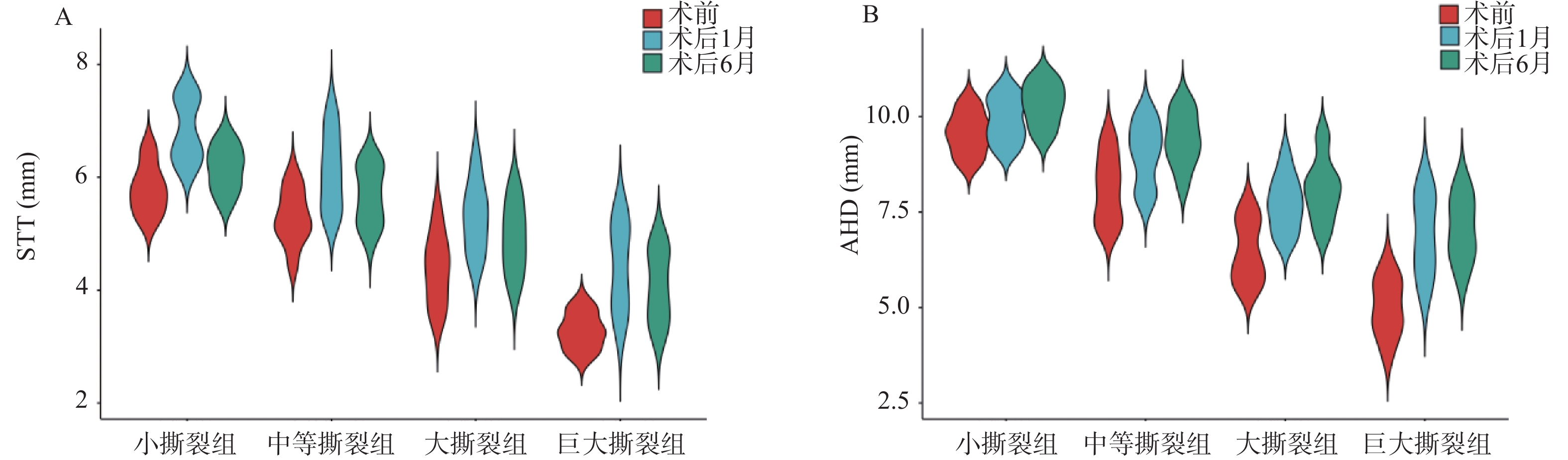
图 1 不同撕裂程度肩袖损伤患者STT和AHD比较
A:不同撕裂程度肩袖损伤患者STT指标比较;B:不同撕裂程度肩袖损伤患者AHD指标比较。
Figure 1. Comparison of STT and AHD values in patients with rotator cuff injuries of varying severity
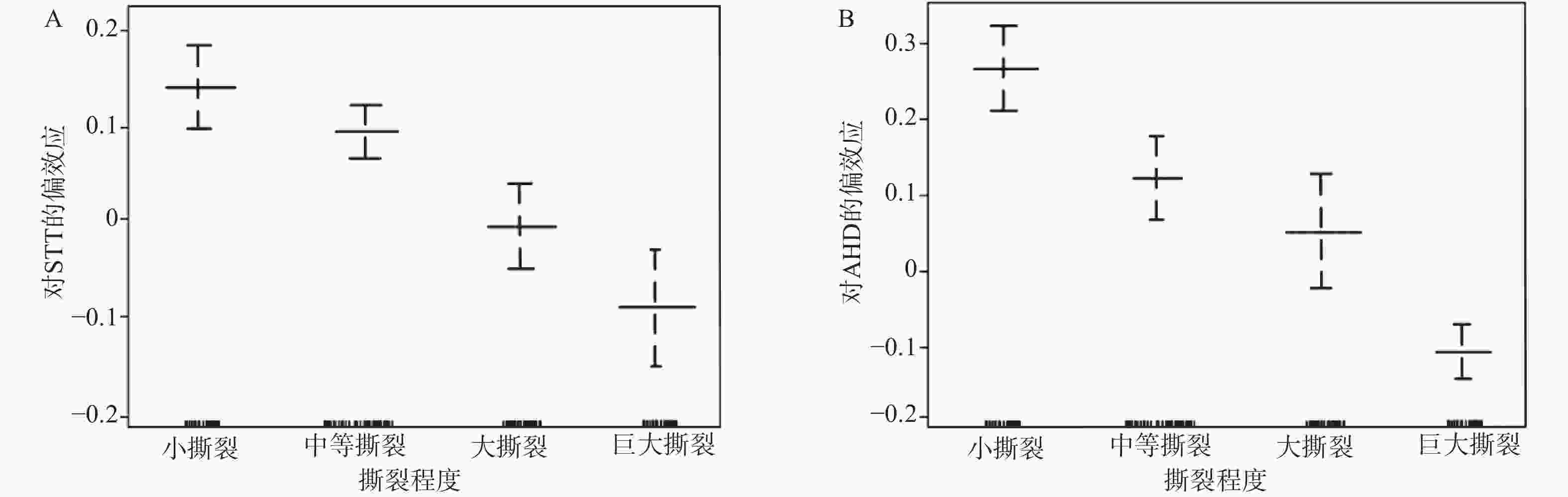
图 2 STT和AHD指标与撕裂程度的GAM图
A:STT指标与撕裂程度的GAM分析;B:AHD指标与撕裂程度的GAM分析。
Figure 2. GAM plot showing the relationship between STT/AHD indicators and tear severity
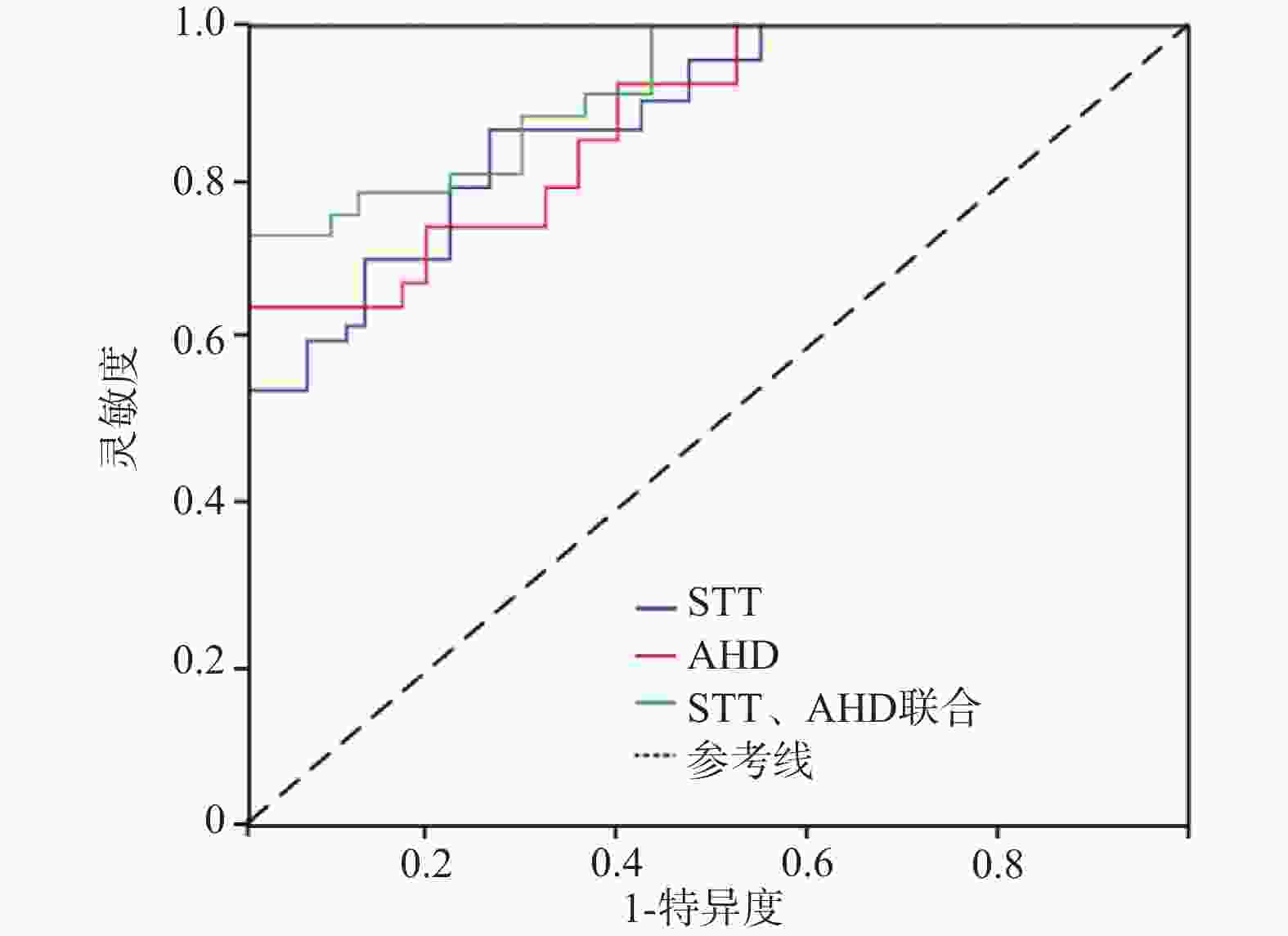
图 3 术前STT和AHD及二者联合预测肩袖撕裂患者预后的ROC曲线
Figure 3. ROC curves of preoperative STT,AHD,and their combined use in predicting prognosis for patients with rotator cuff tears
表 1 不同撕裂程度肩袖损伤患者的临床资料比较[n(%)/($\bar x \pm s $)]
Table 1. Comparison of clinical characteristics among patients with rotator cuff injuries of varying tear severity[n(%)/($ \bar x \pm s $)]
指标 小撕裂组
(n=32)中等撕裂组
(n=45)大撕裂组
(n=30)巨大撕裂组
(n=17)χ2/F/H P 年龄(岁) 49.22 ± 8.55 49.67 ± 8.56 49.43 ± 8.48 49.18 ± 7.02 0.024 0.995 性别 0.141 0.987 男 18(56.25) 27(60.00) 17(56.67) 10(58.82) 女 14(43.75) 18(40.00) 13(43.33) 7(41.18) BMI(kg/m2) 23.38 ± 1.45 23.60 ± 1.70 23.82 ± 1.72 23.39 ± 1.52 0.460 0.711 基础疾病 高血压 10(31.25) 16(35.56) 12(40.00) 7(41.18) 0.717 0.869 糖尿病 5(15.63) 7 (15.56) 5(16.67) 3(17.65) 0.052 0.997 肥胖 7(21.88) 10(22.22) 7(23.33) 4(23.53) 0.032 0.999 饮酒史 0.189 0.979 有 13(40.63) 20(44.44) 12(40.00) 7(41.18) 无 19(59.38) 25(55.56) 18(60.00) 10(58.82) 吸烟史 0.037 0.998 有 12(37.50) 17(37.78) 11(36.67) 6(35.29) 无 20(62.50) 28(62.22) 19(63.33) 11(64.71) 患肩侧别 0.132 0.988 左侧 14(43.75) 21(46.67) 13(43.33) 8(47.06) 右侧 18(56.25) 24(53.33) 17(56.67) 9(52.94) 肩袖损伤病程 0.190 0.979 <1个月 9(28.13) 14(31.11) 8(26.67) 5(29.41) ≥1个月 23(71.88) 31(68.89) 22(73.33) 12(70.59) 肩袖撕裂形状 11.295 0.080 U型 20(62.50) 22(48.89) 10(33.33) 3(17.65) L型 8(25.00) 15(33.33) 13(43.33) 10(58.82) 新月型 4(12.50) 8(17.78) 7(23.33) 4(23.53) ALB(g/L) 41.35 ± 3.20 41.44 ± 3.45 41.74 ± 3.08 41.52 ± 4.42 0.073 0.974 WBC(×109/L) 6.07 ± 1.15 5.62 ± 1.22 5.93 ± 1.32 5.66 ± 1.15 1.032 0.381 PLT(×109/L) 247.38 ± 45.21 245.18 ± 44.74 248.73 ± 43.92 246.65 ± 37.72 0.042 0.988 VAS评分(分) 3.47 ± 1.24 5.38 ± 1.19△ 6.37 ± 1.13△# 8.18 ± 1.38△#& 62.502 <0.001* 术前Constant-Murley评分(分) 72.78 ± 4.04 63.71 ± 3.99 55.20 ± 3.40 48.18 ± 3.34 197.234 <0.001* BMI:体重指数;ALB:白蛋白;WBC:白细胞计数;PLT:血小板计数;VAS:视觉模拟评分。*P < 0.05;与小撕裂组比较,△P < 0.05;与中等撕裂组比较,#P < 0.05;与大撕裂组比较,&P < 0.05。  下载: 导出CSV
表 2 不同撕裂程度肩袖损伤患者STT和AHD变化($\bar x \pm s $)
Table 2. Changes in STT and AHD parameters in patients with rotator cuff injuries of varying tear severity ($\bar x \pm s $)
指标 时间点 小撕裂组
(n=32)中等撕裂组
(n=45)大撕裂组
(n=30)巨大撕裂组
(n=17)F P STT(mm) 术前 5.79 ± 0.44 5.30 ± 0.48△ 4.37 ± 0.62△# 3.28 ± 0.32△#& 118.256 <0.001* 术后1月 6.83 ± 0.54 6.13 ± 0.68△ 5.29 ± 0.62△# 4.43 ± 0.76△#& 62.582 <0.001* 术后6月 6.16 ± 0.40 5.68 ± 0.52△ 4.93 ± 0.62△# 4.08 ± 0.63△#& 67.829 <0.001* F组间 = 118.306,P < 0.001;F时间 = 82.496,P < 0.001;F交互 = 15.601,P < 0.001 AHD(mm) 术前 9.56 ± 0.54 8.13 ± 0.87△ 6.47 ± 0.79△# 5.02 ± 0.75△#& 164.989 <0.001* 术后1月 9.92 ± 0.58 9.04 ± 0.81△ 7.72 ± 0.70△# 6.92 ± 1.03△#& 76.774 <0.001* 术后6月 10.32 ± 0.55 9.42 ± 0.70△ 8.09 ± 0.81△# 7.07 ± 0.84△#& 99.163 <0.001* F组间 = 165.003,P < 0.001;F时间 = 96.711,P < 0.001;F交互 = 22.369,P < 0.001 STT:冈上肌腱厚度;AHD:肩峰肱骨头间距。*P < 0.05;与小撕裂组比较,△P < 0.05;与中等撕裂组比较,#P < 0.05;与大撕裂组比较,&P < 0.05。
下载: 导出CSV
表 3 STT和AHD与撕裂程度的GAM分析
Table 3. GAM analysis of STT and AHD indicators versus tear severity
变量 自由度 均方和 均方 F P STT 3 85.520 28.506 41.622 <0.001* AHD 3 286.413 95.473 63.168 <0.001* STT:冈上肌腱厚度;AHD:肩峰肱骨头间距。GAM模型校正年龄、BMI、性别、基础疾病、饮酒吸烟史、患肩侧别、肩袖损伤病程、肩袖撕裂形状及ALB、WBC、PLT、VAS评分等混杂因素。*P < 0.05。
下载: 导出CSV
表 4 不同预后患者的临床资料比较[n(%)/($ \bar x \pm s $)]
Table 4. Comparison of clinical data among patients with different prognoses[n(%)/($\bar x \pm s $)]
指标 预后良好组
(n=86)预后不良组
(n=38)χ2/t/Z P 年龄(岁) 48.92 ± 8.15 50.43 ± 8.82 0.907 0.366 性别 0.022 0.883 男 51(59.30) 22(57.89) 女 35(40.70) 16(42.11) BMI(kg/m2) 23.57 ± 1.63 23.52 ± 1.55 0.156 0.876 基础疾病 高血压 30(34.88) 15(39.47) 0.240 0.624 糖尿病 14(16.28) 6(15.79) 0.005 0.946 肥胖 20(23.26) 8(21.05) 0.073 0.787 饮酒史 0.584 0.445 有 38(44.19) 14(36.84) 无 48(55.81) 24(63.16) 吸烟史 0.196 0.658 有 33(38.37) 13(34.21) 无 53(61.63) 25(65.79) 患肩侧别 0.207 0.649 左侧 40(46.51) 16(42.11) 右侧 46(53.49) 22(57.89) 肩袖损伤病程 0.074 0.785 <1个月 27(31.40) 11(28.95) ≥1个月 59(68.60) 27(71.05) 肩袖撕裂形状 0.665 0.717 U型 40(46.51) 15(39.47) L型 30(34.88) 16(42.11) 新月型 16(18.60) 7(18.42) 撕裂程度 −4.067 <0.001* 小撕裂 28(32.56) 4(10.53) 中等撕裂 35(40.70) 10(26.32) 大撕裂 17(19.77) 13(34.21) 巨大撕裂 6(6.98) 11(28.95) ALB(g/L) 41.48 ± 3.43 41.55 ± 3.29 0.103 0.918 WBC(×109/L) 5.84 ± 1.24 5.77 ± 1.18 0.287 0.775 PLT(×109/L) 246.83 ± 43.77 247.66 ± 41.05 0.097 0.923 VAS评分(分) 5.50 ± 1.52 7.03 ± 1.81 4.775 <0.001* 术前STT(mm) 5.12 ± 0.92 4.24 ± 0.86 5.007 <0.001* 术前AHD(mm) 8.36 ± 1.14 6.57 ± 1.06 8.232 <0.001* 术前Constant-Murley评分(分) 67.34 ± 10.07 52.16 ± 10.36 7.671 <0.001* BMI:体重指数;ALB:白蛋白;WBC:白细胞计数;PLT:血小板计数;VAS:视觉模拟评分;STT:冈上肌腱厚度;AHD:肩峰肱骨头间距。*P < 0.05。
下载: 导出CSV
表 5 STT和AHD与预后不良的相关性[OR(95%CI)]
Table 5. Correlation between STT,AHD and poor prognosis[OR(95%CI)]
变量 未校正模型 模型1 模型2 P STT 0.802(0.717 ~ 0.897) 0.815(0.726 ~ 0.915) 0.826(0.731 ~ 0.940) <0.001* AHD 0.747(0.668 ~ 0.842) 0.765(0.679 ~ 0.862) 0.780(0.691 ~ 0.873) <0.001* STT:冈上肌腱厚度;AHD:肩峰肱骨头间距。模型1:校正年龄、BMI、性别、基础疾病、饮酒吸烟史、患肩侧别、肩袖损伤病程、肩袖撕裂形状等因素;模型2:在模型1的基础上校正ALB、WBC、PLT、VAS评分及撕裂程度等因素。*P < 0.05。
下载: 导出CSV
表 6 术前STT和AHD及二者联合预测肩袖撕裂患者预后的ROC分析
Table 6. ROC analysis of preoperative STT,AHD,and their combined use in predicting prognosis for patients with rotator cuff tears
指标 AUC 95%CI P 灵敏度 特异度 约登指数 STT 0.796 0.718 ~ 0.874 <0.001* 0.763 0.804 0.567 AHD 0.824 0.752 ~ 0.896 <0.001* 0.816 0.831 0.647 STT联合AHD 0.876 0.809 ~ 0.923 <0.001* 0.867 0.840 0.707 STT:冈上肌腱厚度;AHD:肩峰肱骨头间距。*P < 0.05。
下载: 导出CSV
-
[1] Shah S, Shamas N, Bagum A, et al. Role of scapular stabilisation exercises on pain and range of motion in patients with rotator cuff pathologies: A narrative review[J]. HJPRS, 2025, 5(2): 91-96. doi: 10.55735/h3r2f066 [2] 陈俊, 楼珏翔, 申屠国建, 等. 肩关节峰盂角对肩袖撕裂修补术后再撕裂的影响[J]. 中国运动医学杂志, 2022, 41(6): 423-429. doi: 10.3969/j.issn.1000-6710.2022.06.002 [3] Sikes K J, Andrie K M, Wist S, et al. Acute tear versus chronic-degenerated rotator cuff pathologies are associated with divergent tendon metabolite profiles[J]. Connect Tissue Res, 2024, 65(6): 458-471. doi: 10.1080/03008207.2024.2425867 [4] Laprus H, Brzóska R, Błasiak A, et al. Massive and irreparable rotator cuff tear treatment by arthroscopic partial repair with long head of the biceps tendon augmentation provides better healing and functional results than partial repair only[J]. J Shoulder Elbow Surg, 2024, 33(2): 263-272. doi: 10.1016/j.jse.2023.06.022 [5] Ishigaki T, Yoshino K, Hirokawa M, et al. Supraspinatus tendon thickness and subacromial impingement characteristics in younger and older adults[J]. BMC Musculoskelet Disord, 2022, 23(1): 234. doi: 10.1186/s12891-022-05179-y [6] Ueda Y, Tanaka H, Tachibana T, et al. Factors determining the short-term clinical outcomes of conservative treatment in patients with supraspinatus tear[J]. J Bodyw Mov Ther, 2024, 39: 463-468. doi: 10.1016/j.jbmt.2024.03.044 [7] Baek C H, Kim B T, Kim J G, et al. Increased latissimus dorsi and teres major muscle volume after anterior transfer for irreparable anterior superior rotator cuff tear: Correlation with improved internal rotation strength[J]. Arch Orthop Trauma Surg, 2024, 144(4): 1491-1502. doi: 10.1007/s00402-023-05192-3 [8] Kılıç E, Bingöl O, Özdemir G, et al. The effect of reduced acromiohumeral distance and increased acromial thickness on the risk of rotator cuff tear[J]. Acta Orthop Traumatol Turc, 2023, 57(6): 348-351. doi: 10.5152/j.aott.2023.23033 [9] Oishi R, Hoshikawa K, Mura N, et al. Relationship between the acromiohumeral distance and muscle function of deltoid and infraspinatus in patients with rotator cuff tears[J]. Heliyon, 2025, 11(10): e43431. doi: 10.1016/j.heliyon.2025.e43431 [10] Dede B T, Doğan Y P, Oğuz M, et al. Evaluation of the relationship between acromiohumeral distance and supraspinatus tendon thickness measured by ultrasonography and rotator cuff pathologies, pain, and function[J]. Acta Chir Orthop Traumatol Cech, 2024, 91(3): 164-169. doi: 10.55095/achot2024/024 [11] 于万涛, 俞明晨. 肩袖损伤修复术后再撕裂的相关因素与预测[J]. 中国矫形外科杂志, 2024, 32(23): 2140-2145. doi: 10.20184/j.cnki.Issn1005-8478.100966 [12] 张凯搏, 唐新, 李箭, 等. 2019年美国骨科医师学会(AAOS)肩袖损伤临床实践指南解读[J]. 中国运动医学杂志, 2020, 39(5): 403-412. doi: 10.3969/j.issn.1000-6710.2020.05.012 [13] 甘丽佳, 张云鹏. 冈上冈下肌脂肪浸润定量参数与肩袖损伤冈上肌撕裂程度的关联研究[J]. 中国CT和MRI杂志, 2026, 24(7): 138-141. doi: 10.3969/j.issn.1672-5131.2026.07.039 [14] 方桂婷, 方海燕, 李金花, 等. 超声引导下精准注射自体富血小板血浆治疗肩袖部分撕裂的效能评估[J]. 中国康复医学杂志, 2025, 40(3): 423-426. doi: 10.3969/j.issn.1001-1242.2025.03.016 [15] 韩庆欣, 张磊, 张晟, 等. 关节镜下缝线桥技术治疗肩袖损伤5年以上临床随访结果: 术后再撕裂率及再撕裂对肩关节功能的影响[J]. 中国运动医学杂志, 2021, 40(6): 427-432. doi: 10.3969/j.issn.1000-6710.2021.06.002 [16] Şahin K, Albayrak M O, Şentürk F, et al. Gender and degree of tendon healing are independent predictive factors for clinical outcome in successfully healed rotator cuff tears[J]. Knee Surg Sports Traumatol Arthrosc, 2023, 31(10): 4585-4593. [17] Zuo J, Chen C, Guo J, et al. Efficacy of rotator cuff suture and arthroscopic 360° capsular release in patients with rotator cuff tear with limited shoulder movement[J]. BMC Surg, 2023, 23(1): 379. doi: 10.1186/s12893-023-02157-6 [18] Fossati C, Stoppani C, Menon A, et al. Arthroscopic rotator cuff repair in patients over 70 years of age: A systematic review[J]. J Orthop Traumatol, 2021, 22(1): 3. doi: 10.1186/s10195-021-00565-z [19] Zhang X, Zhou G, Gu Z, et al. Research progress of TCM therapy for rotator cuff injury[J]. Comb Chem High Throughput Screen, 2024, 27(15): 2216-2222. doi: 10.2174/0113862073264977240103070432 [20] Stengaard K, Hejbøl EK, Jensen PT, et al. Early-stage inflammation changes in supraspinatus muscle after rotator cuff tear[J]. J Shoulder Elbow Surg, 2022, 31(7): 1344-1356. doi: 10.1016/j.jse.2021.12.046 [21] Arráez-Aybar L A, García-de-Pereda-Notario C M, Palomeque-Del-Cerro L, et al. Acromiohumeral distance as a diagnostic and prognostic biomarker for shoulder disorders: A systematic review-acromiohumeral distance and shoulder disorders[J]. J Funct Morphol Kinesiol, 2025, 10(4): 478. doi: 10.3390/jfmk10040478 [22] Al Hammadi M I, Shah Z A, Rathod R K, et al. Shoulder impingement pain syndrome: Pathophysiology, diagnosis, and a review of current treatment strategies[J]. Cureus, 2025, 17(9): e92045. doi: 10.7759/cureus.92045 -


 点击查看大图
计量
- 文章访问数: 2
- HTML全文浏览量: 1
- PDF下载量: 0
- 被引次数: 0
