




A Study on the Impact of Catching Growth Rate on Neuropsychological Development in Premature Infants
-
摘要:
目的 探讨早产儿追赶生长速度对其神经心理发育的影响,明确小于胎龄儿(small for gestational age,SGA)与适于胎龄儿(appropriate for gestational age,AGA)追赶生长神经发育应答的异质性。 方法 回顾性分析 2020年1月至2022 年12月首都医科大学附属北京潞河医院 140 例胎龄 < 34 周、随访完整的早产儿资料,收集矫正 0~12 月龄体格测量数据,评估矫正 6、12 月龄神经心理发育水平,采用多重线性回归分析关联并检验组间效应异质性。 结果 多数胎龄 < 34 周早产儿矫正 12 月龄可完成追赶生长,体重追赶最优,头围最慢。多因素校正后,AGA 组矫正 0~3 月龄体重增速与 12 月龄多维度神经发育显著正相关;SGA 组矫正 0~3 月龄头围增速与 12 月龄多项神经发育指标显著正相关,且其 3~6 月龄、6~12 月龄头围及体重增速均对多维度神经发育存在独立效应。交互项分析证实两组对早期追赶生长的神经发育应答存在显著异质性。 结论 多数胎龄 < 34 周早产儿矫正 12 月龄可完成追赶生长,头围及体重追赶速度独立影响其神经心理发育,SGA 对其应答更早更广。 Abstract:Objective To investigate the effects of catch-up growth velocity on neuropsychological development in preterm infants, and to clarify the heterogeneity of neurodevelopmental responses to catch-up growth between preterm small for gestational age (SGA) and appropriate for gestational age (AGA) infants. Methods A retrospective analysis was conducted on 140 preterm infants with gestational age <34 weeks and complete follow-up data, who were admitted to Beijing Luhe Hospital, Capital Medical University between January 2020 and December 2022. Anthropometric measurements were collected at corrected age 0 to 12 months, and neuropsychological development was assessed at corrected age 6 and 12 months. Multiple linear regression was used to analyze the associations and test for between-group heterogeneity in effects. Results Most preterm infants with gestational age <34 weeks achieved catch-up growth by corrected age 12 months, with weight demonstrating the best catch-up and head circumference the slowest. After multivariate adjustment, weight growth velocity at corrected age 0 to 3 months was significantly positively correlated with multidimensional neurodevelopment at 12 months in the AGA group. In the SGA group, head circumference growth velocity at corrected age 0 to 3 months was significantly positively correlated with multiple neurodevelopmental indicators at 12 months; furthermore, head circumference and weight growth velocities at 3 to 6 months and 6 to 12 months also had independent effects on multidimensional neurodevelopment. Interaction term analysis confirmed significant heterogeneity in neurodevelopmental responses to early catch-up growth between the two groups. Conclusion Most preterm infants with gestational age <34 weeks achieve catch-up growth by corrected age 12 months. Head circumference and weight catch-up growth velocities are independent predictors of neuropsychological development in preterm infants, and SGA infants exhibit earlier and more extensive neurodevelopmental responses to catch-up growth. -
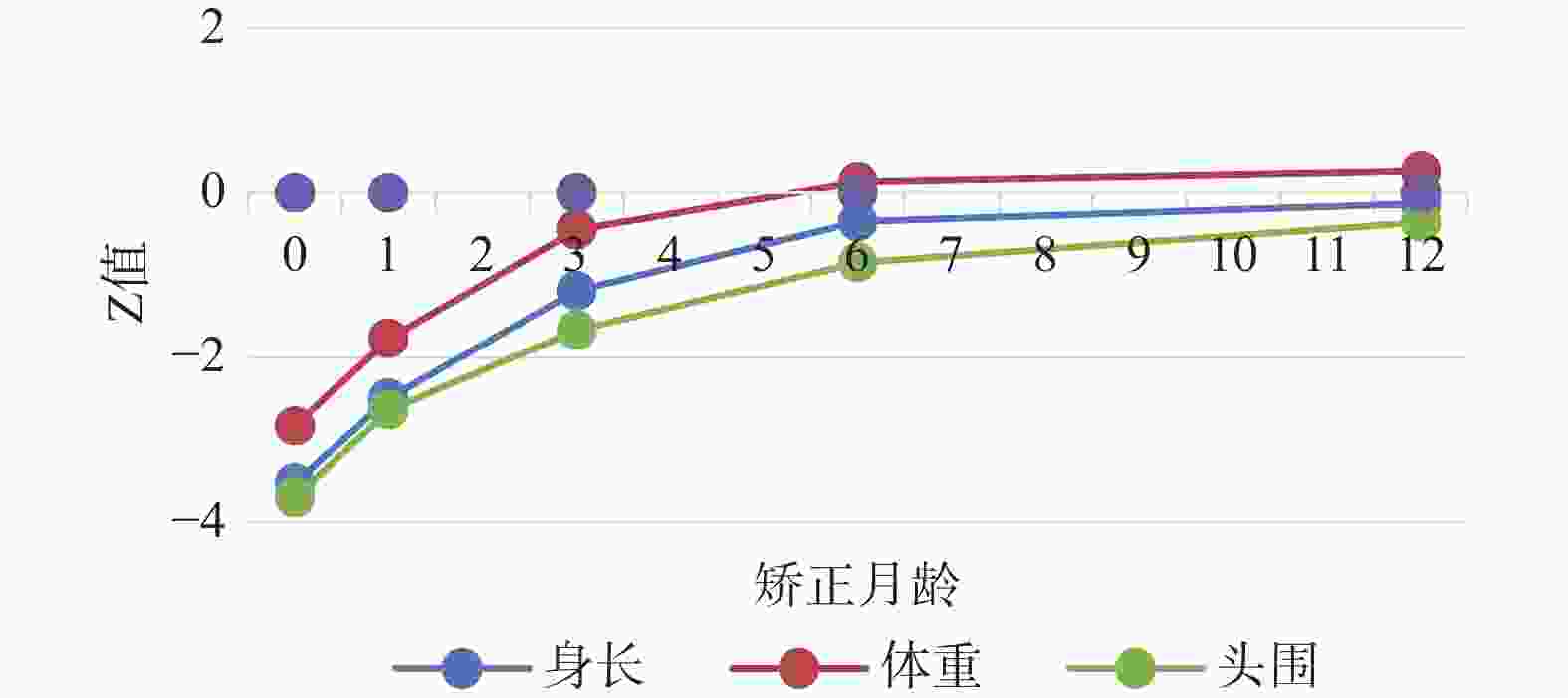
图 1 140例早产儿生后身长、体重、头围Z评分变化
Figure 1. Changes in Z-scores of birth length,weight,and head circumference in 140 preterm infants
表 1 AGA 组矫正 0~3 月龄体重生长速度对矫正 12 月龄神经发育结局的独立效应分析
Table 1. Analysis of the independent effect of weight growth velocity at corrected age 0~3 months on neurodevelopmental outcomes at 12 months’ corrected age in the AGA group
神经发育结局维度 未标准化回归系数β 95%CI P 精细运动 0.268 0.054 ~ 0.482 0.016* 语言 0.295 0.073 ~ 0.517 0.011* 适应能力 0.314 0.096 ~ 0.532 0.008* 社会行为 0.283 0.058 ~ 0.508 0.014* 智龄 0.286 0.061 ~ 0.511 0.013* 发育商 0.241 0.008 ~ 0.474 0.043* *P < 0.05。  下载: 导出CSV
表 2 SGA组不同矫正月龄阶段生长速度对神经发育评分影响的回归分析结果
Table 2. Regression analysis results of the effect of growth velocity at different corrected age stages on neurodevelopmental scores in the SGA group
阶段 神经发育指标 β 95%CI P 矫正 0~3 月龄
(头围生长速度每增加1个单位)语言 0.227 0.018 ~ 0.436 0.034* 适应能力 0.236 0.029 ~ 0.443 0.028* 社会行为 0.211 0.002 ~ 0.420 0.049* 发育商 0.322 0.128 ~ 0.516 0.001* 矫正 3~6 月龄
(头围生长速度每增加1个单位)大运动 0.356 0.175 ~ 0.537 <0.001* 精细运动 0.244 0.053 ~ 0.435 0.014* 语言 0.221 0.026 ~ 0.416 0.027* 适应能力 0.318 0.134 ~ 0.502 <0.001* 社会行为 0.325 0.142 ~ 0.508 <0.001* 智龄 0.311 0.125 ~ 0.497 <0.001* 发育商 0.402 0.233 ~ 0.571 <0.001* 矫正 6~12 月龄 (头围生长速度每增加1个单位) 精细运动 0.289 0.101 ~ 0.477 0.003* 语言 0.271 0.079 ~ 0.463 0.006* 适应能力 0.225 0.027 ~ 0.423 0.028* 智龄 0.294 0.108 ~ 0.480 0.002* 发育商 0.282 0.092 ~ 0.472 0.004* 矫正 6~12 月龄(体重生长速度每增加1个单位) 大运动 0.236 0.030 ~ 0.442 0.027* 精细运动 0.219 0.010 ~ 0.428 0.041* 社会行为 0.224 0.016 ~ 0.432 0.036* 智龄 0.227 0.021 ~ 0.433 0.033* 发育商 0.218 0.007 ~ 0.429 0.042* *P < 0.05。
下载: 导出CSV
表 3 追赶生长速度与 SGA 状态的交互效应对矫正 12 月龄神经发育的影响
Table 3. Interactive Effect of catch-up growth velocity and SGA status on neurodevelopment at 12 months’ corrected age
窗口期 生长速度指标 神经发育结局 交互项β 95%CI 交互项 P 矫正 0~3 月龄 头围生长速度 语言 0.284 0.051 ~ 0.517 0.017* 矫正 0~3 月龄 头围生长速度 适应能力 0.302 0.072 ~ 0.532 0.010* 矫正 0~3 月龄 头围生长速度 发育商 0.357 0.131 ~ 0.583 0.002* 矫正 3~6 月龄 头围生长速度 大运动 0.276 0.048 ~ 0.504 0.018* 矫正 3~6 月龄 头围生长速度 发育商 0.319 0.093 ~ 0.545 0.006* 矫正 6~12 月龄 头围生长速度 社会行为 0.265 0.037 ~ 0.493 0.023* 矫正 6~12 月龄 体重生长速度 大运动 0.228 0.003 ~ 0.453 0.047* *P < 0.05。
下载: 导出CSV
表 4 矫正0个月~矫正3个月时AGA不同体重生长速度神经心理发育比较($\bar x \pm s $)
Table 4. Comparison of neuropsychological development of AGA at different weight growth rates from 0 months to 3 months after correction ($\bar x \pm s $)
矫正12月龄 1组(<P25,n=14) 2组P25~P50,n=13) 3组(P50~P75,n=14) 4组(≥P75,n=14) F 校正后P 精细运动 11.53 ± 0.93 10.91 ± 1.74 11.03 ± 1.07 14.65 ± 7.58* 2.794 0.049* 语言 12.25 ± 1.61 10.50 ± 1.65 11.31 ± 0.99 14.00 ± 5.27* 3.605 0.019* 适应能力 11.61 ± 1.00 10.75 ± 1.73 11.13 ± 1.58 14.69 ± 6.22* 3.953 0.013* 社会行为 11.21 ± 1.58 10.45 ± 1.63 11.16 ± 1.65 14.78 ± 7.50* 3.304 0.027* 智龄 11.30 ± 1.07 10.87 ± 1.66 11.07 ± 1.14 14.57 ± 6.71* 3.313 0.024* 发育商 95.76 ± 2.53 94.59 ± 6.27 97.17 ± 4.74 99.82 ± 6.74* 2.364 0.042* *P < 0.05。
下载: 导出CSV
表 5 矫正0个月~矫正3个月时SGA不同头围生长速度神经心理发育比较($\bar x \pm s $)
Table 5. Comparison of neuropsychological development of SGA at different head circumference growth rates from 0 months to 3 months after correction ($\bar x \pm s $)
矫正12月龄 1组(<P25,n=21) 2组P25~P50,n=22) 3组(P50~P75,n=21) 4组(≥P75,n=21) F 校正后P 语言 11.52 ± 2.90 11.23 ± 1.28 11.31 ± 0.93 12.44 ± 1.08* 2.605 0.047* 适应能力 11.81 ± 3.49 10.96 ± 1.84 11.86 ± 1.05 12.78 ± 1.51* 2.604 0.039* 社会行为 11.54 ± 4.12 10.60 ± 1.73 11.71 ± 1.11 12.09 ± 1.82* 2.072 0.048* 发育商 98.74 ± 4.48 94.96 ± 5.43 94.61 ± 4.36 99.64 ± 6.46* 5.052 0.003* *P < 0.05。
下载: 导出CSV
表 6 矫正3个月~矫正6个月时SGA不同头围生长速度神经心理发育比较($\bar x \pm s $)
Table 6. Comparison of neuropsychological development of SGA at different head circumference growth rates from 3 months to 6 months after correction ($\bar x \pm s $)
矫正6月龄 1组(<P25,n=21) 2组P25~P50,n=22) 3组(P50~P75,n=21) 4组(≥P75,n=21) F 校正后P 大运动 6.55 ± 1.21 5.91 ± 0.37 7.00 ± 1.57* 6.63 ± 1.03 7.502 0.001* 精细运动 6.41 ± 0.92 6.32 ± 0.50 6.82 ± 1.12* 6.37 ± 0.85 3.699 0.015* 语言 6.12 ± 0.73 6.43 ± 0.89 6.61 ± 0.97* 6.45 ± 0.85 3.256 0.026* 适应能力 6.56 ± 1.01 6.3 0 ± 0.92 6.91 ± 1.11* 6.58 ± 1.11 5.805 0.001* 社会行为 6.82 ± 0.99 6.80 ± 0.81 7.27 ± 0.98* 6.87 ± 0.74 5.954 0.001* 智龄 6.66 ± 0.84 6.42 ± 0.60 6.99 ± 0.82* 6.73 ± 0.72 5.678 0.001* 发育商 101.06 ± 9.36 102.25 ± 7.11 103.22 ± 6.24* 99.59 ± 9.96 10.879 0.001* *P < 0.05。
下载: 导出CSV
表 7 矫正6个月~矫正12个月时SGA不同头围生长速度神经心理发育比较($\bar x \pm s $)
Table 7. Comparison of neuropsychological development of SGA at different head circumference growth rates from 6 months to 12 months after correction ($\bar x \pm s $)
矫正12月龄 1组(<P25,n=21) 2组P25~P50,n=22) 3组(P50~P75,n=21) 4组(≥P75,n=21) F 校正后P 精细运动 11.34 ± 4.0 11.53 ± 0.96 12.09 ± 1.14* 11.67 ± 1.35 6.503 0.001* 适应能力 11.65 ± 3.71 11.88 ± 0.80 12.16 ± 0.65* 11.98 ± 0.98 3.909 0.012* 语言 11.74 ± 2.89 11.24 ± 0.75 12.16 ± 0.77* 11.48 ± 0.86 5.716 0.001* 社会行为 11.58±4.19 11.32 ± 1.37 12.69 ± 1.05* 11.45 ± 0.61 6.589 0.001* 智龄 11.81 ± 3.57 11.48 ± 0.66 12.68 ± 0.91* 11.69 ± 1.06 6.224 0.001* 发育商 97.13 ± 7.31 97.53 ± 2.68 99.60 ± 3.41* 95.97 ± 5.60 5.859 0.001* *P < 0.05。
下载: 导出CSV
表 8 矫正6个月~矫正12个月时SGA不同体重生长速度神经心理发育比较($\bar x \pm s $)
Table 8. Comparison of neuropsychological development of SGA at different weight growth rates from 6 months to 12 months after correction ($\bar x \pm s $)
矫正12月龄 1组(<P25,n=21) 2组P25~P50,n=22) 3组(P50~P75,n=21) 4组(≥P75,n=21) F 校正后P 大运动 11.31±0.72 11.74 ± 4.44 11.36 ± 2.04 12.31 ± 2.18* 4.002 0.01* 精细运动 11.89 ± 0.81 11.89 ± 4.79 11.58 ± 1.33 13.40 ± 1.50* 2.802 0.045* 社会行为 11.00 ±1.57 11.31 ± 4.68 11.13 ± 1.39 12.38 ± 1.70* 2.293 0.044* 智龄 11.13 ± 1.00 12.01 ± 4.09 11.17 ± 1.10 12.95 ± 1.34* 3.339 0.023* 发育商 96.20 ± 3.51 98.10 ± 6.86 95.38 ± 5.90 99.84 ± 3.24* 2.915 0.039* *P < 0.05。
下载: 导出CSV
-
[1] Lawn J E, Ohuma E O, Bradley E, et al. Small babies, big risks: Global estimates of prevalence and mortality for vulnerable newborns to accelerate change and improve counting[J]. Lancet, 2023, 401(10389): 1707-1719. doi: 10.1016/S0140-6736(23)00522-6 [2] Bradley E, Blencowe H, Moller AB, et al. Born Too Soon: Global epidemiology of preterm birth and drivers for change[J]. Reproductive Health, 2025, 22(1): 105. [3] 吴天晨, 李驿馨, 石慧峰, 等. 2017年至2022年中国早产流行病学特征及变化趋势[J]. 中华围产医学杂志, 2025, 28(2): 126-133. [4] Yu W H, Wang S T, Chen L W, et al. Effect of first-month head-size growth trajectory on cognitive outcomes in preterm infants[J]. Journal of the Formosan Medical Association, 2022, 121(1): 367-374. [5] Cooke R, Goulet O, Huysentruyt K, et al. Catch-up growth in infants and young children with faltering growth: Expert opinion to guide general clinicians[J]. Journal of Pediatric Gastroenterology and Nutrition, 2023, 77(1): 7-15. doi: 10.1097/MPG.0000000000003784 [6] 苏志文, 林黎黎, 石碧君, 等. 超早产儿 / 超低出生体重儿临床结局的性别差异: 一项倾向性评分匹配研究 [J]. 中国当代儿科杂志, 2022, 24 (5): 514-520. [7] 李佳美, 谢群英, 文羽祺, 等. 早产小于胎龄儿校正0~24月龄追赶生长的纵向研究[J]. 中国当代儿科杂志, 2024, 26(1): 72-78. [8] 朱江, 霍言言, 陈津津. 小于胎龄儿的追赶生长与认知发育[J]. 中国儿童保健杂志, 2024, 32(12): 1339-1342. [9] Lin CY, Chang HY, Hsieh JH, et al. The impact of small-for-gestational-age status on the outcomes in very-low-birth-weight premature infants: a prospective cohort study in Taiwan[J]. Frontiers in Pediatrics, 2023, 11: 1209765. [10] 张紫祎, 肖万祥, 马丽亚, 等. 早产儿校正18~24月龄体格生长和神经发育水平研究[J]. 中国当代儿科杂志, 2023, 25(1): 38-43. [11] Haiden N, Luque V, Domellöf M, et al. Assessment of growth status and nutritional management of prematurely born infants after hospital discharge: A position paper of the ESPGHAN Nutrition Committee[J]. J Pediatr Gastroenterol Nutr, 2025, 81(2): 421-441. [12] 郑直, 沈蔚, 唐丽霞, 等. 极早产儿及中期早产儿校正 18~24 月龄神经发育结局及影响因素分析 [J]. 中华新生儿科杂志 (中英文), 2022, 37 (5): 423-428. [13] World Health Organization. WHO child growth standards: length/height-for-age, weight-for-age, weight-for-length, weight-for-height and body mass index-for-age: methods and development[EB/OL]. (2006-11-11) [2022-03-05]. https://www. who.int/publications/i/item/924154693X. [14] 首都儿科研究所. 0-6 岁儿童神经心理行为检查量表(2016 版)操作手册 [M]. 北京: 人民卫生出版社, 2017. [15] Han J, Jiang Y, Huang J, et al. Postnatal growth of preterm infants during the first two years of life: Catch-up growth accompanied by risk of overweight[J]. Italian Journal of Pediatrics, 2021, 47(1): 66. [16] 刘杨, 刘环. 成都地区早产儿 2 岁内追赶生长的随访研究 [J]. 中国儿童保健杂志, 2021, 29 (3): 243-248. [17] Vohr B R, McGowan E C, Bann C M, et al. Association of high screen-time use with school-age cognitive, executive function, and behavior outcomes in extremely preterm children[J]. JAMA Pediatrics, 2021, 175(10): 1025-1034. [18] 张梅, 匡晓妮, 缪丹, 等. 不同出生体重早产儿 2 岁内追赶生长特征的纵向研究 [J]. 中国儿童保健杂志, 2022, 30 (10): 1136-1140. [19] Smith LA, Johnson AM, Thompson AB, et al. Preeclampsia, Fetal Growth Restriction, and 24-Month Neurodevelopment in Very Preterm Infants[J]. JAMA Pediatrics, 2024, 178(5): e240012. [20] 郭江波, 袁天明. 新生儿缺氧缺血性脑病的发病机制及诊治研究进展 [J]. 医学综述, 2021, 27 (13): 2624-2629. [21] Romano M, Bianchi M, Martini A, et al. In-hospital head circumference growth and 24-month neurodevelopmental outcomes in very low birth weight preterm infants[J]. Frontiers in Pediatrics, 2023, 11: 1180068. [22] Karlsson O, Kim R, Moloney G M, et al. Patterns in child stunting by age: A cross-sectional study of 94 low- and middle-income countries[J]. Maternal & Child Nutrition, 2023, 19(4): e13537. -

 点击查看大图
计量
- 文章访问数: 667
- HTML全文浏览量: 354
- PDF下载量: 107
- 被引次数: 0
