




Association of Postoperative ctDNA Status and Clearance with Pathological High-Risk Features and Recurrence Risk in Colorectal Cancer
-
摘要:
目的 探讨结直肠癌术后循环肿瘤DNA(circulating tumor DNA,ctDNA)状态、负荷及其动态变化与病理高危特征、辅助化疗反应及复发风险之间的关系。 方法 本研究采用单中心前瞻性队列研究设计,连续纳入2022年1月至2024年6月在榆林市第一医院接受根治性切除的结直肠癌患者160例。所有患者于术后4~8周完成ctDNA基线检测,并根据临床治疗和随访节点进行后续ctDNA监测。随访时间定义为自手术日期起至首次复发、远处转移、死亡或末次随访为止。分析ctDNA状态、负荷及动态变化与病理高危特征的相关性;在ctDNA阳性患者中进一步评估ctDNA清除与辅助治疗后分子学变化及复发风险的关系。采用Logistic回归和Cox比例风险模型进行统计分析。 结果 术后ctDNA阳性47例(29.38%)。多因素Logistic回归分析显示,N2分期(OR = 2.41,95%CI 1.12~5.18,P = 0.024)、脉管侵犯(OR = 2.18,95%CI 1.03~4.62,P = 0.041)及肿瘤出芽BD2~3级(OR = 2.67,95%CI 1.22~5.86,P = 0.014)与ctDNA阳性独立相关。在ctDNA阳性并接受辅助化疗的患者中,初始ctDNA负荷(OR = 0.63,95%CI 0.45~0.88,P = 0.007)和完成≥6周期化疗(OR = 2.74,95%CI 1.11~6.78,P = 0.029)是ctDNA清除的独立相关因素。自手术日期起计算,中位随访24.50个月,发生复发43例(26.88%)。多因素Cox回归分析显示,术后ctDNA阳性(HR = 2.96,95%CI 1.63~5.39,P < 0.001)和肿瘤出芽BD2~3级(HR = 2.11,95%CI 1.18~3.78,P = 0.012)为复发的独立危险因素。在ctDNA阳性亚组中,ctDNA未清除患者复发风险显著升高(HR = 2.58,95%CI 1.21~5.48,P = 0.014)。 结论 ctDNA状态及其动态变化与结直肠癌术后病理高危特征和复发风险密切相关。ctDNA可作为传统病理评估的重要补充,有助于识别复发高风险患者。 Abstract:Objective To investigate the associations of postoperative circulating tumor DNA (ctDNA) status, burden, and dynamics with high-risk pathological features, response to adjuvant chemotherapy, and recurrence risk in colorectal cancer. Methods This single-center prospective cohort study consecutively included 160 patients with colorectal cancer who underwent radical resection at the First Hospital of Yulin from January 2022 to June 2024. Baseline ctDNA testing was performed 4–8 weeks after surgery in all patients, followed by serial ctDNA monitoring in accordance with clinical treatment and follow-up schedules. The follow-up duration was defined as the interval from the date of surgery to the first recurrence, distant metastasis, death, or last follow-up. The correlations of ctDNA status, burden, and dynamics with high-risk pathological features were analyzed; among ctDNA-positive patients, the associations of ctDNA clearance with molecular changes after adjuvant chemotherapy and recurrence risk were further evaluated. Logistic regression and Cox proportional hazards models were used for statistical analysis. Results Postoperative ctDNA was positive in 47 patients(29.38%). Multivariable logistic regression analysis showed that N2 stage (OR = 2.41, 95% CI 1.12–5.18, P = 0.024), lymphovascular invasion (OR = 2.18, 95% CI 1.03–4.62, P = 0.041), and tumor budding grade BD2–3 (OR = 2.67, 95% CI 1.22–5.86, P = 0.014) were independently associated with ctDNA positivity. Among ctDNA-positive patients receiving adjuvant chemotherapy, lower baseline ctDNA burden (OR = 0.63, 95% CI 0.45–0.88, P = 0.007) and completion of ≥6 chemotherapy cycles (OR = 2.74, 95% CI 1.11–6.78, P = 0.029) were independently associated with ctDNA clearance. With a median follow-up of 24.50 months calculated from the date of surgery, recurrence occurred in 43 patients (26.88%). Multivariable Cox regression analysis demonstrated that postoperative ctDNA positivity (HR = 2.96, 95% CI 1.63–5.39, P < 0.001) and tumor budding grade BD2–3 (HR = 2.11, 95% CI 1.18–3.78, P = 0.012) were independent risk factors for recurrence. In the ctDNA-positive subgroup, patients without ctDNA clearance had a significantly higher risk of recurrence (HR = 2.58, 95% CI 1.21–5.48, P = 0.014). Conclusion ctDNA status and its dynamics are closely associated with high-risk pathological features and recurrence risk after colorectal cancer surgery. ctDNA may serve as an important complement to conventional pathological assessment and help identify patients at high risk of recurrence. -
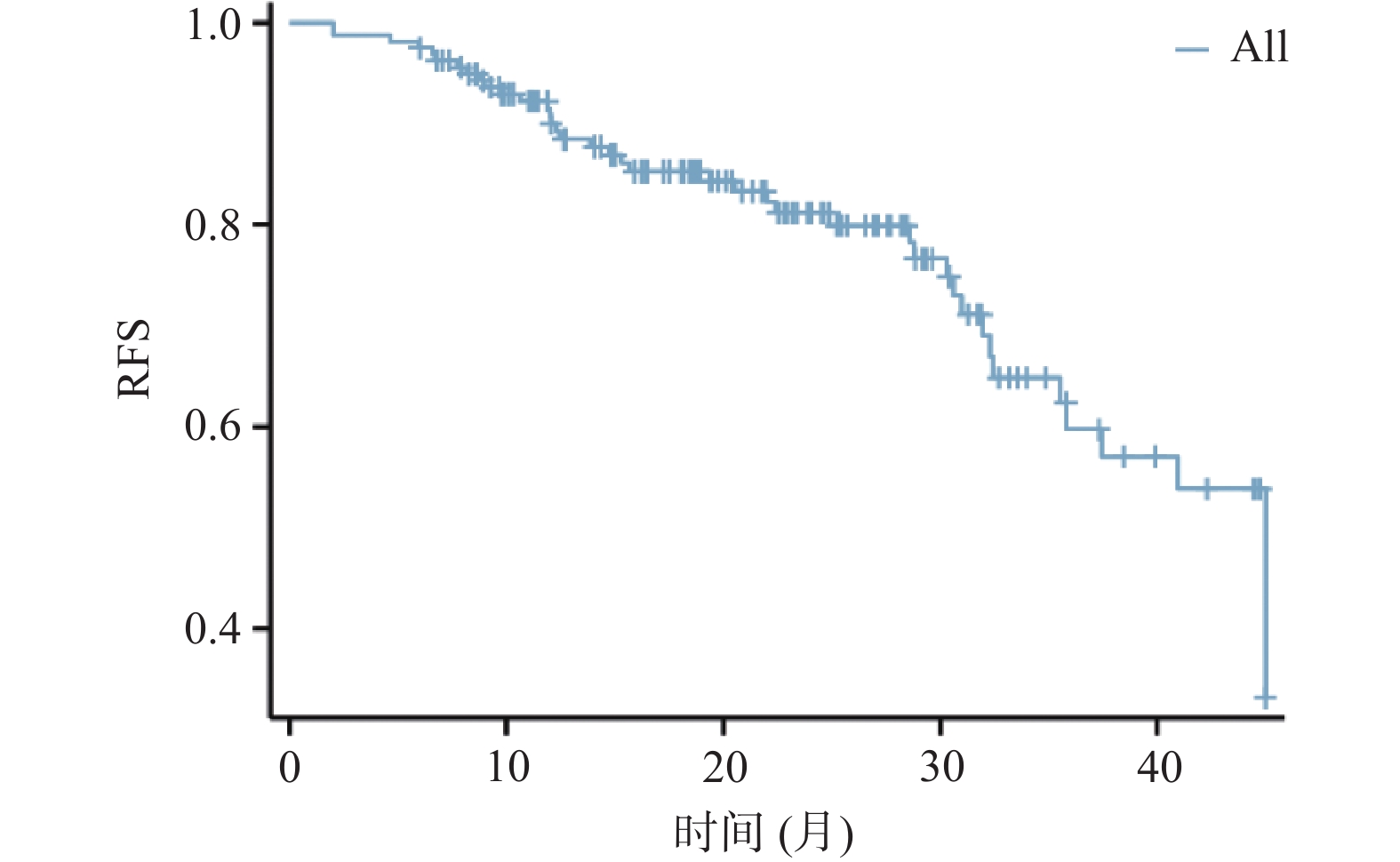
图 1 160例结直肠癌患者无复发生存概率的Kaplan–Meier曲线
Figure 1. Kaplan–Meier curves of recurrence-free survival probability in 160 patients with colorectal cancer
表 1 患者基线临床与病理特征[M(P25,P75)/n(%),n = 160]
Table 1. Baseline clinical and pathological characteristics of the patients (n = 160)
变量 分类 数值 年龄(岁) — 62.00(54.00,69.00) 性别 男 94(58.75) 女 66(41.25) BMI(kg/m2) — 23.40(21.30,25.60) 肿瘤部位 右半结肠 41(25.63) 左半结肠 55(34.38) 直肠 64(40.00) AJCC分期 Ⅱ期 68(42.50) Ⅲ期 92(57.50) pT分期 T1~3 118(73.75) T4 42(26.25) pN分期 N0 68(42.50) N1 33(20.63) N2 59(36.88) 分化程度 高/中分化 139(86.88) 低分化/高级别 21(13.13) LVI 阴性 122(76.25) 阳性 38(23.75) PNI 阴性 131(81.88) 阳性 29(18.13) 肿瘤出芽(ITBCC) BD1 126(78.75) BD2~3 34(21.25) 淋巴结检出数 ≥12枚 134(83.75) < 12枚 26(16.25) 肠梗阻/穿孔 否 141(88.13) 是 19(11.88) 术后CEA升高 否 129(80.63) 是 31(19.38) 接受辅助化疗 否 41(25.63) 是 119(74.38) 随访时间(月) — 24.50(18.00,31.00) 复发事件 否 117(73.13) 是 43(26.88)  下载: 导出CSV
表 2 术后ctDNA状态及负荷分布
Table 2. Postoperative ctDNA status and burden distribution
指标 数值 ctDNA阴性 113(70.63) ctDNA阳性(MRD阳性) 47(29.38) ctDNA最大VAF(%)† 2.40(1.30,4.80) ctDNA低负荷(VAF≤2.40%)† 24(51.06) ctDNA高负荷(VAF>2.40%)† 23(48.94) 注:†仅在47例术后ctDNA阳性患者中统计;M为中位数,P25和P75分别为第25和第75百分位数;ctDNA为循环肿瘤DNA,MRD为微小残留病灶,VAF为变异等位基因频率。
下载: 导出CSV
表 3 术后ctDNA阳性相关因素的单因素Logistic回归分析
Table 3. Univariable logistic regression analysis of factors associated with postoperative ctDNA positivity
变量 B SE OR 95% CI Wald χ2 P 年龄(连续,每增加1岁) 0.018 0.013 1.018 0.992~1.045 1.923 0.166 性别(男vs 女) 0.214 0.332 1.239 0.650~2.360 0.415 0.519 BMI(连续,每增加1 kg/m2) −0.061 0.052 0.941 0.851~1.041 1.383 0.240 肿瘤部位(直肠 vs 结肠) 0.294 0.341 1.342 0.688~2.620 0.744 0.388 AJCC分期(Ⅲ期 vs Ⅱ期) 0.781 0.329 2.184 1.145~4.166 5.637 0.018 T分期(T4 vs T1~3) 0.812 0.356 2.253 1.121~4.526 5.212 0.022 N分期(N2 vs N0~1) 1.034 0.381 2.812 1.333~5.929 7.345 0.007 分化程度(低分化/高级别 vs 高/中分化) 0.765 0.398 2.149 0.986~4.689 3.698 0.054 LVI(阳性 vs 阴性) 0.912 0.369 2.489 1.205~5.143 6.092 0.014 PNI(阳性 vs 阴性) 0.843 0.401 2.323 1.056~5.110 4.414 0.036 肿瘤出芽(BD2~3 vs BD1) 1.062 0.392 2.892 1.341~6.237 7.327 0.007 淋巴结检出数( < 12枚 vs ≥12枚) 0.701 0.358 2.015 0.999~4.064 3.835 0.050 梗阻/穿孔(有 vs 无) 0.654 0.447 1.923 0.801~4.620 2.142 0.143 CEA(升高 vs 正常) 0.654 0.361 1.923 0.947~3.902 3.275 0.070
下载: 导出CSV
表 4 术后ctDNA阳性相关因素的多因素Logistic回归分析
Table 4. Multivariable logistic regression analysis of factors associated with postoperative ctDNA positivity
变量 B SE OR 95% CI Wald χ2 P AJCC分期(Ⅲ期 vs Ⅱ期) 0.312 0.421 1.366 0.598~3.118 0.551 0.458 T分期(T4 vs T1~3) 0.401 0.387 1.493 0.699~3.188 1.074 0.300 N分期(N2 vs N0~1) 0.881 0.392 2.410 1.120~5.180 5.049 0.024* 分化程度(低分化/高级别 vs 高/中分化) 0.517 0.438 1.677 0.711~3.955 1.393 0.238 LVI(阳性 vs 阴性) 0.780 0.383 2.180 1.030~4.620 4.178 0.041* PNI(阳性 vs 阴性) 0.462 0.406 1.588 0.718~3.513 1.294 0.255 肿瘤出芽(BD2~3 vs BD1) 0.983 0.402 2.670 1.220~5.860 6.012 0.014* 淋巴结检出数( < 12枚 vs ≥12枚) 0.354 0.392 1.425 0.660~3.077 0.817 0.366 CEA(升高 vs 正常) 0.411 0.375 1.509 0.724~3.145 1.200 0.273 *P < 0.05。
下载: 导出CSV
表 5 ctDNA阳性患者中ctDNA清除相关因素的单因素Logistic回归分析(n(%) = 39)
Table 5. Univariable logistic regression analysis of factors associated with ctDNA clearance in patients with positive ctDNA ( n(%) = 39)
变量 B SE OR 95% CI Wald χ2 P 性别(男 vs 女) 0.057 0.641 1.059 0.301~3.732 0.008 0.929 AJCC分期(Ⅲ期 vs Ⅱ期) −0.713 0.664 0.490 0.134~1.788 1.152 0.283 初始ctDNA负荷(高 vs 低) −1.553 0.619 0.212 0.063~0.714 6.295 0.012 LVI(阳性 vs 阴性) −0.887 0.673 0.412 0.111~1.531 1.737 0.188 肿瘤出芽(BD2~3 vs BD1) −0.896 0.706 0.408 0.102~1.640 1.611 0.204 化疗周期(≥6周期 vs < 6周期) 1.528 0.633 4.609 1.334~15.927 5.829 0.016 RDI(≥80% vs < 80%) 1.099 0.651 3.001 0.838~10.756 2.847 0.092
下载: 导出CSV
表 6 ctDNA清除相关因素的多因素Logistic回归分析
Table 6. Multivariable logistic regression analysis of factors associated with ctDNA clearance
变量 B SE OR 95% CI P 初始ctDNA负荷(高 vs 低) −0.462 0.171 0.630 0.450~0.880 0.007 AJCC分期(Ⅲ期 vs Ⅱ期) −0.381 0.498 0.683 0.257~1.816 0.445 LVI(阳性 vs 阴性) −0.312 0.467 0.732 0.293~1.831 0.503 肿瘤出芽(BD2~3 vs BD1) −0.438 0.492 0.645 0.246~1.693 0.374 化疗周期(≥6周期 vs < 6周期) 1.009 0.462 2.740 1.110~6.780 0.029 RDI(≥80% vs < 80%) 0.574 0.456 1.776 0.726~4.346 0.208
下载: 导出CSV
表 8 复发相关因素的多因素Cox回归分析
Table 8. Multivariable Cox regression analysis of factors associated with recurrence
变量 B SE HR 95% CI P 年龄(连续,每增加1岁) 0.012 0.013 1.012 0.986~1.039 0.350 AJCC分期(Ⅲ期 vs Ⅱ期) 0.291 0.332 1.337 0.697~2.565 0.381 T分期(T4 vs T1~3) 0.318 0.319 1.375 0.736~2.568 0.319 N分期(N2 vs N0~1) 0.402 0.327 1.495 0.787~2.837 0.219 分化程度(低分化/高级别 vs 高/中分化) 0.374 0.351 1.454 0.731~2.891 0.286 LVI(阳性 vs 阴性) 0.298 0.316 1.347 0.725~2.503 0.346 PNI(阳性 vs 阴性) 0.264 0.331 1.302 0.681~2.492 0.425 肿瘤出芽(BD2~3 vs BD1) 0.747 0.300 2.110 1.180~3.780 0.012 淋巴结检出数( < 12枚 vs ≥12枚) 0.291 0.338 1.338 0.690~2.595 0.390 CEA(升高 vs 正常) 0.322 0.319 1.380 0.739~2.578 0.312 ctDNA状态(阳性 vs 阴性) 1.085 0.305 2.960 1.630~5.390 < 0.001
下载: 导出CSV
表 7 复发相关因素的单因素Cox回归分析
Table 7. Univariable Cox regression analysis of factors associated with recurrence
变量 B SE HR 95% CI P 年龄(连续,每增加1岁) 0.021 0.012 1.021 0.997~1.045 0.080 性别(男 vs 女) 0.188 0.288 1.207 0.688~2.116 0.514 肿瘤部位(直肠 vs 结肠) 0.311 0.302 1.365 0.756~2.466 0.303 AJCC分期(Ⅲ期 vs Ⅱ期) 0.694 0.298 2.002 1.117~3.589 0.020 T分期(T4 vs T1~3) 0.601 0.305 1.824 1.003~3.318 0.049 N分期(N2 vs N0~1) 0.742 0.309 2.100 1.150~3.840 0.016 分化程度(低分化/高级别 vs 高/中分化) 0.655 0.332 1.925 1.003~3.695 0.049 LVI(阳性 vs 阴性) 0.688 0.302 1.990 1.100~3.600 0.023 PNI(阳性 vs 阴性) 0.621 0.317 1.860 1.000~3.460 0.050 肿瘤出芽(BD2~3 vs BD1) 0.803 0.301 2.230 1.240~4.000 0.008 淋巴结检出数( < 12枚 vs ≥12枚) 0.572 0.319 1.772 0.950~3.302 0.073 CEA(升高 vs 正常) 0.577 0.295 1.780 1.000~3.160 0.050 ctDNA状态(阳性 vs 阴性) 1.182 0.292 3.262 1.840~5.784 < 0.001
下载: 导出CSV
表 9 ctDNA阳性亚组中ctDNA清除状态与复发风险的Cox回归分析
Table 9. Cox regression analysis of ctDNA clearance status and recurrence risk in the ctDNA-positive subgroup
变量 B SE HR 95% CI Wald χ2 P ctDNA清除状态(未清除 vs 清除) 0.949 0.388 2.580 1.210~5.480 6.040 0.014 AJCC分期(Ⅲ期 vs Ⅱ期) 0.371 0.429 1.449 0.627~3.349 0.746 0.388 N分期(N2 vs N0~1) 0.611 0.344 1.840 0.940~3.610 3.153 0.076 肿瘤出芽(BD2~3 vs BD1) 0.514 0.371 1.672 0.806~3.467 1.920 0.166
下载: 导出CSV
-
[1] Siegel R L, Kratzer T B, Wagle N S, et al. Cancer statistics, 2026[J]. CA Cancer J Clin, 2026, 76: e70043. [2] Faulkner L G, Howells L M, Pepper C, et al. The utility of ctDNA in detecting minimal residual disease following curative surgery in colorectal cancer: A systematic review and meta-analysis[J]. Br J Cancer, 2023, 128(2): 297-309. doi: 10.1038/s41416-022-02017-9 [3] Zhou Q, Chen X, Zeng B, et al. Circulating tumor DNA as a biomarker of prognosis prediction in colorectal cancer: A systematic review and meta-analysis[J]. J Natl Cancer Cent, 2025, 5(2): 167-178. [4] Kim H, Park K U. Clinical circulating tumor DNA testing for precision oncology[J]. Cancer Res Treat, 2023, 55(2): 351-366. doi: 10.4143/crt.2022.1026 [5] Tie J, Cohen J D, Lahouel K, et al. Circulating tumor DNA analysis guiding adjuvant therapy in stage II colon cancer[J]. N Engl J Med, 2022, 386(24): 2261-2272. doi: 10.1056/NEJMoa2200075 [6] Kotani D, Oki E, Nakamura Y, et al. Molecular residual disease and efficacy of adjuvant chemotherapy in patients with colorectal cancer[J]. Nat Med, 2023, 29(1): 127-134. doi: 10.1038/s41591-022-02115-4 [7] Battaglin F, Lenz H J. Clinical applications of circulating tumor DNA profiling in GI cancers[J]. JCO Oncol Pract, 2024, 20(11): 1481-1490. [8] Tie J, Wang Y, Lo S N, et al. Circulating tumor DNA analysis guiding adjuvant therapy in stage II colon cancer: 5-year outcomes of the randomized DYNAMIC trial[J]. Nat Med, 2025, 31(5): 1509-1518. doi: 10.1038/s41591-025-03579-w [9] Nakamura Y, Watanabe J, Akazawa N, et al. ctDNA-based molecular residual disease and survival in resectable colorectal cancer[J]. Nat Med, 2024, 30(11): 3272-3283. doi: 10.1038/s41591-024-03254-6 [10] Cisneros-Villanueva M, Hidalgo-Pérez L, Rios-Romero M, et al. Cell-free DNA analysis in current cancer clinical trials: A review[J]. Br J Cancer, 2022, 126(3): 391-400. [11] Nesic M, Bødker J S, Terp S K, et al. Optimization of preanalytical variables for cfDNA processing and detection of ctDNA in archival plasma samples[J]. Biomed Res Int, 2021, 2021: 5585148. doi: 10.1155/2021/5585148 [12] Shin S, Woo H I, Kim J W, et al. Clinical practice guidelines for pre-analytical procedures of plasma epidermal growth factor receptor variant testing[J]. Ann Lab Med, 2022, 42(2): 141-149. doi: 10.3343/alm.2022.42.2.141 [13] Van Der Pol Y, Moldovan N, Verkuijlen S, et al. The effect of preanalytical and physiological variables on cell-free DNA fragmentation[J]. Clin Chem, 2022, 68(6): 803-813. doi: 10.1093/clinchem/hvac029 [14] Lee J S, Cho E H, Kim B, et al. Clinical practice guideline for blood-based circulating tumor DNA assays[J]. Ann Lab Med, 2024, 44(3): 195-209. doi: 10.3343/alm.2023.0389 [15] Devereaux K A, Souers R J, Merker J D, et al. Clinical testing for tumor cell-free DNA: College of American pathologists proficiency programs reveal practice trends[J]. Arch Pathol Lab Med, 2023, 147(4): 425-433. doi: 10.5858/arpa.2021-0585-CP [16] Yuan Z, Weng S, Ye C, et al. CSCO guidelines for colorectal cancer version 2022: Updates and discussions[J]. Chin J Cancer Res, 2022, 34(2): 67-70. doi: 10.21147/j.issn.1000-9604.2026.03.10 [17] Haddad T S, Lugli A, Aherne S, et al. Improving tumor budding reporting in colorectal cancer: A Delphi consensus study[J]. Virchows Arch, 2021, 479(3): 459-469. doi: 10.1007/s00428-021-03059-9 [18] Benson A B, Venook A P, Adam M, et al. Colon cancer, version 3.2024, NCCN clinical practice guidelines in oncology [J]. J Natl Compr Canc Netw, 2024, 22(2 D): e240029. [19] Kennedy E, Zwaal C, Asmis T, et al. An evidence-based guideline for surveillance of patients after curative treatment for colon and rectal cancer[J]. Curr Oncol, 2022, 29(2): 724-740. doi: 10.3390/curroncol29020062 [20] Thakur N, Ailia M J, Chong Y, et al. Tumor budding as a marker for poor prognosis and epithelial-mesenchymal transition in lung cancer: A systematic review and meta-analysis[J]. Front Oncol, 2022, 12: 828999. doi: 10.3389/fonc.2022.828999 [21] Hong T H, Hwang S, Abbosh C, et al. Association of pre-surgical circulating tumor DNA detection, use of sublobar resection with risk of recurrence in stage I non-small cell lung cancer[J]. Eur J Cancer, 2025, 217: 115237. doi: 10.1016/j.ejca.2025.115237 [22] Ji J, Wang C, Goel A, et al. Circulating tumor DNA testing in curatively resected colorectal cancer and salvage resection[J]. JAMA Netw Open, 2024, 7(12): e2452661. doi: 10.1001/jamanetworkopen.2024.52661 [23] Baxter N N, Kennedy E B, Bergsland E, et al. Adjuvant therapy for stage II colon cancer: ASCO guideline update[J]. J Clin Oncol, 2022, 40(8): 892-910. doi: 10.1200/JCO.21.02538 [24] Reinert T, Henriksen T V, Christensen E, et al. Analysis of plasma cell-free DNA by ultradeep sequencing in patients with stages I to III colorectal cancer[J]. JAMA Oncol, 2019, 5(8): 1124-1131. doi: 10.1001/jamaoncol.2019.0528 [25] Tie J, Wang Y, Tomasetti C, et al. Circulating tumor DNA analysis detects minimal residual disease and predicts recurrence in patients with stage II colon cancer[J]. Sci Transl Med, 2016, 8(346): 346ra92. -

 点击查看大图
计量
- 文章访问数: 3
- HTML全文浏览量: 3
- PDF下载量: 0
- 被引次数: 0
