




Research Progress on Animal Models of Depression in Non-Human Primates
-
摘要: 郁症 (major depressive disorder,MDD) 是全球高发的精神障碍类疾病,其发病机制复杂且未明,存在临床治疗起效慢、部分患者难治等诸多局限。非人灵长类动物在神经发育、情绪调控、应激应答等方面与人类高度相似,是MDD机制研究与药物研发中更具转化价值的动物模型。系统梳理了国内外经典的非人灵长类MDD模型,详细阐述各模型的造模原理、构建方法以及行为与生理表型,为深入揭示MDD病理机制、开发新型治疗策略与药物筛选提供新思路。Abstract: Major Depressive Disorder (MDD) is a highly prevalent psychiatric disorder worldwide. Its pathogenesis is complex and not yet fully understood, and current clinical management is limited by delayed therapeutic onset of and treatment resistance in a subset of patients. Non-human primates share a high degree of similarity with humans in neural development, emotional regulation, stress response and other aspects, making them more translationally valuable animal models for the research on MDD mechanisms and drug development. This paper systematically consolidates classical NHP models of MDD established both domestically and internationally, elaborating in detail on the modeling principles, construction methodologies, as well as behavioral and physiological phenotypes of each model. This synthesis aims to provide novel insights for deepening our understanding of MDD pathophysiology and for developing innovative therapeutic strategies and drug screening paradigms.
-
Key words:
- Major depressive disorder /
- Non-human primates /
- Animal models /
- Modeling methodologies
-
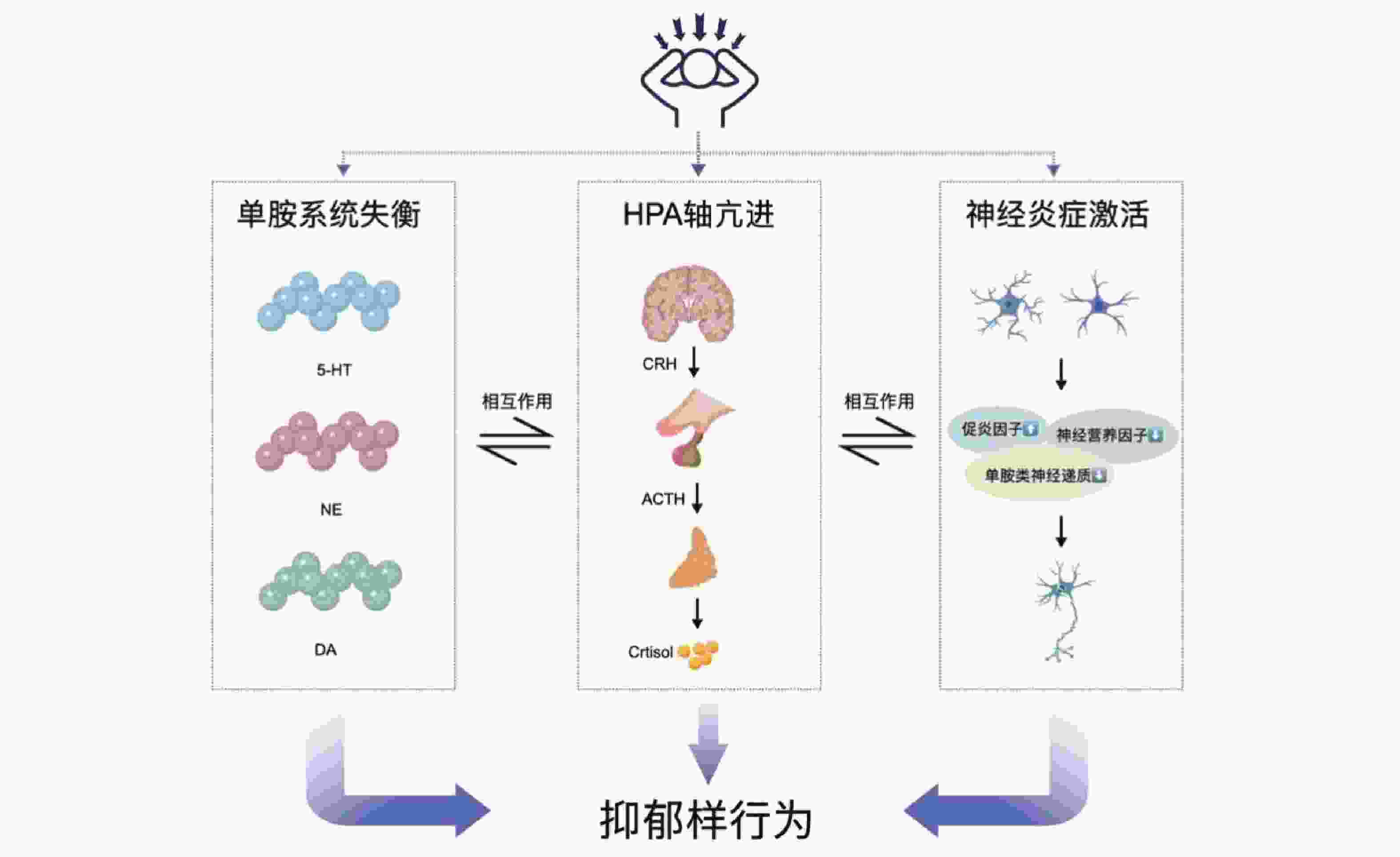
图 1 HPA轴-单胺系统-神经炎症交互机制模式图
Figure 1. Schematic diagram of the interactive mechanism among HPA axis,monoamine system and neuroinflammation
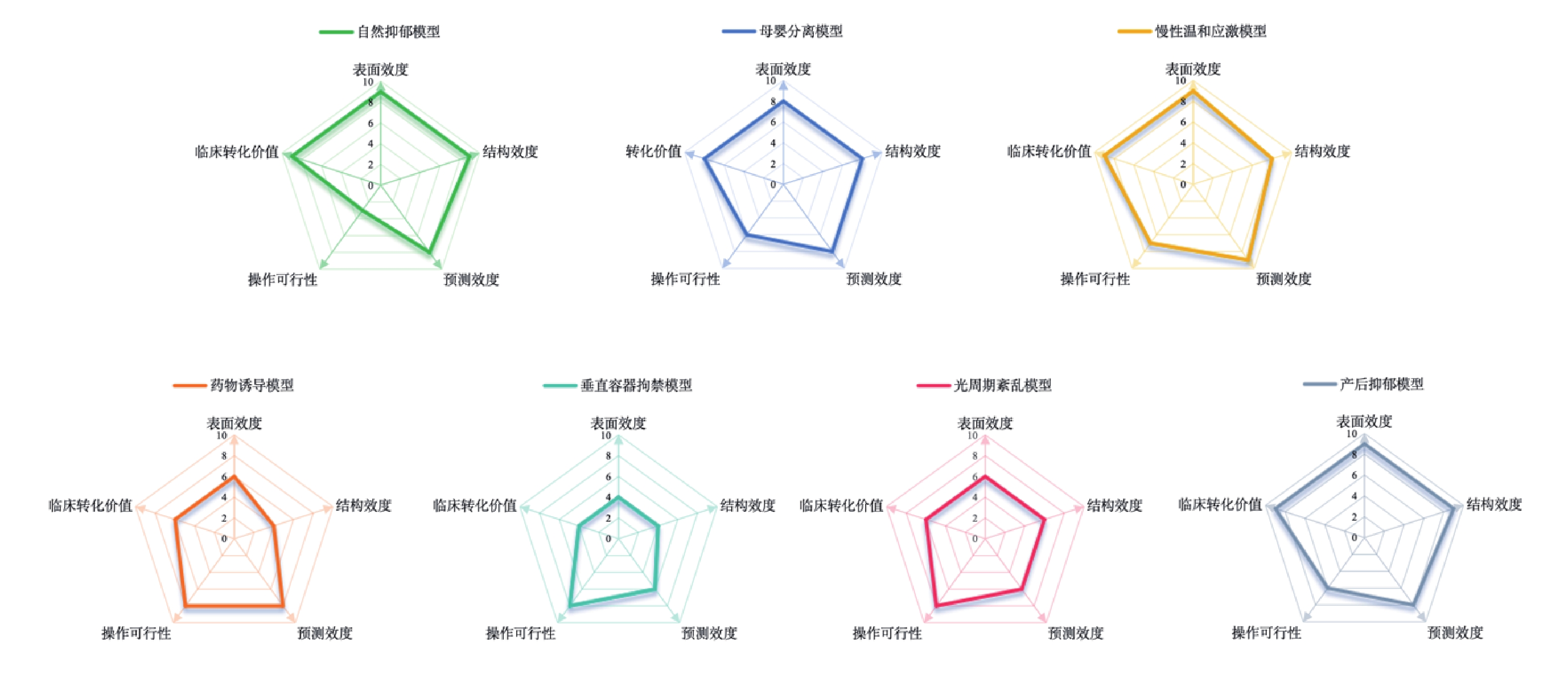
表 1 非人灵长类抑郁模型核心特征对比
Table 1. Comparison of core characteristics of non-human primate depression models
模型种类 造模方法 造模周期 模型优势 模型局限 自然抑郁模型 群体饲养中自然形成社会等级,筛选低地位且表现抑郁样行为个体 / 贴近人类自然发病场景,无人工干预偏倚;病理进程贴近临床 建模周期长、个体差异大、自然发病占比仅 0.2%,样本量少 母婴分离模型 婴猴6个月大时,将母猴与婴猴分离 10~14 d 模拟人类早期创伤诱因,结构效度高,机制明确 仅聚焦早期应激,无法覆盖其他病因,造模过程涉及幼崽伦理争议 慢性温和应激模型 每日随机给予噪音、水剥夺、食物剥夺、寒冷刺激、空间限制、足部电击、频闪灯等刺激 2个月 造模周期短、可重复性强、操作简便;复刻负性生活事件致病机制 抑郁状态维持时间短;应激引发的焦虑易与抑郁行为混淆 药物诱导模型 注射长效糖皮质激素或IFN-α 4~6周 造模周期短,表面效度及结构效度上可靠性较高 停药后抑郁表型快速逆转,无法用于慢性病程、复发机制研究 垂直容器拘禁模型 将实验猴置于倒梯形垂直笼中拘禁 1~2个月 造模简单、成本低、重复性好 空间束缚造成躯体不适,干扰行为判定;行为本质存在争议,预测效度不足 光周期紊乱模型 将12h光照/12h黑暗周期调整为5h光照/19h黑暗 3个月 无创操作、重复性强;模拟现代人生物钟紊乱诱因,病因贴近生活 造模周期长、行为表型稳定性差,需长期监测;光周期改变同时影响睡眠、进食,干扰成模指标判断 产后抑郁模型 观察自然分娩母猴行为,筛选出现异常表型的个体 1个月 完全自发造模,无外源性干预;高度复刻人类产后抑郁表型,转化价值高 自然发生率低,个体差异大;发病时间、症状程度不可控,重复性差  下载: 导出CSV
表 2 非人灵长类抑郁模型构建策略与表型谱
Table 2. Construction strategies and phenotypic spectrum of depression models in non-human primates
诱因 模型种类 核心行为表型 核心生理改变 临床对应症状/亚型 社会社交源性刺激 自然抑郁模型 蜷缩样行为与独坐增多、自主活动与探索行为减少、社交退缩 HPA轴长期过度激活,毛发皮质醇水平持续升高 心境低落,社交障碍 应激源性刺激 母婴分离模型 反抗期:发声、活动量增加;绝望期:蜷缩、动作迟缓、自我抓握 HPA轴永久性功能损伤,皮质醇稳态失衡 快感缺失,伴随失眠、食欲紊乱、精神运动迟滞 慢性温和应激模型 蜷缩样行为、自主活动减少、摄食异常、快感缺失 小胶质细胞活化释放 IL-6、TNF-α 诱发神经炎症,损伤单胺能神经元 快感缺失,并伴随焦虑与抑郁共病 垂直容器拘禁模型 蜷缩样行为和自我抓握行为增加,自主活动、探索行为和社交行为减少 长期激活 HPA 轴,糖皮质激素持续升高;5-HT、DA、NE单胺递质代谢紊乱 快感缺失、精神运动性迟缓、社交障碍 药物源性刺激 药物诱导模型 蜷缩样行为和自我导向性行为增加,探索行为减少,快感缺失 外周刺激:急性与慢性HPA轴功能障碍;中枢刺激:直接诱发脑内神经炎症,多巴胺、去甲肾上腺素代谢紊乱 快感缺失,高皮质醇血症、库欣综合征相关抑郁 环境节律源性刺激 光周期紊乱模型 蜷缩样行为增加,自主活动、反应行为减少,快感缺失,体重下降及高皮质醇水平 视交叉上核生物钟功能紊乱;HPA 轴过度激活,皮质醇节律紊乱 季节性情感障碍、熬夜/轮班/昼夜颠倒诱发抑郁 生理内分泌源性刺激 产后抑郁模型 蜷缩样行为及情感依附行为增多 中枢单胺递质失衡;催产素、催乳素分泌紊乱,脑内促炎因子升高 心境低落、母婴依恋障碍、丧失照料兴趣
下载: 导出CSV
-
[1] Liu L, Wang H, Chen X, et al. Gut microbiota and its metabolites in depression: From pathogenesis to treatment[J]. EBioMedicine, 2023, 90: 104527. doi: 10.1016/j.ebiom.2023.104527 [2] Wang Y, Zhu J, Zhou J. Disease burden and attributable risk factors of major depressive disorder in China, Japan, and South Korea from 1990 to 2021 and its prediction to 2035[J]. Front Public Health, 2025, 13: 1510091. doi: 10.3389/fpubh.2025.1510091 [3] Cui L, Li S, Wang S, et al. Major depressive disorder: Hypothesis, mechanism, prevention and treatment[J]. Signal Transduct Target Ther, 2024, 9: 30. doi: 10.1038/s41392-024-01738-y [4] Yamamoto M, Hirakata H, Toda K. Neural signaling mechanisms in depression: Bridging classical monoamine hypotheses, animal models, and emerging antidepressant strategies[J]. Front Cell Dev Biol, 2026, 14: 1777975. doi: 10.3389/fcell.2026.1777975 [5] Eugene A R. Country-specific psychopharmacological risk of reporting suicidality comparing 38 antidepressants and lithium from the FDA Adverse Event Reporting System, 2017–2023[J]. Front Psychiatry, 2024, 15: 1442490. doi: 10.3389/fpsyt.2024.1442490 [6] 王宏, 季维智, 司维. 非人灵长类生物医学与人类健康[J]. 昆明理工大学学报(自然科学版), 2024, 49(4): 211-220. doi: 10.16112/j.cnki.53-1223/n.2024.04.661 [7] Murphy J M. Depression and anxiety in relation to social status: A prospective epidemiologic study[J]. Arch Gen Psychiatry, 1991, 48(3): 223. doi: 10.1001/archpsyc.1991.01810270035004 [8] Shively C A. Social subordination stress, behavior, and central monoaminergic function in female Cynomolgus monkeys[J]. Biol Psychiatry, 1998, 44(9): 882-891. doi: 10.1016/S0006-3223(97)00437-X [9] Wu J, Li Y, Huang Y, et al. Integrating spatial and single-nucleus transcriptomic data elucidates microglial-specific responses in female Cynomolgus macaques with depressive-like behaviors[J]. Nat Neurosci, 2023, 26(8): 1352-1364. doi: 10.1038/s41593-023-01379-4 [10] Sun L J, Zhang L M, Liu D, et al. The faster-onset antidepressant effects of hypidone hydrochloride (YL-0919)[J]. Metab Brain Dis, 2019, 34(5): 1375-1384. doi: 10.1007/s11011-019-00439-8 [11] Qin D, Rizak J, Chu X, et al. A spontaneous depressive pattern in adult female Rhesus macaques[J]. Sci Rep, 2015, 5: 11267. doi: 10.1038/srep11267 [12] Chu X. Preliminary validation of natural depression in macaques with acute treatments of the fast-acting antidepressant ketamine[J]. Behav Brain Res, 2019, 360: 60-68. doi: 10.1016/j.bbr.2018.11.044 [13] Merz E C, Myers B, Hansen M, et al. Socioeconomic disparities in hypothalamic-pituitary-adrenal axis regulation and prefrontal cortical structure[J]. Biol Psychiatry Glob Open Sci, 2024, 4(1): 83-96. doi: 10.1016/j.bpsgos.2023.10.004 [14] Correia A S, Cardoso A, Vale N. BDNF unveiled: Exploring its role in major depression disorder serotonergic imbalance and associated stress conditions[J]. Pharmaceutics, 2023, 15(8): 2081. doi: 10.3390/pharmaceutics15082081 [15] Deng F L, Pan J X, Zheng P, et al. Metabonomics reveals peripheral and central short-chain fatty acid and amino acid dysfunction in a naturally occurring depressive model of macaques[J]. Neuropsychiatr Dis Treat, 2019, 15: 1077-1088. doi: 10.2147/NDT.S186071 [16] Li W, Luo L Y, Yang X, et al. Depressed female Cynomolgus monkeys (Macaca fascicularis) display a higher second-to-fourth (2D: 4D) digit ratio[J]. Zool Res, 2019, 40(3): 219-225. [17] He Y, Li W, Wang Y, et al. Major depression accompanied with inflammation and multiple cytokines alterations: Evidences from clinical patients to Macaca fascicularis and LPS-induced depressive mice model[J]. J Affect Disord, 2020, 271: 262-271. doi: 10.1016/j.jad.2020.03.131 [18] Bowlby J. Separation anxiety[J]. Int J Psychoanal, 1960, 41: 89-113. [19] Worlein J M. Nonhuman primate models of depression: Effects of early experience and stress[J]. Ilar j, 2014, 55(2): 259-273. doi: 10.1093/ilar/ilu030 [20] Harlow H F, Suomi S J. Induced depression in monkeys[J]. Behav Biol, 1974, 12(3): 273-296. doi: 10.1016/S0091-6773(74)91475-8 [21] Seay B, Hansen E, Harlow H F. Mother-infant separation in monkeys[J]. J Child Psychol Psychiatry, 1962, 3(3-4): 123-132. doi: 10.1111/j.1469-7610.1962.tb02047.x [22] Feng X, Wang L, Yang S, et al. Maternal separation produces lasting changes in Cortisol and behavior in Rhesus monkeys[J]. Proc Natl Acad Sci U S A, 2011, 108(34): 14312-14317. doi: 10.1073/pnas.1010943108 [23] Boccia M L, Scanlan J M, Laudenslager M L, et al. Juvenile friends, behavior, and immune responses to separation in bonnet macaque infants[J]. Physiol Behav, 1997, 61(2): 191-198. doi: 10.1016/S0031-9384(96)00370-8 [24] Pryce C R, Dettling A C, Spengler M, et al. Deprivation of parenting disrupts development of homeostatic and reward systems in marmoset monkey offspring[J]. Biol Psychiatry, 2004, 56(2): 72-79. doi: 10.1016/j.biopsych.2004.05.002 [25] Strekalova T, Liu Y, Kiselev D, et al. Chronic mild stress paradigm as a rat model of depression: Facts, artifacts, and future perspectives[J]. Psychopharmacology, 2022, 239(3): 663-693. doi: 10.1007/s00213-021-05982-w [26] Teng T, Shively C A, Li X, et al. Chronic unpredictable mild stress produces depressive-like behavior, hypercortisolemia, and metabolic dysfunction in adolescent Cynomolgus monkeys[J]. Transl Psychiatry, 2021, 11: 9. doi: 10.1038/s41398-020-01132-6 [27] Markov D D. Sucrose preference test as a measure of anhedonic behavior in a chronic unpredictable mild stress model of depression: Outstanding issues[J]. Brain Sci, 2022, 12(10): 1287. doi: 10.3390/brainsci12101287 [28] Zhang Z Y, Mao Y, Feng X L, et al. Early adversity contributes to chronic stress induced depression-like behavior in adolescent male Rhesus monkeys[J]. Behav Brain Res, 2016, 306: 154-159. doi: 10.1016/j.bbr.2016.03.040 [29] Yin Y Y, Tian C Y, Fang X X, et al. The faster-onset antidepressant effects of hypidone hydrochloride (YL-0919) in monkeys subjected to chronic unpredictable stress[J]. Front Pharmacol, 2020, 11: 586879. doi: 10.3389/fphar.2020.586879 [30] Hassamal S. Chronic stress, neuroinflammation, and depression: An overview of pathophysiological mechanisms and emerging anti-inflammatories[J]. Front Psychiatry, 2023, 14: 1130989. doi: 10.3389/fpsyt.2023.1130989 [31] Johnson S A, Fournier N M, Kalynchuk L E. Effect of different doses of corticosterone on depression-like behavior and HPA axis responses to a novel stressor[J]. Behav Brain Res, 2006, 168(2): 280-288. doi: 10.1016/j.bbr.2005.11.019 [32] Lei A A, Phang V W X, Lee Y Z, et al. Chronic stress-associated depressive disorders: The impact of hpa axis dysregulation and neuroinflammation on the hippocampus-a mini review[J]. Int J Mol Sci, 2025, 26(7): 29-40. [33] Gulbaz Z U A, Mirza S, Naveed S, et al. Towards objective major depressive disorder detection: A systematic review and meta-analysis of diagnostic biomarkers[J]. Psychiatr Q, 2025: ■-■. [34] Sahu M K, Dubey R K, Chandrakar A, et al. A systematic review and meta-analysis of serum and plasma Cortisol levels in depressed patients versus control[J]. Indian J Psychiatry, 2022, 64(5): 440-448. doi: 10.4103/indianjpsychiatry.indianjpsychiatry_561_21 [35] Aukema R J, Petrie G N, Baglot S L, et al. Acute stress activates basolateral amygdala neurons expressing corticotropin-releasing hormone receptor type 1 (CRHR1): Topographical distribution and projection-specific activation in male and female rats[J]. Neurobiol Stress, 2024, 33: 100694. doi: 10.1016/j.ynstr.2024.100694 [36] Georgiou P, Farmer C A, Medeiros G C, et al. Associations between hypothalamic-pituitary-adrenal (HPA) axis hormone levels, major depression features and antidepressant effects of ketamine[J]. J Affect Disord, 2025, 373: 126-132. doi: 10.1016/j.jad.2024.12.036 [37] Yue Y, Zhang J, Li Y, et al. Disruptions of p11 (S100A10) and HPA axis homeostasis participate in the major depressive disorder (MDD) especially in female patients[J]. Neuropsychiatr Dis Treat, 2025, 21: 2237-2249. doi: 10.2147/NDT.S549538 [38] Menke A. The HPA axis as target for depression[J]. Curr Neuropharmacol, 2024, 22(5): 904-915. doi: 10.2174/1570159X21666230811141557 [39] Qin D, Li Z, Li Z, et al. Chronic glucocorticoid exposure induces depression-like phenotype in Rhesus macaque (Macaca mulatta)[J]. Front Neurosci, 2019, 13: 188. doi: 10.3389/fnins.2019.00188 [40] Vorona K, Ryapolova A, Sokolova O, et al. Interferon-based therapeutics in cancer therapy: Past, present, and future[J]. Int J Mol Sci, 2025, 26(23): 11679. doi: 10.3390/ijms262311679 [41] Miller A H. Advancing an inflammatory subtype of major depression[J]. Am J Psychiatry, 2025, 182(6): 516-524. doi: 10.1176/appi.ajp.20250289 [42] Felger J C, Alagbe O, Hu F, et al. Effects of interferon-alpha on Rhesus monkeys: A nonhuman primate model of cytokine-induced depression[J]. Biol Psychiatry, 2007, 62(11): 1324-1333. doi: 10.1016/j.biopsych.2007.05.026 [43] Escalona R, Fawcett J. Pramipexole in treatment resistant-depression, possible role of inflammatory cytokines[J]. Neuropsychopharmacology, 2017, 42(1): 363. doi: 10.1038/npp.2016.217 [44] Li Z, Li Z, Lv X, et al. Intracerebroventricular administration of interferon-alpha induced depressive-like behaviors and neurotransmitter changes in Rhesus monkeys[J]. Front Neurosci, 2020, 14: 585604. doi: 10.3389/fnins.2020.585604 [45] Bekhbat M, Block A M, Dickinson S Y, et al. Neurotransmitter and metabolic effects of interferon-alpha in association with decreased striatal dopamine in a non-human primate model of cytokine-Induced depression[J]. Brain Behav Immun, 2025, 125: 308-318. doi: 10.1016/j.bbi.2025.01.010 [46] Lai J Y, Ho J X, Kow A S F, et al. Interferon therapy and its association with depressive disorders–A review[J]. Front Immunol, 2023, 14: 1048592. doi: 10.3389/fimmu.2023.1048592 [47] Suomi S J, Harlow H F. Depressive behavior in young monkeys subjected to vertical chamber confinement[J]. J Comp Physiol Psychol, 1972, 80(1): 11-18. doi: 10.1037/h0032843 [48] McKinney W T. Vertical-chamber confinement of juvenile-age Rhesus monkeys: A study in experimental psychopathology[J]. Arch Gen Psychiatry, 1972, 26(3): 223. [49] Moran E C. Effects of chlorpromazine on the vertical chamber syndrome in Rhesus monkeys[J]. Arch Gen Psychiatry, 1975, 32(11): 1409. doi: 10.1001/archpsyc.1975.01760290077009 [50] Kim K, Kim J, Jung S, et al. Global prevalence of seasonal affective disorder by latitude: A systematic review and meta-analysis[J]. J Affect Disord, 2025, 390: 119807. doi: 10.1016/j.jad.2025.119807 [51] Qin D, Chu X, Feng X, et al. The first observation of seasonal affective disorder symptoms in Rhesus macaque[J]. Behav Brain Res, 2015, 292: 463-469. doi: 10.1016/j.bbr.2015.07.005 [52] Richardson E, Patterson R, Meltzer-Brody S, et al. Transformative therapies for depression: Postpartum depression, major depressive disorder, and treatment-resistant depression[J]. Annu Rev Med, 2025, 76: 81-93. doi: 10.1146/annurev-med-050423-095712 [53] Pettman D, O’Mahen H, Blomberg O, et al. Effectiveness of cognitive behavioural therapy-based interventions for maternal perinatal depression: A systematic review and meta-analysis[J]. BMC Psychiatry, 2023, 23(1): 208. doi: 10.1186/s12888-023-04547-9 [54] Chu X X, Dominic Rizak J, Yang S C, et al. A natural model of behavioral depression in postpartum adult female cynomolgus monkeys (macaca fascicularis)[J]. Dongwuxue Yanjiu, 2014, 35(3): 174-181. -

 点击查看大图
图(2) / 表(2)
计量
- 文章访问数: 4
- HTML全文浏览量: 3
- PDF下载量: 1
- 被引次数: 0
