




Fall Risk Prediction in Older Inpatients Using Night-Shift Workload and Nursing Indicators
-
摘要:
目的 构建基于夜班护理负荷与护理敏感指标的老年住院患者跌倒风险预测模型,比较Logistic回归、支持向量机和随机森林模型的判别表现,并评价加入病区层夜班资源变量后的模型增益。 方法 采用回顾性病例对照研究,选取2020年1月—2025年12月联勤保障部队第九六〇医院60岁及以上住院患者1 200例,其中夜间跌倒组300例、同期未跌倒组900例。按结局7∶3分层随机分为训练集和验证集,分别构建8项患者层指标模型与增加4项夜班护理负荷指标的联合模型,共同调整抽样相关因素。训练集内完成5折交叉验证、参数选择及分类阈值确定,同时报告训练集表观性能与验证集性能;验证集AUC差异采用配对DeLong检验,并进行Holm校正。 结果 训练集840例、验证集360例。联合Logistic模型中,MFS 25~44分及≥45分、夜间如厕持续协助、夜班护患比≥1∶11与跌倒独立相关(P < 0.05)。仅患者层Logistic、支持向量机和随机森林模型的验证集AUC分别为0.735、0.738和0.750,联合模型分别为0.768、0.765和0.766。相同算法联合模型与患者层模型的AUC差值分别为0.033、0.027和0.016,Holm校正后P值分别为0.170、0.491和0.663;3种联合模型两两比较的校正后P值均为1.000。联合Logistic模型的训练集及验证集AUC分别为0.800和0.768,验证集准确率、精确率、灵敏度、特异度、F1指数及Brier评分分别为0.700、0.440、0.733、0.689、0.550和0.153。 结论 夜班护理负荷与患者层护理指标联合建模可辅助夜间跌倒风险识别,但经多重比较校正后,其判别增益未达统计学显著水平。 Abstract:Objective To develop fall-risk models using patient-level nursing-sensitive indicators and night-shift workload, compare Logistic regression, support vector machine (SVM) and random forest (RF), and assess the incremental discrimination from ward-level workload variables. Methods This retrospective case-control study included 1, 200 inpatients aged 60 years or older from January 2020 to December 2025, comprising 300 night-time fall cases and 900 non-fall controls. Outcome-stratified random splitting produced a training set of 840 patients and a validation set of 360 patients. Patient-only models included eight nursing indicators; joint models added four workload indicators. Both adjusted for sampling-related factors. Five-fold cross-validation, hyperparameter selection and classification-threshold selection were confined to training data. Apparent training performance and validation performance were reported. Paired DeLong tests with Holm correction compared validation AUCs. Results In the joint Logistic model, MFS categories of 25–44 and ≥45, continuous toileting assistance and a night nurse-to-patient ratio ≥1:11 were independently associated with falls (P < 0.05). Validation AUCs of patient-only Logistic, SVM and RF models were 0.735, 0.738 and 0.750; corresponding joint-model AUCs were 0.768, 0.765 and 0.766. AUC differences were 0.033, 0.027 and 0.016, with Holm-adjusted P values of 0.170, 0.491 and 0.663. Adjusted P values for comparisons among the three joint models were all 1.000. The joint Logistic model had a training AUC of 0.800 and a validation AUC of 0.768. Its validation accuracy, precision, sensitivity, specificity, F1 score and Brier score were 0.700, 0.440, 0.733, 0.689, 0.550 and 0.153, respectively. Conclusions Combining patient-level indicators with night-shift workload can assist night-time fall-risk identification, but the discrimination gain was not statistically significant after multiplicity adjustment. -
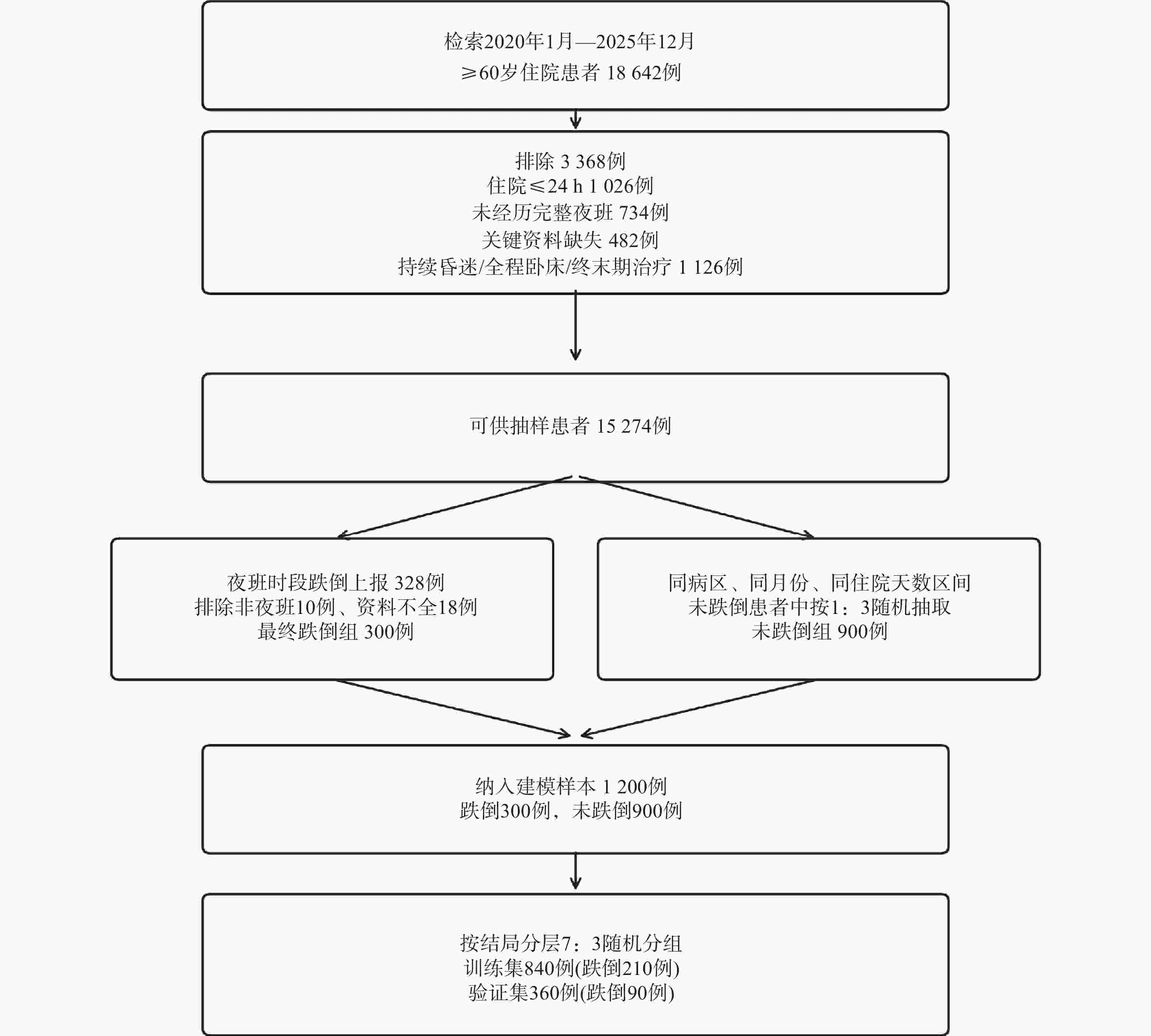
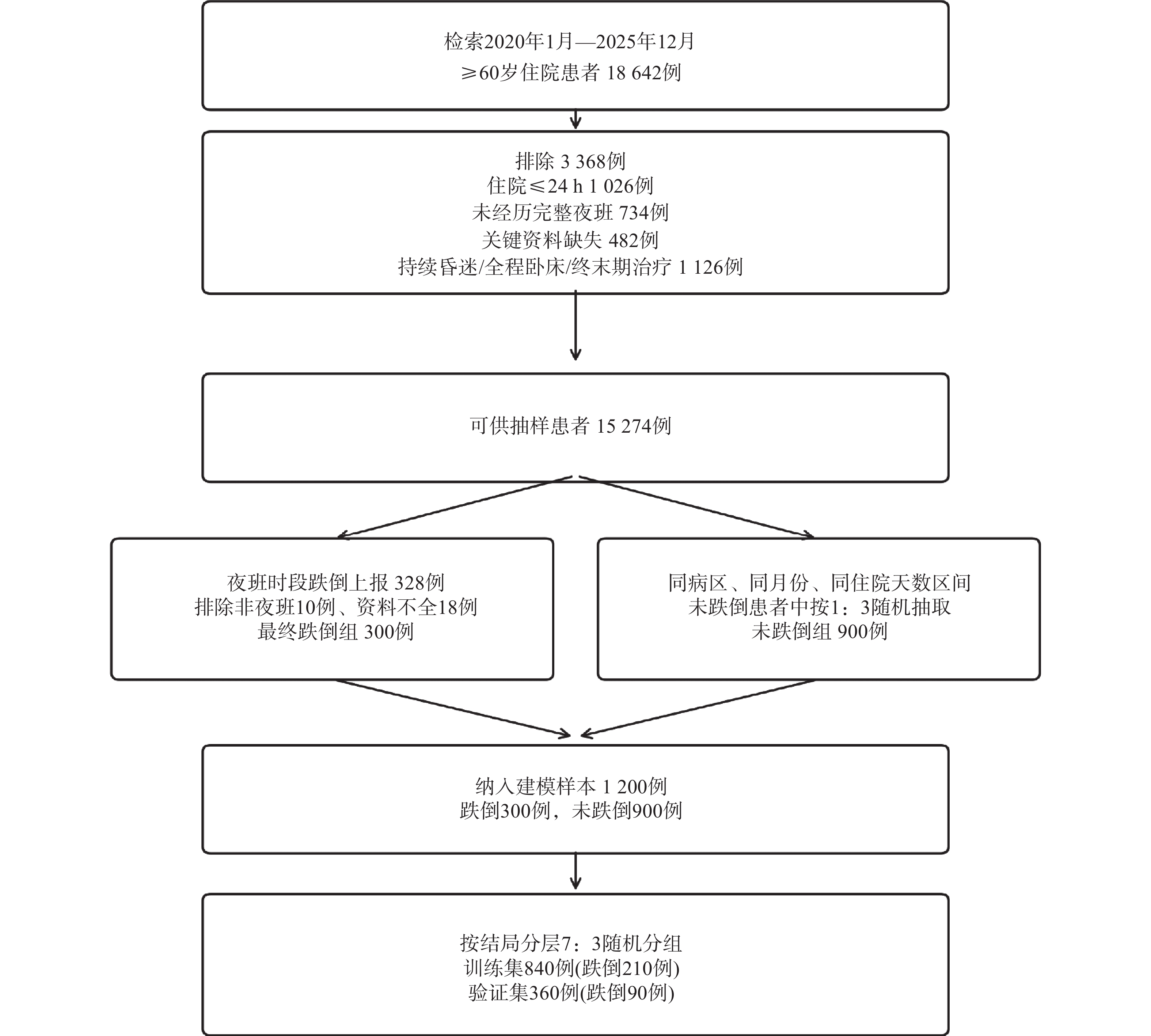
图 1 老年住院患者研究对象选择流程
Figure 1. Flow diagram of participant selection among older inpatients
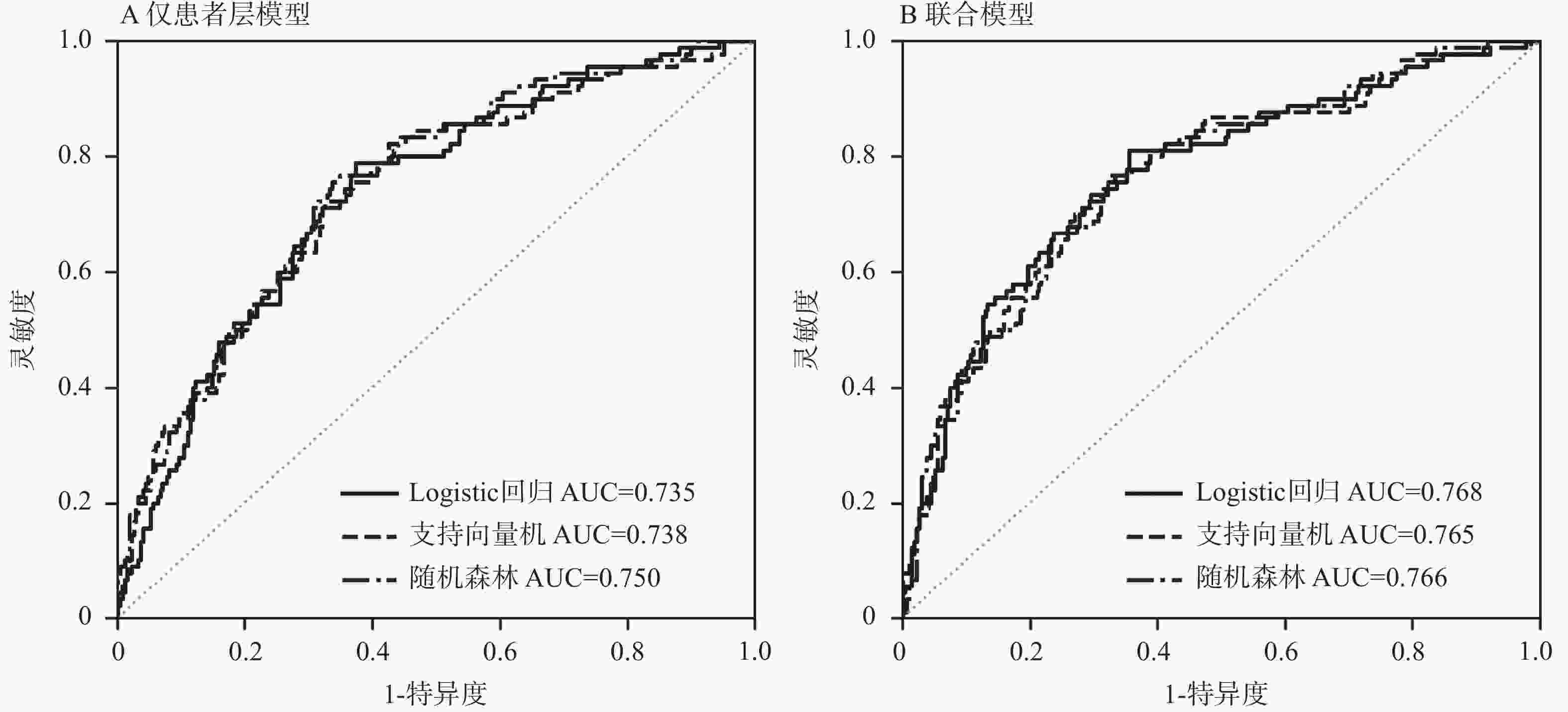
图 2 仅患者层模型与联合模型预测老年住院患者跌倒风险的ROC曲线(验证集)
A:仅患者层模型;B:联合模型;SVM为支持向量机;RF为随机森林。
Figure 2. ROC curves of patient-only and joint models for fall-risk prediction in the validation set
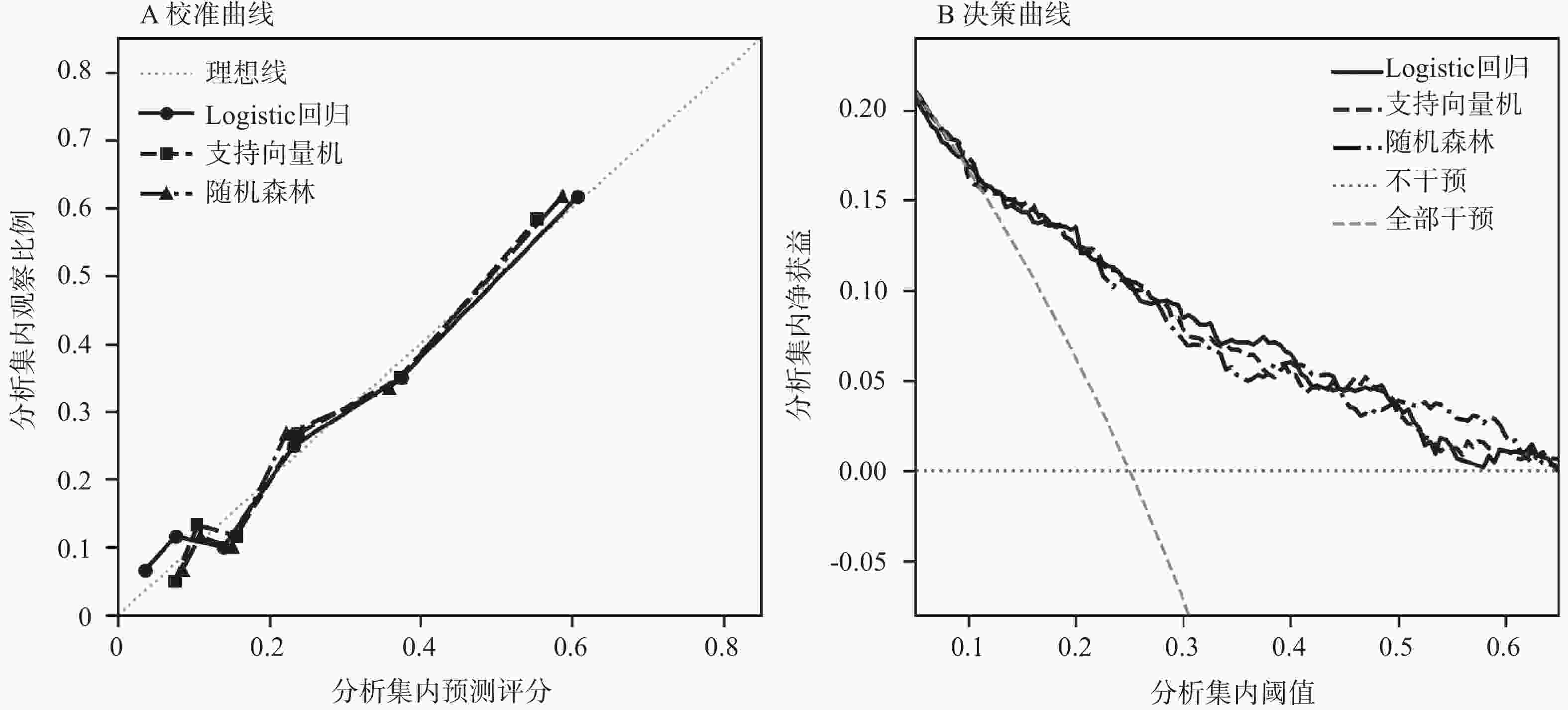
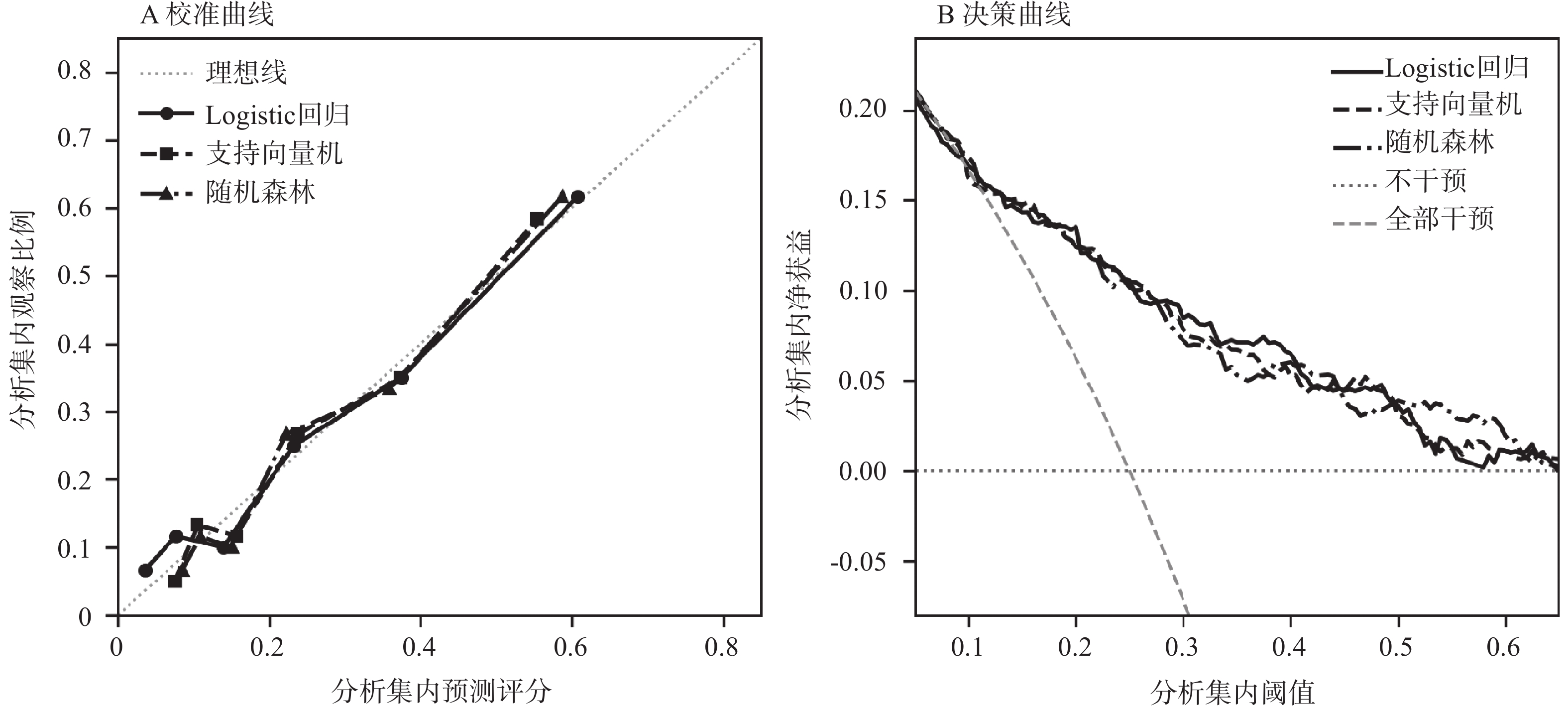
图 3 联合模型在病例对照分析集内的校准曲线与决策曲线(验证集)
注:A为校准曲线;B为决策曲线。DCA为决策曲线分析。
Figure 3. Calibration and decision curves of joint models within the case-control analysis set (validation set)
表 1 训练集与验证集一般资料比较
Table 1. Comparison of baseline characteristics between training and validation sets
项目 训练集(n = 840) 验证集(n = 360) t / χ2 P 年龄($\bar x \pm s $,岁) 74.75 ± 8.10 74.98 ± 8.19 −0.447 0.655 男性 443(52.7) 189(52.5) 0.006 0.940 跌倒 210(25.0) 90(25.0) 0.000 1.000 住院科室 0.177 0.996 老年医学科 188(22.4) 82(22.8) 神经内科 176(21.0) 77(21.4) 康复医学科 158(18.8) 69(19.2) 骨科 164(19.5) 67(18.6) 呼吸与危重症医学科 154(18.3) 65(18.1) BI≤40分 244(29.0) 101(28.1) 0.121 0.728 MFS≥45分 286(34.0) 121(33.6) 0.021 0.884 夜间如厕持续协助 236(28.1) 102(28.3) 0.007 0.933 夜班护患比≥1∶11 228(27.1) 97(26.9) 0.005 0.943 24 h护理时数<3.2 h/床日 186(22.1) 79(21.9) 0.006 0.939 注:计量资料以均数 ± 标准差表示,计数资料以例(%)表示;BI为Barthel指数;MFS为Morse跌倒评估量表。  下载: 导出CSV
表 2 老年住院患者跌倒的单因素分析(训练集,n = 840)
Table 2. Univariate analysis of falls in older inpatients in the training set (n = 840)
项目 未跌倒组(n = 630) 跌倒组(n = 210) Z/χ2 P BI分层 −8.178 <0.001 >60分 248(39.4) 34(16.2) 41~60分 244(38.7) 70(33.3) ≤40分 138(21.9) 106(50.5) MFS分层 −9.219 <0.001 <25分 184(29.2) 16(7.6) 25~44分 284(45.1) 70(33.3) ≥45分 162(25.7) 124(59.0) 夜间如厕协助级别 −9.515 <0.001 无需协助 236(37.5) 24(11.4) 间歇协助 268(42.5) 76(36.2) 持续协助 126(20.0) 110(52.4) 夜间睡眠中断次数 −8.561 <0.001 0~1次 278(44.1) 36(17.1) 2~3次 245(38.9) 84(40.0) ≥4次 107(17.0) 90(42.9) 固定夜间陪护 45.141 <0.001 是 412(65.4) 82(39.0) 否 218(34.6) 128(61.0) 首次离床陪同 39.514 <0.001 是 526(83.5) 132(62.9) 否 104(16.5) 78(37.1) 呼叫铃响应时间 −8.458 <0.001 ≤3 min 418(66.3) 74(35.2) >3~5 min 164(26.0) 86(41.0) >5 min 48(7.6) 50(23.8) 高危时段重点巡视完成情况 31.109 <0.001 是 514(81.6) 132(62.9) 否 116(18.4) 78(37.1) 夜班护患比 −8.549 <0.001 ≤1∶9 252(40.0) 32(15.2) 1∶10 252(40.0) 76(36.2) ≥1∶11 126(20.0) 102(48.6) 24 h护理时数 −7.142 <0.001 ≥3.6 h/床日 248(39.4) 38(18.1) 3.2~<3.6 h/床日 276(43.8) 92(43.8) <3.2 h/床日 106(16.8) 80(38.1) 夜班新入转入量 −7.519 <0.001 0~1人 302(47.9) 46(21.9) 2~3人 226(35.9) 88(41.9) ≥4人 102(16.2) 76(36.2) 夜班资深护士占比 −7.460 <0.001 ≥40% 234(37.1) 30(14.3) 30%~<40% 262(41.6) 88(41.9) <30% 134(21.3) 92(43.8) 注:计量资料以均数 ± 标准差表示,计数资料以例(%)表示;BI为Barthel指数;MFS为Morse跌倒评估量表。
下载: 导出CSV
表 3 多因素Logistic回归自变量赋值方式
Table 3. Assignment of independent variables in multivariable Logistic regression
自变量 赋值方式或参照类别 BI分层 >60分*;41~60分;≤40分 MFS分层 <25分*;25~44分;≥45分 夜间如厕协助级别 无需协助*;间歇协助;持续协助 夜间睡眠中断次数 0~1次*;2~3次;≥4次 无固定夜间陪护 有=0,无=1 首次离床未陪同 陪同=0,未陪同=1 呼叫铃响应时间 ≤3 min*;>3~5 min;>5 min 高危时段重点巡视未完成 完成=0,未完成=1 夜班护患比 ≤1∶9*;1∶10;≥1∶11 24 h护理时数 ≥3.6 h/床日*;3.2~<3.6 h/床日;<3.2 h/床日 夜班新入转入量 0~1人*;2~3人;≥4人 夜班资深护士占比 ≥40%*;30%~<40%;<30% 注:*表示参照类别。
下载: 导出CSV
4A 仅患者层Logistic模型回归参数(训练集,n = 840)
4A. Regression parameters of the patient-only Logistic model (training set,n = 840)
变量 β SE χ2 P OR(95%CI) 常量 −2.302 0.510 20.339 <0.001 — BI分层 41~60分(参照:>60分) −0.058 0.267 0.047 0.829 0.944(0.559~1.593) BI分层 ≤40分(参照:>60分) 0.406 0.309 1.725 0.189 1.501(0.819~2.753) MFS分层 25~44分(参照:<25分) 0.622 0.324 3.681 0.055 1.863(0.987~3.516) MFS分层 ≥45分(参照:<25分) 1.149 0.360 10.194 0.001 3.154(1.558~6.384) 夜间如厕协助级别 间歇协助(参照:无需协助) 0.426 0.284 2.256 0.133 1.532(0.878~2.671) 夜间如厕协助级别 持续协助(参照:无需协助) 0.990 0.332 8.881 0.003 2.692(1.403~5.162) 夜间睡眠中断次数 2~3次(参照:0~1次) 0.356 0.254 1.967 0.161 1.427(0.868~2.347) 夜间睡眠中断次数 ≥4次(参照:0~1次) 0.492 0.313 2.479 0.115 1.636(0.886~3.020) 无固定夜间陪护 −0.015 0.223 0.004 0.948 0.986(0.637~1.526) 首次离床未陪同 0.003 0.234 0.000 0.991 1.003(0.633~1.587) 呼叫铃响应时间 >3~5 min(参照:≤3 min) 0.188 0.232 0.655 0.418 1.207(0.766~1.902) 呼叫铃响应时间 >5 min(参照:≤3 min) 0.368 0.318 1.333 0.248 1.444(0.774~2.696) 高危时段重点巡视未完成 −0.143 0.233 0.377 0.539 0.867(0.550~1.367) 住院科室 神经内科(参照:老年医学科) −0.147 0.266 0.305 0.581 0.863(0.513~1.454) 住院科室 康复医学科(参照:老年医学科) −0.094 0.277 0.116 0.734 0.910(0.528~1.568) 住院科室 骨科(参照:老年医学科) −0.341 0.280 1.485 0.223 0.711(0.411~1.231) 住院科室 呼吸与危重症医学科(参照:老年医学科) −0.422 0.287 2.165 0.141 0.656(0.374~1.150) 入院年份 2021年(参照:2020年) 0.141 0.326 0.189 0.664 1.152(0.608~2.181) 入院年份 2022年(参照:2020年) 0.105 0.311 0.114 0.735 1.111(0.603~2.045) 入院年份 2023年(参照:2020年) −0.014 0.308 0.002 0.963 0.986(0.539~1.804) 入院年份 2024年(参照:2020年) −0.284 0.322 0.775 0.379 0.753(0.400~1.416) 入院年份 2025年(参照:2020年) 0.156 0.313 0.250 0.617 1.169(0.633~2.161) 入院月份 2月(参照:1月) −0.044 0.450 0.009 0.923 0.957(0.396~2.313) 入院月份 3月(参照:1月) −0.083 0.440 0.035 0.851 0.921(0.389~2.179) 入院月份 4月(参照:1月) −0.464 0.431 1.161 0.281 0.629(0.270~1.462) 入院月份 5月(参照:1月) 0.428 0.411 1.085 0.298 1.535(0.685~3.438) 入院月份 6月(参照:1月) −0.019 0.426 0.002 0.964 0.981(0.426~2.259) 入院月份 7月(参照:1月) 0.076 0.427 0.031 0.859 1.078(0.467~2.488) 入院月份 8月(参照:1月) 0.122 0.453 0.073 0.788 1.130(0.465~2.747) 入院月份 9月(参照:1月) −0.111 0.451 0.060 0.806 0.895(0.370~2.165) 入院月份 10月(参照:1月) −0.160 0.441 0.132 0.717 0.852(0.359~2.021) 入院月份 11月(参照:1月) −0.320 0.450 0.506 0.477 0.726(0.301~1.753) 入院月份 12月(参照:1月) −0.488 0.474 1.060 0.303 0.614(0.243~1.553) 住院日 8~14 d(参照:1~7 d) −0.510 0.213 5.725 0.017 0.601(0.396~0.912) 住院日 ≥15 d(参照:1~7 d) −0.400 0.236 2.864 0.091 0.670(0.422~1.065) 注:β为回归系数;SE为标准误;OR为比值比;CI为置信区间;“—”表示不适用。
下载: 导出CSV
4B 联合Logistic模型回归参数(训练集,n = 840)
4B. Regression parameters of the joint Logistic model (training set,n = 840)
变量 β SE χ2 P OR(95%CI) 常量 −3.206 0.581 30.450 <0.001 — BI分层 41~60分(参照:>60分) −0.126 0.279 0.205 0.650 0.881(0.510~1.523) BI分层 ≤40分(参照:>60分) 0.287 0.321 0.800 0.371 1.332(0.711~2.497) MFS分层 25~44分(参照:<25分) 0.668 0.330 4.083 0.043 1.950(1.020~3.727) MFS分层 ≥45分(参照:<25分) 1.169 0.369 10.065 0.002 3.220(1.564~6.631) 夜间如厕协助级别 间歇协助(参照:无需协助) 0.513 0.290 3.138 0.076 1.670(0.947~2.946) 夜间如厕协助级别 持续协助(参照:无需协助) 1.020 0.338 9.112 0.003 2.772(1.430~5.374) 夜间睡眠中断次数 2~3次(参照:0~1次) 0.285 0.261 1.193 0.275 1.330(0.797~2.220) 夜间睡眠中断次数 ≥4次(参照:0~1次) 0.279 0.322 0.749 0.387 1.321(0.703~2.484) 无固定夜间陪护 −0.048 0.230 0.043 0.835 0.953(0.608~1.495) 首次离床未陪同 −0.094 0.245 0.148 0.701 0.910(0.563~1.471) 呼叫铃响应时间 >3~5 min(参照:≤3 min) 0.115 0.241 0.227 0.633 1.122(0.700~1.797) 呼叫铃响应时间 >5 min(参照:≤3 min) 0.232 0.332 0.488 0.485 1.261(0.658~2.414) 高危时段重点巡视未完成 −0.126 0.239 0.278 0.598 0.882(0.552~1.408) 夜班护患比 1∶10(参照:≤1∶9) 0.429 0.275 2.434 0.119 1.535(0.896~2.630) 夜班护患比 ≥1∶11(参照:≤1∶9) 1.001 0.320 9.783 0.002 2.722(1.453~5.098) 24 h护理时数 3.2~<3.6 h/床日(参照:≥3.6 h/床日) −0.042 0.262 0.025 0.873 0.959(0.574~1.603) 24 h护理时数 <3.2 h/床日(参照:≥3.6 h/床日) 0.217 0.330 0.434 0.510 1.243(0.651~2.374) 夜班新入转入量 2~3人(参照:0~1人) 0.189 0.258 0.538 0.463 1.208(0.729~2.004) 夜班新入转入量 ≥4人(参照:0~1人) 0.349 0.315 1.229 0.268 1.417(0.765~2.626) 夜班资深护士占比 30%~<40%(参照:≥40%) 0.321 0.287 1.244 0.265 1.378(0.785~2.420) 夜班资深护士占比 <30%(参照:≥40%) 0.489 0.333 2.154 0.142 1.630(0.849~3.132) 住院科室 神经内科(参照:老年医学科) −0.145 0.279 0.270 0.604 0.865(0.501~1.494) 住院科室 康复医学科(参照:老年医学科) −0.177 0.291 0.371 0.542 0.838(0.474~1.481) 住院科室 骨科(参照:老年医学科) −0.436 0.291 2.243 0.134 0.647(0.366~1.144) 住院科室 呼吸与危重症医学科(参照:老年医学科) −0.403 0.298 1.825 0.177 0.668(0.372~1.199) 入院年份 2021年(参照:2020年) 0.300 0.338 0.790 0.374 1.350(0.696~2.619) 入院年份 2022年(参照:2020年) 0.316 0.325 0.946 0.331 1.371(0.726~2.592) 入院年份 2023年(参照:2020年) 0.132 0.322 0.167 0.683 1.141(0.607~2.142) 入院年份 2024年(参照:2020年) −0.153 0.341 0.201 0.654 0.858(0.440~1.674) 入院年份 2025年(参照:2020年) 0.212 0.326 0.424 0.515 1.236(0.653~2.340) 入院月份 2月(参照:1月) 0.098 0.475 0.043 0.836 1.103(0.435~2.797) 入院月份 3月(参照:1月) −0.082 0.463 0.032 0.859 0.921(0.372~2.282) 入院月份 4月(参照:1月) −0.431 0.456 0.890 0.345 0.650(0.266~1.590) 入院月份 5月(参照:1月) 0.327 0.430 0.579 0.447 1.387(0.597~3.223) 入院月份 6月(参照:1月) −0.014 0.450 0.001 0.974 0.986(0.408~2.380) 入院月份 7月(参照:1月) 0.027 0.448 0.004 0.952 1.027(0.427~2.473) 入院月份 8月(参照:1月) 0.144 0.473 0.093 0.761 1.155(0.457~2.917) 入院月份 9月(参照:1月) −0.229 0.474 0.233 0.630 0.796(0.314~2.015) 入院月份 10月(参照:1月) −0.182 0.460 0.156 0.693 0.834(0.338~2.055) 入院月份 11月(参照:1月) −0.469 0.475 0.973 0.324 0.626(0.246~1.588) 入院月份 12月(参照:1月) −0.673 0.501 1.806 0.179 0.510(0.191~1.361) 住院日 8~14 d(参照:1~7 d) −0.463 0.221 4.377 0.036 0.629(0.408~0.971) 住院日 ≥15 d(参照:1~7 d) −0.439 0.249 3.103 0.078 0.645(0.396~1.051) 注:β为回归系数;SE为标准误;OR为比值比;CI为置信区间;“—”表示不适用。
下载: 导出CSV
5A 仅患者层模型与联合模型的训练集及验证集性能
5A. Training and validation performance of patient-only and joint models
数据集 模型 准确率 精确率 灵敏度 特异度 F1指数 AUC(95%CI) Brier评分 训练集 仅患者层Logistic 0.764 0.526 0.571 0.829 0.548 0.766(0.729~0.804) 0.152 训练集 仅患者层SVM 0.794 0.573 0.690 0.829 0.626 0.874(0.848~0.900) 0.128 训练集 仅患者层RF 0.621 0.382 0.829 0.552 0.523 0.772(0.736~0.808) 0.154 训练集 联合Logistic 0.698 0.438 0.743 0.683 0.551 0.800(0.767~0.834) 0.143 训练集 联合SVM 0.645 0.403 0.871 0.570 0.551 0.817(0.784~0.849) 0.140 训练集 联合RF 0.657 0.407 0.814 0.605 0.543 0.789(0.754~0.823) 0.148 验证集 仅患者层Logistic 0.736 0.473 0.478 0.822 0.475 0.735(0.677~0.793) 0.164 验证集 仅患者层SVM 0.722 0.455 0.567 0.774 0.505 0.738(0.678~0.798) 0.162 验证集 仅患者层RF 0.622 0.383 0.833 0.552 0.524 0.750(0.693~0.807) 0.160 验证集 联合Logistic 0.700 0.440 0.733 0.689 0.550 0.768(0.710~0.826) 0.153 验证集 联合SVM 0.622 0.381 0.822 0.556 0.521 0.765(0.706~0.823) 0.153 验证集 联合RF 0.656 0.406 0.811 0.604 0.541 0.766(0.709~0.823) 0.154 注:SVM为支持向量机;RF为随机森林;AUC为ROC曲线下面积;CI为置信区间。
下载: 导出CSV
5B 固定分类阈值下的混淆矩阵
5B. Confusion matrices at the fixed classification thresholds
数据集 模型 分类阈值 TP FP FN TN 训练集 仅患者层Logistic 0.359661 120 108 90 522 训练集 仅患者层SVM 0.336505 145 108 65 522 训练集 仅患者层RF 0.172028 174 282 36 348 训练集 联合Logistic 0.226714 156 200 54 430 训练集 联合SVM 0.169004 183 271 27 359 训练集 联合RF 0.182428 171 249 39 381 验证集 仅患者层Logistic 0.359661 43 48 47 222 验证集 仅患者层SVM 0.336505 51 61 39 209 验证集 仅患者层RF 0.172028 75 121 15 149 验证集 联合Logistic 0.226714 66 84 24 186 验证集 联合SVM 0.169004 74 120 16 150 验证集 联合RF 0.182428 73 107 17 163 注:TP为真阳性;FP为假阳性;FN为假阴性;TN为真阴性。
下载: 导出CSV
表 6 验证集各模型AUC差异
Table 6. Differences in validation AUCs between models
模型比较 ΔAUC(95%CI) Z P P(校正) 联合Logistic-仅患者层Logistic 0.033(0.004~0.063) 2.193 0.028 0.170 联合SVM-仅患者层SVM 0.027(−0.005~0.059) 1.653 0.098 0.491 联合RF-仅患者层RF 0.016(−0.007~0.040) 1.386 0.166 0.663 联合RF-联合Logistic −0.002(−0.029~0.025) −0.128 0.898 1.000 联合RF-联合SVM 0.001(−0.012~0.014) 0.184 0.854 1.000 联合SVM-联合Logistic −0.003(−0.023~0.017) −0.288 0.774 1.000 注:ΔAUC为前一模型AUC减去后一模型AUC;CI为置信区间。
下载: 导出CSV
表 7 联合随机森林模型中护理指标的重要性排序
Table 7. Importance ranking of nursing indicators in the joint random forest model
变量 重要性 排序 变量 重要性 排序 MFS分层 0.183 1 夜班新入转入量 0.060 7 夜间如厕协助级别 0.177 2 无固定夜间陪护 0.057 8 夜班护患比 0.122 3 呼叫铃响应时间 0.057 9 BI分层 0.088 4 24 h护理时数 0.050 10 夜间睡眠中断次数 0.079 5 首次离床未陪同 0.039 11 夜班资深护士占比 0.066 6 高危时段重点巡视未完成 0.022 12
下载: 导出CSV
表 8 疫情时期分层资料比较
Table 8. Stratified comparison according to the COVID-19 period
项目 2020—2022年(n = 570) 2023—2025年(n = 630) χ2 P 跌倒 147(25.8) 153(24.3) 0.361 0.548 夜班护患比≥1∶11 156(27.4) 169(26.8) 0.045 0.833 24 h护理时数<3.2 h/床日 121(21.2) 144(22.9) 0.462 0.497 无固定夜间陪护 229(40.2) 265(42.1) 0.440 0.507 注:数据以例数(%)表示。
下载: 导出CSV
-
[1] 岳跃学, 贾玉玲, 王秀红. 老年人跌倒风险预测模型研究进展[J]. 护理研究, 2022, 36(16): 2944-2948. doi: 10.12102/j.issn.1009-6493.2022.16.022 [2] 赵敏, 苏晓霞, 李曙光, 等. 跌倒对患者住院时间及费用影响的研究[J]. 中国护理管理, 2021, 21(07): 1074-1078. doi: 10.3969/j.issn.1672-1756.2021.07.022 [3] 李冰冰, 张晓萌, 张艳. 住院患者跌倒风险评估工具及预测模型研究进展[J/OL]. 中华临床医师杂志(电子版), 2023, 17(11): 1192-1195. [4] 任媛渊, 丁福, 徐志会, 等. 住院患者跌倒风险预测模型的研究现状[J]. 实用临床医药杂志, 2023, 27(08): 144-148. doi: 10.7619/jcmp.20230036 [5] 戴倩, 熊小燕, 陆旭婷, 等. 用药数量和Barthel指数对住院老年人跌倒的影响[J]. 实用老年医学, 2024, 38(03): 312-316. doi: 10.3969/j.issn.1003-9198.2024.03.024 [6] 刘墩秀, 丁福, 朱跃平, 等. 汉化版Morse跌倒评估量表和HendrichⅡ跌倒因素模型量表在老年住院患者跌倒风险评估中的适用性比较[J]. 中国护理管理, 2020, 20(08): 1168-1172. doi: 10.3969/j.issn.1672-1756.2020.08.011 [7] 国家卫生健康委办公厅. 护理专业医疗质量控制指标(2020年版)[S/OL]. 北京: 国家卫生健康委办公厅, 2020. [8] Dall'Ora C, Saville C, Rubbo B, et al. Nurse staffing levels and patient outcomes: a systematic review of longitudinal studies[J]. International Journal of Nursing Studies, 2022, 129: 104311. doi: 10.1101/2021.09.17.21263699 [9] Moriwaki M, Kakehashi M, Hayashida K, et al. Impact of Nurse Staffing Levels on Patient Fall Rates: A Retrospective Cross-Sectional Study in General Wards in Japan[J]. Healthcare, 2025, 13(1): 88. doi: 10.3390/healthcare13010088 [10] 杜美晨, 汪晖, 刘于, 等. 护理人力资源配置评价指标的范围综述[J]. 中华护理杂志, 2023, 58(03): 366-373. doi: 10.3761/j.issn.0254-1769.2023.03.015 [11] 相爽, 王宾, 苗华, 等. 急性冠脉综合征住院患者跌倒风险评估及影响因素分析[J]. 中华护理杂志, 2023, 58(09): 1082-1087. doi: 10.3761/j.issn.0254-1769.2023.09.009 [12] 吴延, 王广玲, 聂作婷, 等. 2022年版《世界指南: 老年人跌倒的预防与管理》解读[J]. 中国全科医学, 2023, 26(10): 1159-1163, 1171. doi: 10.12114/j.issn.1007-9572.2022.0842 [13] Hsu Y C, Weng H H, Kuo C Y, et al. Prediction of fall events during admission using eXtreme gradient boosting: a comparative validation study[J]. Scientific Reports, 2020, 10: 16777. doi: 10.1038/s41598-020-73776-9 [14] Liu C H, Hu Y H, Lin Y H. A machine learning-based fall risk assessment model for inpatients[J]. CIN: Computers, Informatics, Nursing, 2021, 39(8): 450-459. [15] Chu W M, Kristiani E, Wang Y C, et al. A model for predicting fall risks of hospitalized elderly in Taiwan: a machine learning approach based on both electronic health records and comprehensive geriatric assessment[J]. Frontiers in Medicine, 2022, 9: 937216. doi: 10.3389/fmed.2022.937216 [16] Jung H, Yoo S, Kim S, et al. Patient-Level Fall Risk Prediction Using the Observational Medical Outcomes Partnership's Common Data Model: pilot feasibility study[J]. JMIR Medical Informatics, 2022, 10(3): e35104. doi: 10.2196/35104 [17] 丁湘云, 程艳爽, 黄静, 等. 住院患者跌倒监测系统的研发与临床验证[J]. 解放军医学院学报, 2021, 42(06): 686-690. doi: 10.3969/j.issn.2095-5227.2021.06.019 [18] 付荣娟, 丁福. 临床跌倒防范信息系统的构建及应用[J]. 中华护理杂志, 2024, 59(03): 317-323. doi: 10.3761/j.issn.0254-1769.2024.03.010 [19] Mao A, Su J, Ren M, et al. Risk prediction models for falls in hospitalized older patients: a systematic review and meta-analysis[J]. BMC Geriatrics, 2025, 25(1): 29. doi: 10.1186/s12877-025-05688-0 [20] Xu J, Peng S, Yao L, et al. Clinical characteristics and influencing factors of serious fall injuries among older inpatients: A secondary analysis of multicenter cross-sectional administrative data[J]. International Journal of Nursing Studies, 2025, 161: 104956. doi: 10.1016/j.ijnurstu.2024.104956 -

 点击查看大图
计量
- 文章访问数: 3
- HTML全文浏览量: 4
- PDF下载量: 0
- 被引次数: 0
