




Association Between Hepatitis B Virus Serological Patterns and Hepatocellular Carcinoma: A Case-Control Study
-
摘要:
目的 探讨乙型肝炎病毒(hepatitis b virus,HBV)血清学模式与肝细胞癌(hepatocellular carcinoma,HCC)的关联,并比较血清学模式、单项标志物及五项标志物联合分析对HCC病例与健康对照的区分能力。 方法 采用回顾性病例对照研究,纳入2022年4月8日至2026年4月9日在云南省肿瘤医院住院并经组织病理学检查确诊为HCC患者 2532 例和同期健康体检对照6970 例。定义血清学模式后以全阴模式为参照,采用Firth logistic回归分析各模式与病例-对照分组的关联,估计经年龄非线性效应、性别和地区调整的比值比(odds ratios,OR)及95% 置信区间(confidence interval,CI)。分别建立人口学基础模型、单项标志物模型、五项标志物联合模型和完整模式模型,评估区分度、概率误差及模型间差值的95% CI。结果 共观察到19种血清学模式,最常见者为2+(仅HBsAb阳性,47.51%)、全阴(26.27%)和145+(HBsAg、HBeAb、HBcAb阳性,11.42%)。以全阴为参照,2+与HCC呈负向关联(OR = 0.55,95% CI:0.45~0.68);145+、15+和135+与HCC呈正向关联,调整后OR分别为56.70(95% CI:41.91~76.72)、241.81(95% CI:124.17~470.87)和195.63(95% CI:73.94~517.61)。人口学基础模型、最佳单项标志物模型(HBsAg)、五项标志物联合模型和完整模式模型的交叉验证曲线下面积(area under the curve,AUC)分别为 0.9165 (95% CI:0.9110 ~0.9226 )、0.9649 (95% CI:0.9610 ~0.9685 )、0.9693 (95% CI:0.9657 ~0.9728 )和0.9702 (95% CI:0.9666 ~0.9736 );完整模式模型较五项标志物联合模型的AUC增加0.00088 (95% CI:0.00039 ~0.00139 )。结论 HBV血清学模式与HCC的关联存在明显异质性。五项标志物联合模型对病例与体检对照的区分能力高于单项标志物,但完整模式相较五项标志物联合模型仅有很小的性能增益,其主要价值在于保留并呈现具体的联合血清学表型。 -
关键词:
- 肝细胞癌 /
- 乙型肝炎病毒 /
- 血清学 /
- 病例对照研究 /
- Logistic模型
Abstract:Objective To examine the association between hepatitis B virus (HBV) serological patterns and hepatocellular carcinoma ( HCC), and to compare the discriminative ability of serological patterns, individual markers, and a combined analysis of five markers in distinguishing HCC cases from healthy controls. Methods A retrospective case-control study was conducted, including 2, 532 HCC patients hospitalized at Yunnan Cancer Hospital and confirmed by histopathological examination from April 8, 2022 to April 9, 2026, and 6, 970 healthy physical examination controls during the same period. After defining serological patterns, the fully negative pattern was used as the reference. Firth logistic regression was applied to analyze the association between each pattern and case-control status, and odds ratios (ORs) and 95% confidence intervals (CIs) adjusted for non-linear age effects, sex, and region were estimated. A demographic baseline model, a single-marker model, a five-marker combined model, and a full-pattern model were constructed separately to evaluate discrimination, prediction error, and the 95% CIs of differences between models. Results A total of 19 serological observed, the most common being 2+ (HBsAb positive only, 47.51%), all-negative (26.27%), and 145+ (HBsAg, HBeAb, and HBcAb positive, 11.42%). Compared with the all-negative pattern, 2+ was negatively associated with HCC (OR 0.55, 95% CI: 0.45~0.68); 145+, 15+, and 135+ were positively associated with HCC, with adjusted ORs of 56.70 (95% CI: 41.91~76.72), 241.81 (95% CI: 124.17~470.87), and 195.63 (95% CI: 73.94~517.61), respectively. The cross-validated area under the curve (AUC) for the demographic baseline model, the best single-marker model (HBsAg), the five-marker combined model, and the full-pattern model was 0.9165 (95% CI:0.9110 ~0.9226 ),0.9649 (95% CI:0.9610 ~0.9685 ),0.9693 (95% CI:0.9657 ~0.9728 ), and0.9702 (95% CI:0.9666 ~0.9736 ), respectively; the AUC of the full-pattern model increased by0.00088 (95% CI:0.00039 ~0.00139 ) compared with the five-marker combined model.Conclusion The association between HBV serological patterns and HCC showed marked heterogeneity. The five-marker combined model had better discriminative ability for distinguishing cases from physical examination controls than a single marker, but the full-pattern model provided only a very small performance gain over the five-marker combined model; its main value lies in retaining and presenting specific combined serological phenotypes. -
Key words:
- Hepatocellular carcinoma /
- Hepatitis B virus /
- Serology /
- Case-control studies /
- Logistic models
-
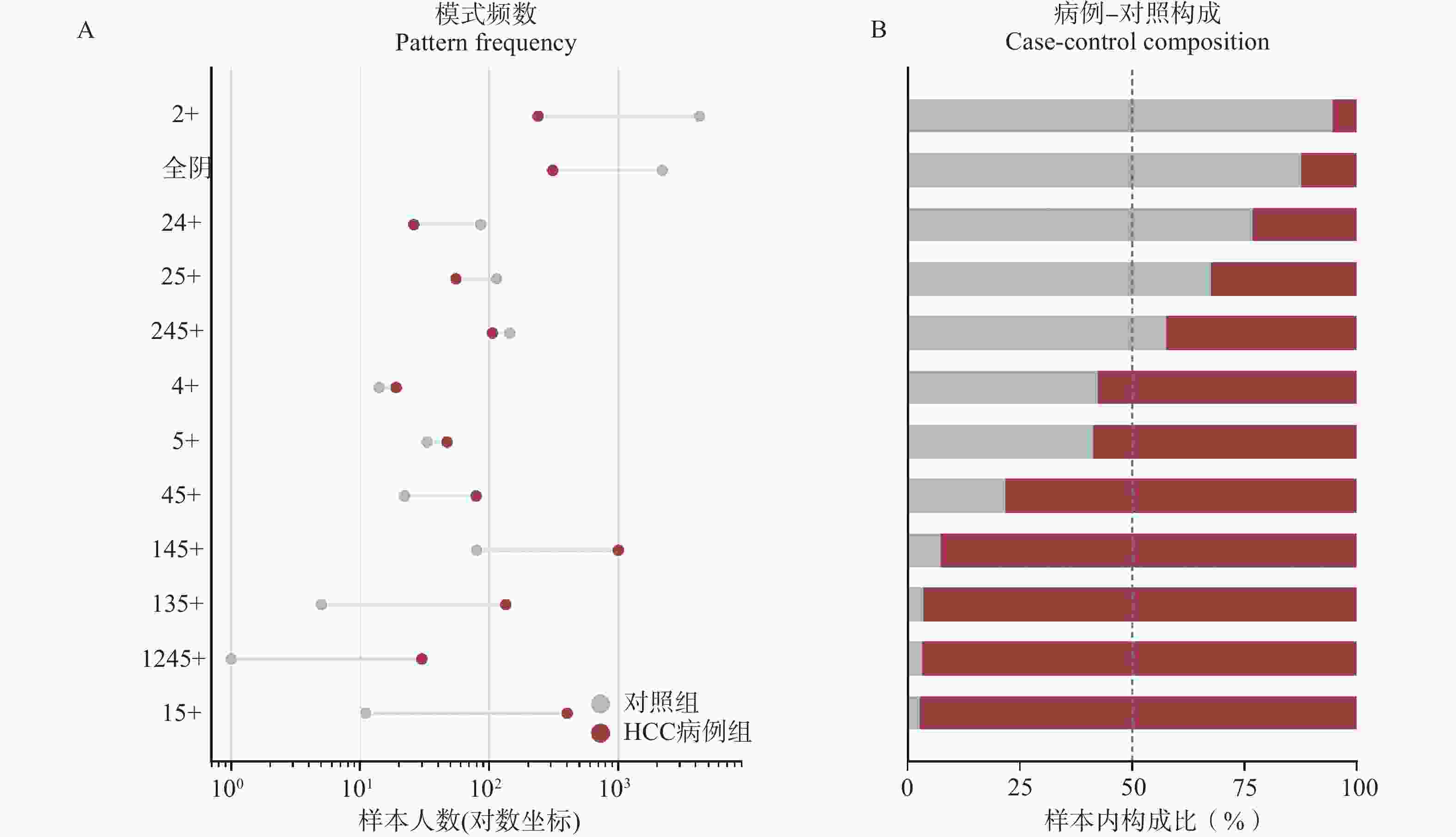
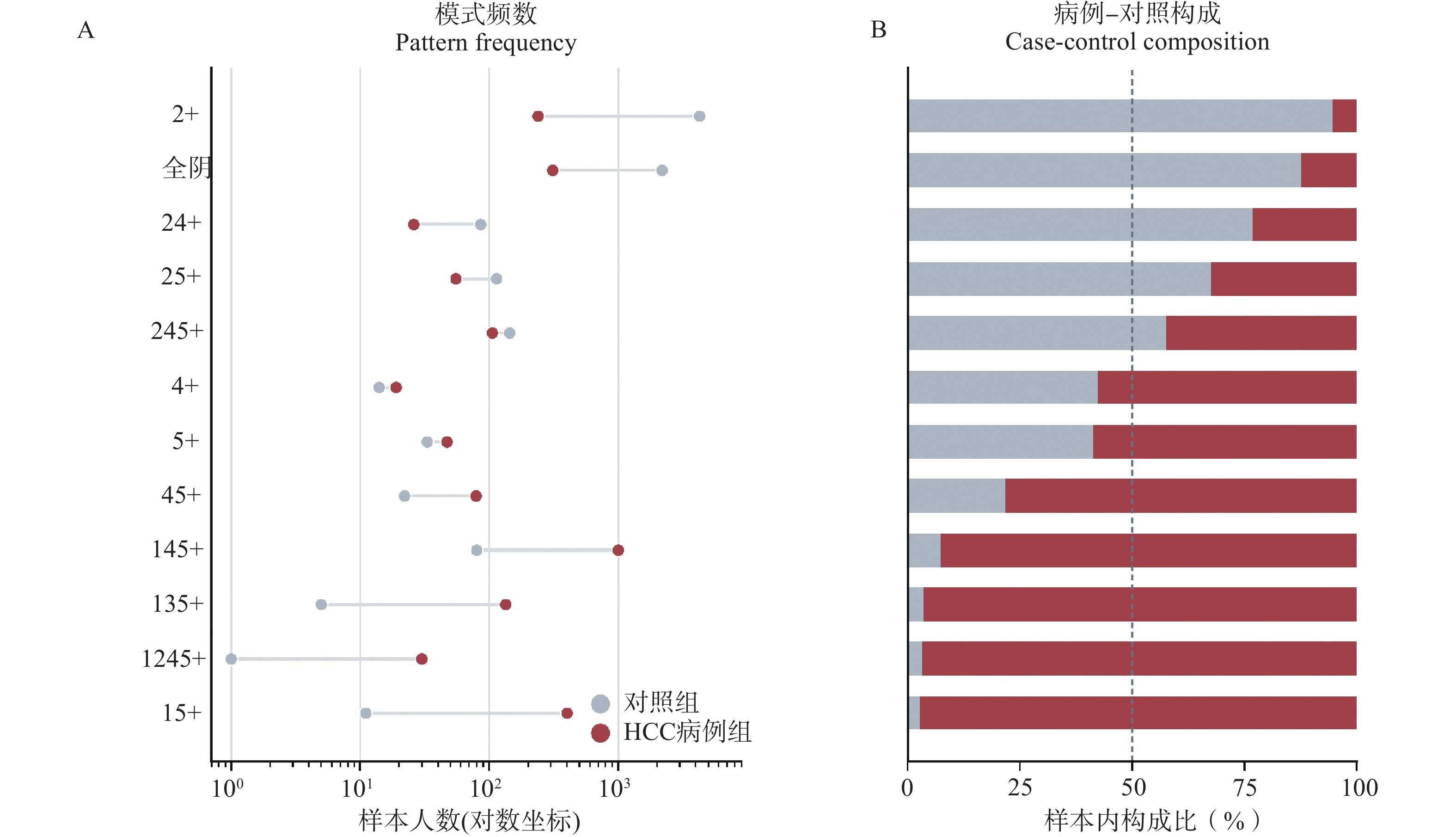
图 1 常见HBV血清学模式在HCC病例与健康体检对照样本中的分布
A:两组绝对人数;B:病例-对照样本内部构成。常见模式定义为n ≥ 30。1~5依次表示HBsAg、HBsAb、HBeAg、HBeAb和HBcAb阳性。
Figure 1. Distribution of common HBV serological patterns in the analytical sample
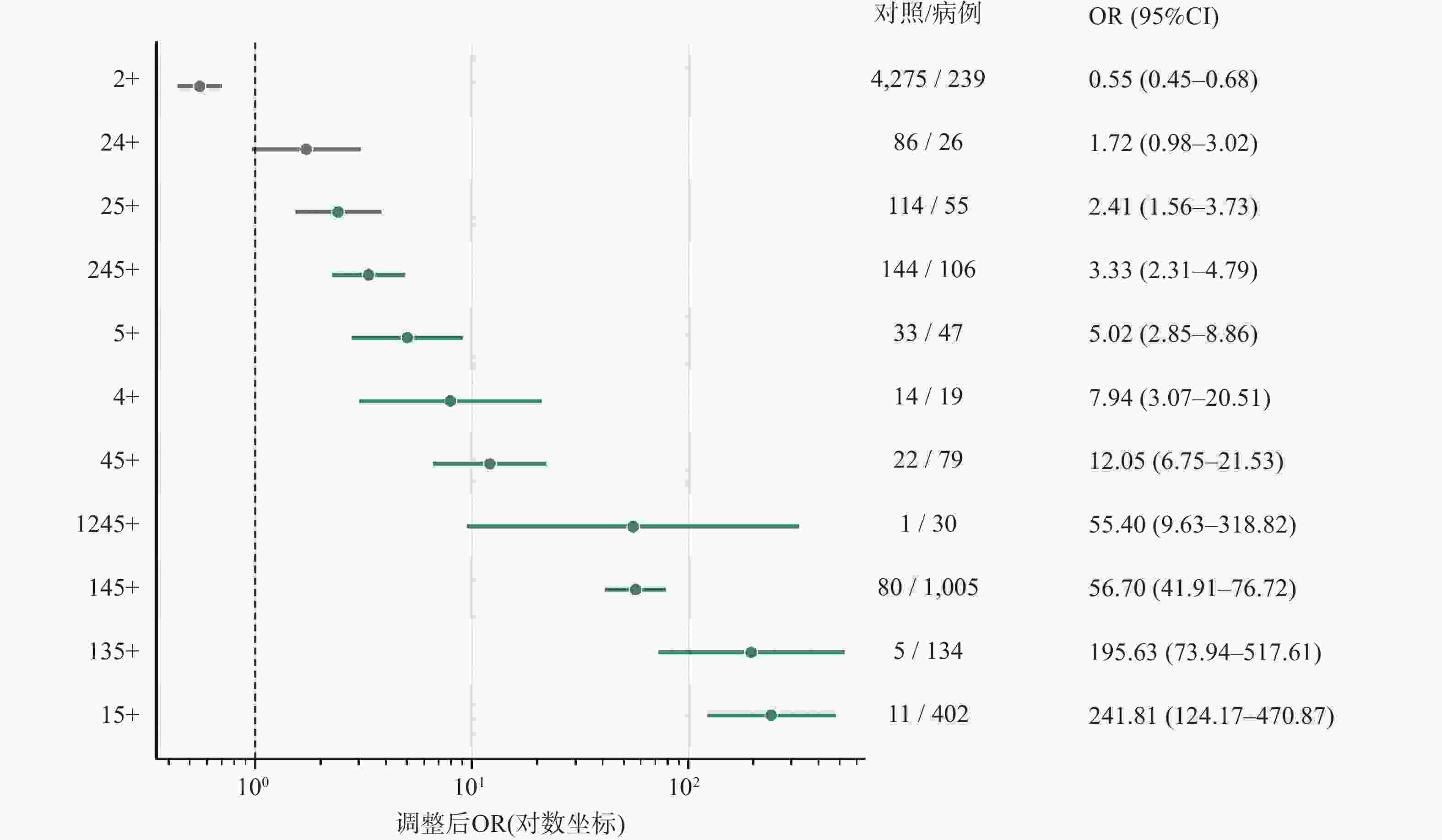
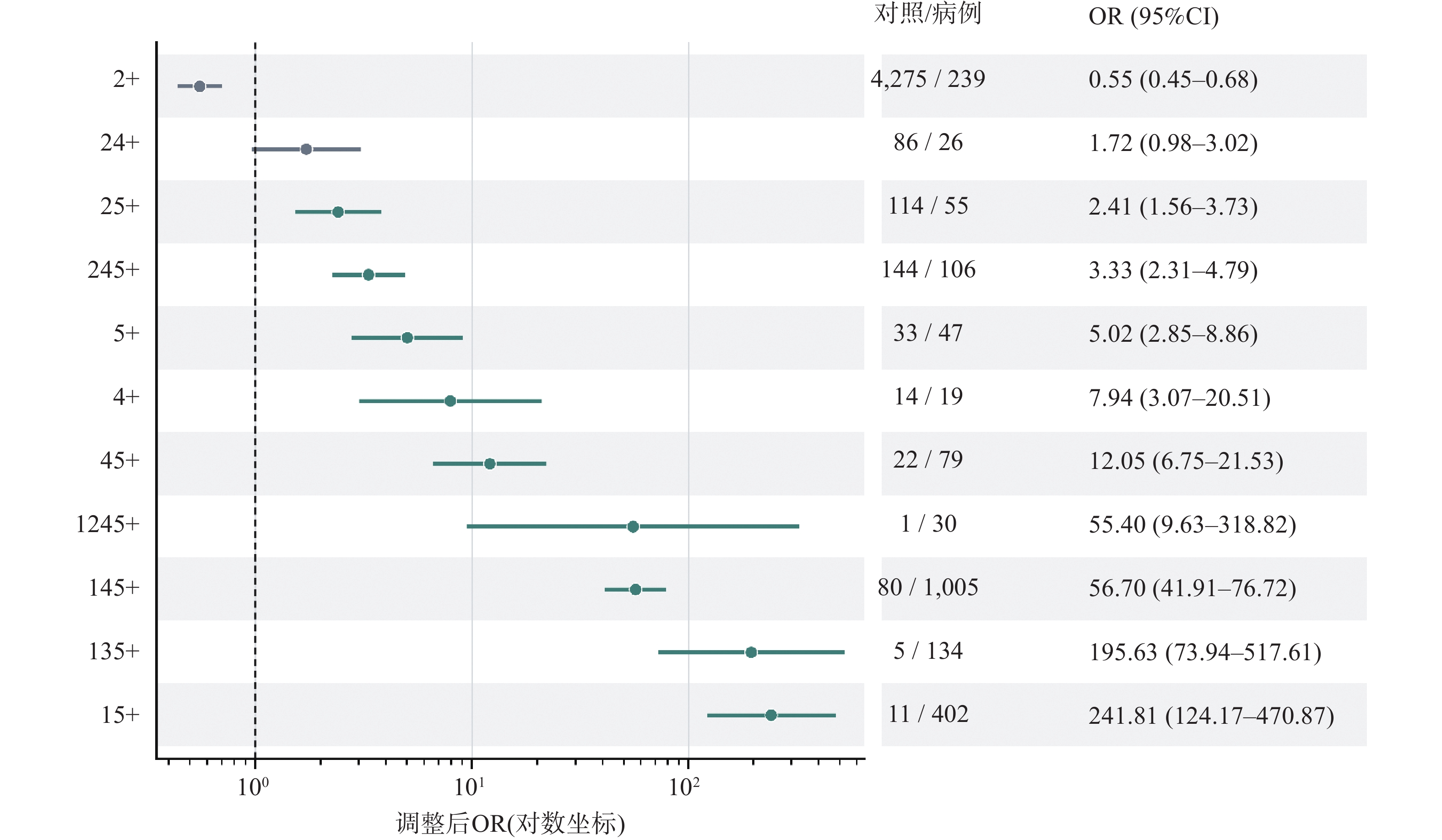
图 2 常见HBV血清学模式与HCC的调整后关联
点表示Firth Logistic回归OR,横线表示逐项Wald 95% CI;模型调整年龄非线性、性别和地区,以全阴模式为参照。仅展示n ≥30的模式。
Figure 2. Adjusted associations of common HBV serological patterns with HCC
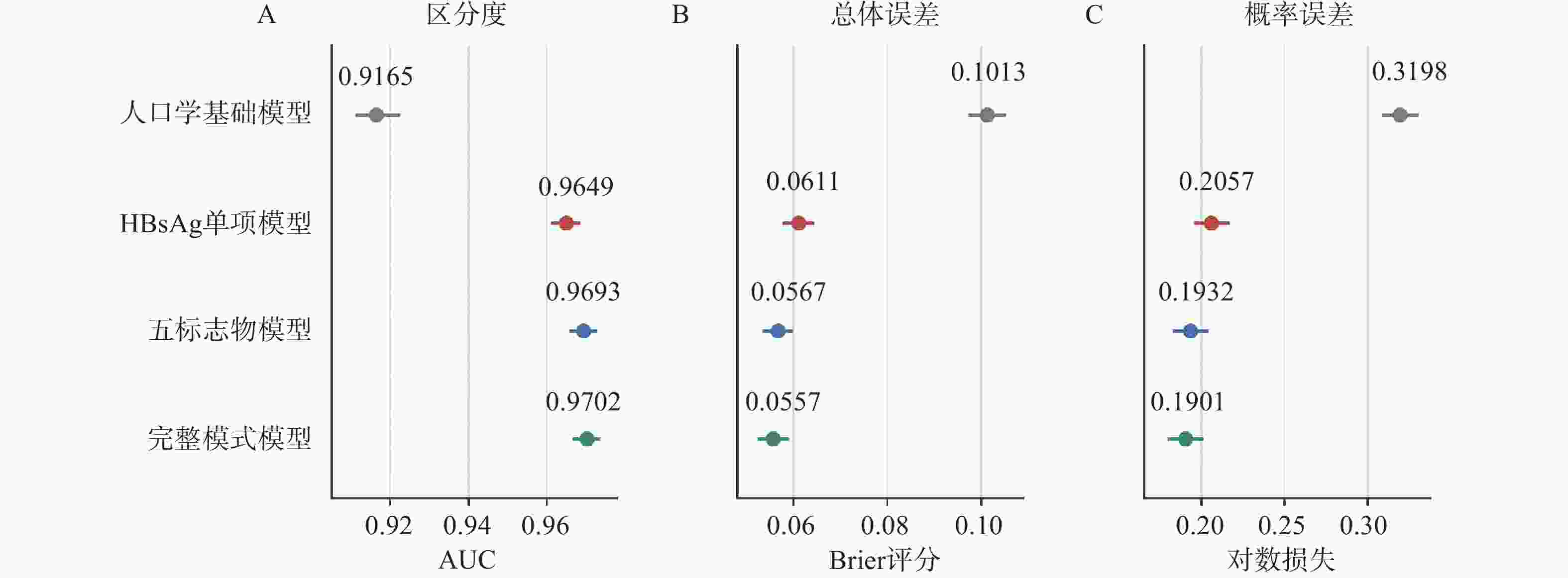
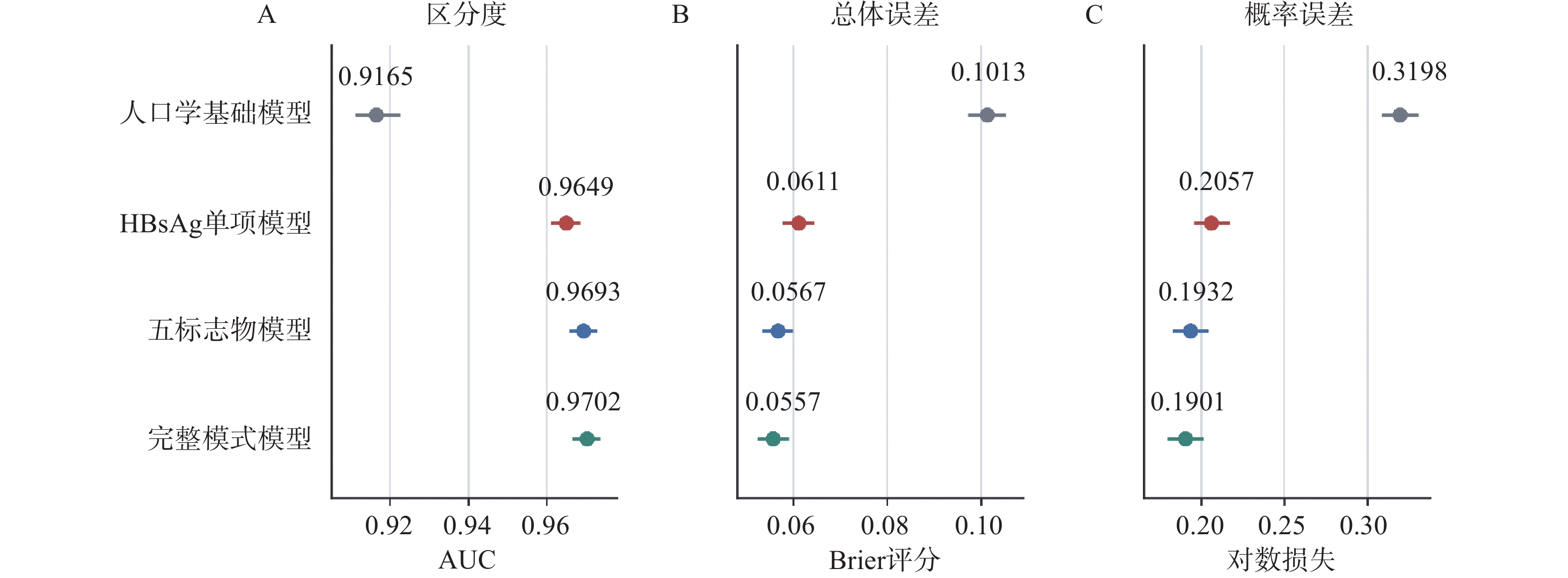
图 3 人口学基础模型、HBsAg单项模型、五标志物联合模型和完整模式模型在当前病例-对照样本中的折外区分表现
A:AUC;B:Brier评分;C:对数损失;为交叉验证估计,横线为患者层面bootstrap 95% CI。
Figure 3. Out-of-fold discrimination performance of the demographic,the HBsAg single-marker model,the five-marker combined model,and the full model in the current case-control sample
表 1 研究人群的基本特征[($\bar x \pm s $)/n (%)]
Table 1. Basic characteristics of the study population [($\bar x \pm s $)/n (%)]
特征 总体(n = 9502 )对照组(n = 6970 )HCC病例组(n = 2532 )t/χ2值 P值 年龄(岁) 45.61 ± 13.88 41.50 ± 12.65 56.92 ± 10.37 t=60.263 < 0.001 性别 χ2= 1346.137 < 0.001 女性 4392 (46.22)4010 (57.53)382(15.09) − − 男性 5110 (53.78)2960 (42.47)2150 (84.91)− − 地区 χ2= 1168.545 < 0.001 昆明 3662 (38.54)3284 (47.12)378 (14.93) − − 曲靖 1419 (14.93)991 (14.22) 428 (16.90) − − 玉溪 407 (4.28) 290 (4.16) 117 (4.62) − − 大理 620 (6.52) 457 (6.56) 163 (6.44) − − 保山 256 (2.69) 188 (2.70) 68 (2.69) − − 楚雄 539 (5.67) 366 (5.25) 173 (6.83) − − 德宏 104 (1.09) 61 (0.88) 43 (1.70) − − 迪庆 32 (0.34) 23 (0.33) 9 (0.36) − − 红河 495 (5.21) 332 (4.76) 163 (6.44) − − 丽江 190 (2.00) 125 (1.79) 65 (2.57) − − 临沧 163 (1.72) 95 (1.36) 68 (2.69) − − 怒江 51 (0.54) 30 (0.43) 21 (0.83) − − 普洱 326 (3.43) 144 (2.07) 182 (7.19) − − 文山 323 (3.40) 120 (1.72) 203 (8.02) − − 西双版纳 99 (1.04) 46 (0.66) 53 (2.09) − − 昭通 816 (8.59) 418 (6.00) 398 (15.72) − − 注:百分比为各列内部构成比。年龄采用Welch独立样本t检验;性别和地区采用Pearson χ2检验;地区P值为16个地区总体分布的比较结果。  下载: 导出CSV
表 2 共19种HBV血清学模式的定义与样本分布[n (%)/n]
Table 2. Definitions and distributions of 19 HBV serological patterns [n (%)/n]
模式 HBsAg HBsAb HBeAg HBeAb HBcAb 总体n(%) 对照/病例n 2+ − + − − − 4514 (47.51)4275 /239全阴 − − − − − 2496 (26.27)2185 /311145+ + − − + + 1085 (11.42)80/ 1005 15+ + − − − + 413(4.35) 11/402 245+ − + − + + 250(2.63) 144/106 25+ − + − − + 169(1.78) 114/55 135+ + − + − + 139(1.46) 5/134 24+ − + − + − 112(1.18) 86/26 45+ − − − + + 101(1.06) 22/79 5+ − − − − + 80(0.84) 33/47 4+ − − − + − 33(0.35) 14/19 1245 ++ + − + + 31(0.33) 1/30 125+ + + − − + 26(0.27) 0/26 1+ + − − − − 15(0.16) 0/15 1345 ++ − + + + 15(0.16) 0/15 1235 ++ + + − + 9(0.09) 0/9 14+ + − − + − 7(0.07) 0/7 235+ − + + − + 6(0.06) 0/6 12+ + + − − − 1(0.01) 0/1 注:+为阳性,−为阴性;数字1~5依次代表HBsAg、HBsAb、HBeAg、HBeAb、HBcAb阳性。
下载: 导出CSV
表 3 常见HBV血清学模式与HCC住院病例-健康体检对照分组的关联[n(%)、%及OR(95% CI)]
Table 3. Association between common HBV serological patterns and the grouping of HCC inpatient cases and healthy physical examination controls [n(%)、%及OR(95% CI)]
血清学模式 总体 对照/病例 样本病例构成(%) 调整后OR(95% CI) 未调整地区OR(95% CI) 全阴 2496 (26.27)2185 /31112.46 1.00(参照) 1.00(参照) 2+ 4514 (47.51)4275 /2395.29 0.55(0.45~0.68) 0.56(0.46~0.68) 24+ 112(1.18) 86/26 23.21 1.72(0.98~3.02) 1.88(1.11~3.16) 25+ 169(1.78) 114/55 32.54 2.41(1.56~3.73) 2.67(1.78~3.99) 245+ 250(2.63) 144/106 42.40 3.33(2.31~4.79) 3.90(2.79~5.45) 5+ 80(0.84) 33/47 58.75 5.02(2.85~8.86) 5.38(3.21~9.02) 4+ 33(0.35) 14/19 57.58 7.94(3.07~20.51) 8.04(3.36~19.28) 45+ 101(1.06) 22/79 78.22 12.05(6.75~21.53) 14.37(8.26~24.98) 1245 +31(0.33) 1/30 96.77 55.40(9.63~318.82) 73.58(12.17~444.89) 145+ 1085 (11.42)80/ 1005 92.63 56.70(41.91~76.72) 76.47(57.19~102.24) 135+ 139(1.46) 5/134 96.40 195.63(73.94~517.61) 223.62(89.31~559.92) 15+ 413(4.35) 11/402 97.34 241.81(124.17~470.87) 287.79(152.19~544.19) 注:数字1~5依次代表HBsAg、HBsAb、HBeAg、HBeAb、HBcAb阳性。Firth Logistic回归以全阴为参照;主模型调整年龄非线性、性别和地区,敏感性模型调整年龄非线性和性别但不纳入地区。样本量 < 30的模式因估计不稳定未列入主表。表中95% CI为逐项、未经多重比较校正的Wald区间。
下载: 导出CSV
表 4 五项HBV血清学标志物与HCC的多变量关联[OR (95% CI) /n (%)]
Table 4. Multivariable associations of five HBV serological markers with HCC [OR (95% CI) /n (%)]
变量 调整后OR 95% CI 总体n(%) 对照组n(%) HCC病例组n(%) 男性(以女性为参照) 3.45 2.86~4.17 5110 (53.78)2960 (42.47)2150 (84.91)HBsAg阳性 13.54 9.68~18.94 1741 (18.32)97(1.39) 1644 (64.93)HBsAb阳性 0.54 0.45~0.65 5118 (53.86)4620 (66.28)498(19.67) HBeAg阳性 4.37 1.63~11.75 169(1.78) 5(0.07) 164(6.48) HBeAb阳性 1.33 1.01~1.75 1634 (17.20)347(4.98) 1287 (50.83)HBcAb阳性 4.65 3.53~6.13 2324 (24.46)410(5.88) 1914(75.59) 注:Firth Logistic回归同时纳入五项标志物,并调整年龄非线性、性别和地区。
下载: 导出CSV
表 5 四种模型在当前病例-对照样本中的折外区分表现[估计值(95% CI)]
Table 5. Out-of-fold discrimination performance of four models within the present case-control sample [estimate (95% CI)]
模型 AUC(95% CI) Brier评分(95% CI) 对数损失(95% CI) 人口学基础模型 0.9165 (0.9110 ~0.9226 )0.1013 (0.0972 ~0.1052 )0.3198 (0.3087 ~0.3307 )HBsAg单项模型 0.9649 (0.9610 ~0.9685 )0.0611 (0.0577 ~0.0644 )0.2057 (0.1952 ~0.2169 )五标志物联合模型 0.9693 (0.9657 ~0.9728 )0.0567 (0.0534 ~0.0599 )0.1932 (0.1823 ~0.2040 )完整模式模型 0.9702 (0.9666 ~0.9736 )0.0557 (0.0524 ~0.0590 )0.1901 (0.1792 ~0.2010 )注:采用重复3次的嵌套分层5折交叉验证;95% CI由固定折外概率的2000次非分层患者层面配对bootstrap获得。Brier评分和对数损失仅用于同一病例—对照抽样框架内的相对比较。
下载: 导出CSV
-
[1] Bray F, Laversanne M, Sung H, et al. Global cancer statistics 2022: GLOBOCAN estimates of incidence and mortality worldwide for 36 cancers in 185 countries[J]. CA Cancer J Clin, 2024, 74(3): 229-263. [2] Tan E Y, Danpanichkul P, Yong J N, et al. Liver cancer in 2021: Global Burden of Disease study[J]. J Hepatol, 2025, 82(5): 851-860. doi: 10.1016/j.jhep.2024.10.031 [3] Han B, Zheng R, Zeng H, et al. Cancer incidence and mortality in China, 2022[J]. J Natl Cancer Cent, 2024, 4(1): 47-53. [4] 中华人民共和国国家卫生健康委员会医政司. 原发性肝癌诊疗指南(2024年版)[J]. 中华肝脏病杂志, 2024, 32(7): 581-630. [5] Singal A G, Llovet J M, Yarchoan M, et al. AASLD Practice Guidance on prevention, diagnosis, and treatment of hepatocellular carcinoma[J]. Hepatology, 2023, 78(6): 1922-1965. doi: 10.1097/HEP.0000000000000466 [6] 中华医学会肝病学分会, 中华医学会感染病学分会. 慢性乙型肝炎防治指南(2022年版)[J]. 中华肝脏病杂志, 2022, 30(12): 1309-1331. doi: 10.3760/cma.j.cn501113-20221204-00607 [7] European Association for the Study of the Liver. EASL Clinical Practice Guidelines on the management of hepatitis B virus infection[J]. J Hepatol, 2025, 83(2): 502-583. [7] Cornberg M, Sandmann L, Jaroszewicz J, et al. EASL Clinical Practice Guidelines on the management of hepatitis B virus infection[J]. J Hepatol, 2025, 83(2): 502-583. [8] Wang J, Qiu K, Zhou S, et al. Risk factors for hepatocellular carcinoma: An umbrella review of systematic review and meta-analysis[J]. Ann Med, 2025, 57(1): 2455539. doi: 10.1080/07853890.2025.2455539 [9] Huang R, Trinh H N, Yasuda S, et al. Differential HCC risk among HBV indeterminate types at baseline and by phase transition[J]. Gut, 2025, 74(11): 1873-1882. doi: 10.1136/gutjnl-2025-335033 [10] Liu M, Zhao T, Zhang J, et al. Estimating the key outcomes and hepatocellular carcinoma risk in patients in immune-tolerant phase of chronic hepatitis B virus infection: A systematic review and meta-analysis[J]. Rev Med Virol, 2024, 34(4): e2570. doi: 10.1002/rmv.2570 [11] Cao Q H, Liu H, Yan L J, et al. Role of hepatitis B core-related antigen in predicting the occurrence and recurrence of hepatocellular carcinoma in patients with chronic hepatitis B: A systemic review and meta-analysis[J]. J Gastro And Hepatol, 2024, 39(8): 1464-1475. doi: 10.1111/jgh.16558 [12] Mahajan A, Kharawala S, Desai S, et al. Association of hepatitis B surface antigen levels with long-term complications in chronic hepatitis B virus infection: A systematic literature review[J]. J Viral Hepat, 2024, 31(11): 746-759. doi: 10.1111/jvh.13988 [13] Song A, Wang X, Lu J, et al. Durability of hepatitis B surface antigen seroclearance and subsequent risk for hepatocellular carcinoma: A meta-analysis[J]. J Viral Hepat, 2021, 28(4): 601-612. doi: 10.1111/jvh.13471 [14] de Franchis R, Primignani M, Vecchi M, et al. Case-control study of hepatitis B virus infection in chronic liver disease and hepatocellular carcinoma[J]. Ric Clin E Lab, 1984, 14(1): 81-88. doi: 10.1007/BF02905044 [15] Yang H I, Lu S N, Liaw Y F, et al. Hepatitis B e antigen and the risk of hepatocellular carcinoma[J]. N Engl J Med, 2002, 347(3): 168-174. doi: 10.1056/NEJMoa013215 [16] Lin Y, Zhuo H Y, Song H W, et al. AnXGBoost-based multicenter model for PredictingHBV-related hepatocellular carcinoma: Development and validation[J]. Cancer Med, 2026, 15(5): e71887. doi: 10.1002/cam4.71887 [17] Kucukakcali Z, Akbulut S, Colak C. Machine learning-based prediction of HBV-related hepatocellular carcinoma and detection of key candidate biomarkers[J]. Medeni Med J, 2022, 37(3): 255-263. doi: 10.4274/MMJ.galenos.2022.39049 [18] Collins G S, Moons K G M, Dhiman P, et al. TRIPOD+AI statement: updated guidance for reporting clinical prediction models that use regression or machine learning methods[J]. BMJ, 2024, 385: e078378. doi: 10.1136/bmj-2023-078378 [19] HARRELL F E. Regression modeling strategies: with applications to linear models, logistic and ordinal regression, and survival analysis[M]. 2nd ed. Cham: Springer, 2015: 26-28. [20] Firth D. Bias reduction of maximum likelihood estimates[J]. Biometrika, 1993, 80(1): 27-38. [21] Heinze G, Schemper M. A solution to the problem of separation in logistic regression[J]. Stat Med, 2002, 21(16): 2409-2419. doi: 10.1002/sim.1047 [22] Conners E E, Panagiotakopoulos L, Hofmeister M G, et al. Screening and testing for hepatitis B virus infection: CDC recommendations - United States, 2023[J]. MMWR Recomm Rep, 2023, 72(1): 1-25. [23] Vandenbroucke J P, von Elm E, Altman D G, et al. Strengthening the reporting of observational studies in epidemiology (STROBE): Explanation and elaboration[J]. PLoS Med, 2007, 4(10): e297. doi: 10.1371/journal.pmed.0040297 [24] Rutjes A W S, Reitsma J B, Vandenbroucke J P, et al. Case-control and two-gate designs in diagnostic accuracy studies[J]. Clin Chem, 2005, 51(8): 1335-1341. doi: 10.1373/clinchem.2005.048595 -

 点击查看大图
计量
- 文章访问数: 1
- HTML全文浏览量: 1
- PDF下载量: 0
- 被引次数: 0
