




Awareness of the Core Knowledge of Cancer Prevention and Control in Ethnic Minority Areas of Yunnan,China:A Cross-Sectional Study
-
摘要:
目的 了解云南省少数民族地区居民癌症防治核心知识知晓水平及其影响因素。 方法 2022年9月—12月,在云南省8个少数民族自治州进行了一项横断面研究,采用多阶段概率抽样的方法招募参与者,收集的调查对象的人口学特征信息,癌症防治核心知识信息,涵盖癌症的基本知识,预防、早诊早治、健康管理、康复5个维度。采用逐步条件法的二元Logistics回归模型来确定与癌症防治核心知识相关的影响因素。 结果 共计纳入 3507 名研究对象,云南省8个少数民族地区癌症防治核心知识的总体知晓率为52.07%(95%CI:50.42%~53.72%),民族、所在州市、文化程度、职业、癌症家族史、自我评估健康状况和是否参与癌症筛查或防癌体检是癌症防治核心知识知晓率的影响因素。结论 云南省8个少数民族地区癌症防治核心知识的总体知晓水平较低,且民族、所在州市、文化程度、职业、癌症家族史、自我健康状况评估和是否参与癌症筛查是影响居民防癌意识的因素。 Abstract:Objective To understand the core knowledge of cancer prevention and control and its influencing factors of residents living in Yunnan-Province ethnic minority area , for putting forward targeted countermeasures and recommendations. Methods A cross-sectional study was conducted in eight ethnic minority areas in Yunnan Province from September to December 2022, multi-stage probability sampling was used to recruit participants, and their demographic characteristics were collected, the five core areas of cancer prevention and control knowledge: basic knowledge, prevention, early-stage diagnosis and treatment, health management and rehabilitation was included. A binary logistics regression model with the stepwise conditional method was employed to identify the influencing factors asscoiated with the core knowledge of cancer prevention and control. Results A total of 3507 participants were included in this study, and the overall rate of awareness was 52.07%(95%CI: 50.42%~53.72%). The ethnicity, city/prefecture of residence, education level, occupation, family history of cancer, self-assessment of health status, and whether participated in cancer screening were significantly associated with the awareness rate of cancer prevention knowledge.Conclusions The overall awareness rate of cancer prevention and control is low among eight ethnic minority regions of Yunnan Province. In addition, ethnicity, city/prefecture of residence, education level, occupation, family history of cancer, self-assessment of health status, and whether participated in cancer screening were found to influence residents' core knowledge of cancer prevention and control. -
Key words:
- Cancer prevention and control /
- Awareness /
- Ethnic minority /
- Cross-sectional survey /
- Yunnan
-
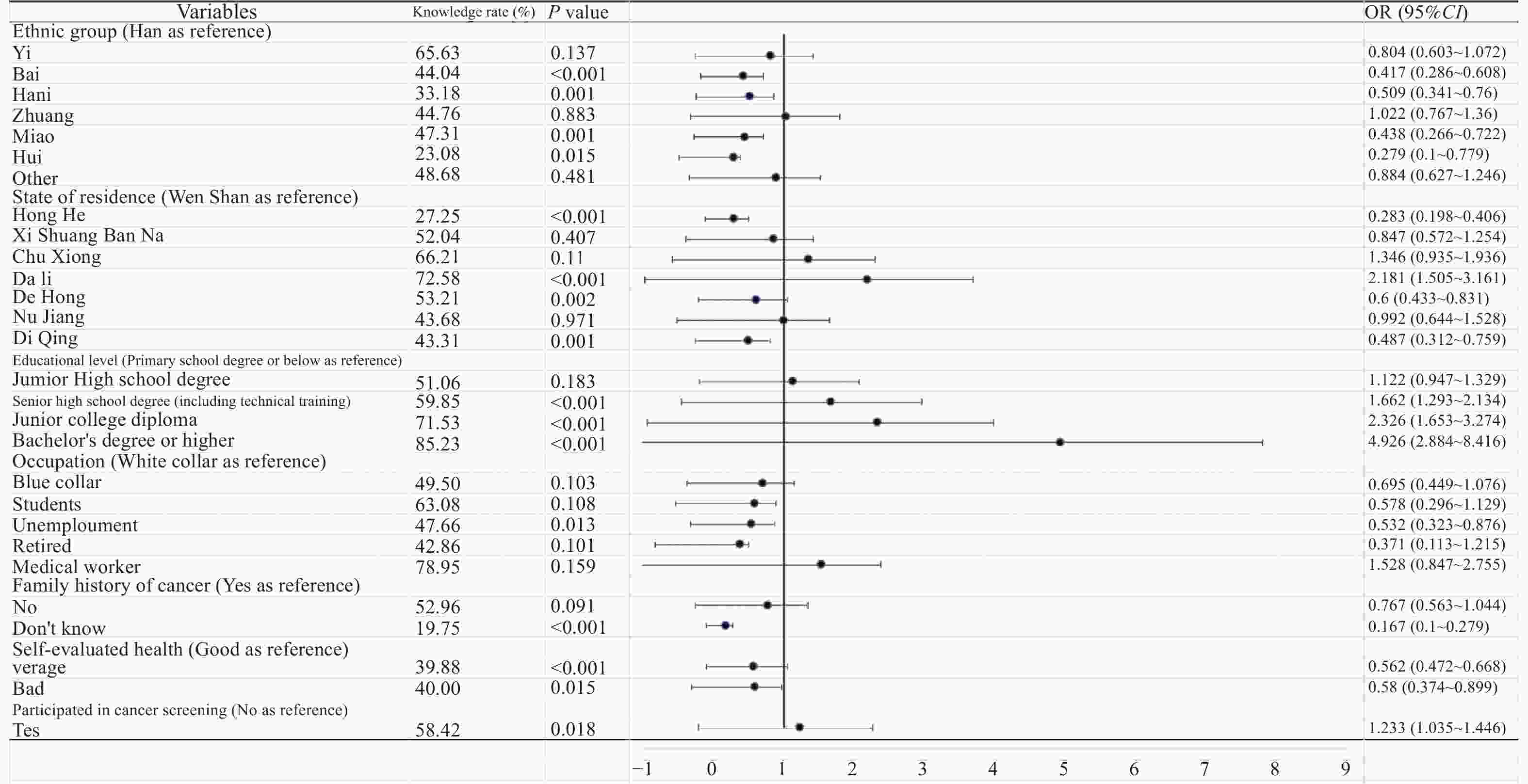
图 2 云南省8个少数民族自治州居民癌症防治核心知识知晓影响因素森林图
Figure 2. Forest plot of factors influencing awareness rate of core cancer prevention and control knowledge among residents in 8 ethnic minority states in Yunnan
表 1 不同人群特征癌症核心知识知晓情况(n =
3507 )[n(%)](1)Table 1. Cancer core knowledge awareness in different demographic groups(n =
3507 )[n(%)](1)分组 知晓不足
(n=1681 )知晓
(n=1826)合计
(n=3507 )性别 男 856(49.20) 884(50.80) 1740 (49.62)女 825(46.69) 942(53.31) 1767 (50.38)年龄(岁) <25 156(44.96) 191(55.04) 347(9.89) 25~ 865(46.48) 996(53.52) 1861(53.07) 45~ 579(50.00) 579(50.00) 1158 (33.02)>65 81(57.45) 60(42.55) 141(4.02) 户口类型 城市 1517 (48.50)1611 (51.50)3128 (89.19)农村 164(43.27) 215(56.73) 379(10.81) 民族 汉族 397(41.40) 562(56.60) 959(27.35) 彝族 210(34.37) 401(65.63) 611(17.42) 白族 249(55.96) 196(44.04) 445(12.69) 哈尼族 149(66.82) 74(33.18) 223(6.36) 壮族 237(55.24) 192(44.76) 429(12.23) 苗族 49(52.69) 44(47.31) 93(2.65) 回族 20(76.92) 6(23.08) 26(0.74) 其他 370(51.32) 351(48.68) 721(20.56) 居住地 文山 172(40.38) 254(59.62) 426(12.15) 红河 307(75.75) 115(27.25) 422(12.03) 西双版纳 212(47.96) 230(52.04) 442(12.60) 楚雄 147(33.79) 288(66.21) 435(12.40) 大理 116(27.42) 307(72.58) 423(12.06) 德宏 197(46.79) 224(53.21) 421(12.00) 怒江 263(56.32) 204(43.68) 467(13.32) 迪庆 267(56.69) 204(43.31) 471(13.43) 婚姻状况 独居(未婚、离婚和丧偶) 274(44.48) 342(55.52) 616(17.56) 已婚 1407 (48.67)1484 (55.52)2891 (82.44)文化程度 小学及以下 838(56.24) 652(43.76) 1490 (42.49)初中 578(48.94) 630(51.06) 1181 (33.68)高中(含职高) 163(40.15) 243(59.85) 406(11.58) 大专 80(28.47) 201(71.53) 281(8.01) 本科及以上 22(14.77) 127(85.23) 149(4.25) 职业 白领 43(24.02) 136(75.98) 179(5.10) 蓝领 1455 (50.50)1426 (49.50)2881 (82.15)学生 24(36.92) 41(63.08) 65(1.85) 未就业 123(52.34) 112(47.66) 235(6.70) 离退休 8(57.14) 6(42.86) 14(0.40) 医务人员 28(21.05) 105(78.95) 133(3.79) BMI:体重指数;白领:包括办公室职员、教师、工程师、公务员等脑力工作者;蓝领:包括农民、工人、渔民、司机等体力工作者。  下载: 导出CSV
1 不同人群特征癌症核心知识知晓情况(n =
3507 )[n(%)](2)1. Cancer core knowledge awareness in different demographic groups(n =
3507 )[n(%)](2)分组 知晓不足
(n=1681 )知晓
(n=1826)合计
(n=3507 )癌症家族史 是 79(37.26) 133(62.74) 212(6.05) 否 1476 (47.04)1662 (52.96)3138 (89.48)不知道 126(80.25) 31(19.75) 157(4.48) BMI(kg/m2) <18.5(偏瘦) 102(52.58) 92(47.42) 194(5.53) 18.5~24.9(正常) 1158 (47.99)1255 (52.01)2413 (68.81)≥25(超重) 421(46.78) 479(53.22) 900(25.66) 吸烟状况 吸烟 522(50.24) 517(49.76) 1039 (29.63)以前吸,已戒烟 86(52.76) 77(47.24) 163(4.65) 从不吸烟 1073 (46.55)1232 (53.45)2305 (65.73)自我健康状况评估 好 1113 (43.44)1449 (56.56)2562 (73.05)一般 508(60.12) 337(39.88) 845(24.09) 差 60(60.00) 40(40.00) 100(2.85) 参与癌症筛查 是 385(41.58) 541(58.42) 926(26.40) 否 1296 (50.21)1285 (49.79)2581 (73.60)BMI:体重指数;白领:包括办公室职员、教师、工程师、公务员等脑力工作者;蓝领:包括农民、工人、渔民、司机等体力工作者。
下载: 导出CSV
表 2 云南省8个少数民族自治州居民各条目知晓情况
Table 2. Awareness of each item among residents in 8 ethnic minority states in Yunnan
题目类别 问题 知晓人数 知晓率(%) 癌症认知 B1.癌症的发生通常需要十几到几十年的时间 1626 46.40 B6.癌症不是绝症,患者可以与癌症“和平共存” 1918 54.69 C1.关于癌症与生活方式的关系,以下说法正确的是 2027 57.79 C2.目前,我国人群中最常见的癌症是 2658 75.79 C3.以下关于肿瘤的说法,正确的是 2044 58.28 D1.癌症的发生和哪些因素有关 1462 41.68 癌症预防 B2.有些癌症(如乳腺癌、肠癌等)具有一定的遗传性,家人应引起重视 2331 66.47 C4.关于癌症的预防,以下说法正确的是 2001 57.06 D2.长期食用下列哪些食物可增加患癌风险 1383 39.44 D3.您认为工作中长期接触下列哪些物质时,可能增加癌症的发生风险 1466 41.80 D4.预防癌症的发生,应该做到 2324 66.27 D5.采取以下哪些措施,可有效降低癌症的发病和死亡 1874 53.44 早诊早治 B3.出现经常性干咳、痰中带血等症状,提示可能患有肺癌 2364 67.41 C5.关于癌症确诊方式的说法,以下正确的是 2214 63.13 C6.如果近期出现如厕频繁,大便带血且大便变细,则可能是患了 2260 64.44 C7.以下关于癌症治疗效果和生存时间说法,正确的是 2413 68.81 D6.出现下列哪些症状时,提示可能患有乳腺癌,应及时去医院就诊 1881 53.64 D7.以下哪些症状可能是癌症的警示信号,应引起重视 1656 47.22 管理 B4.很多癌症可以通过民间偏方,服用保健品,或遵从广告中的治疗方案来治愈 2941 83.86 康复 B5.癌症的康复阶段只需要做到积极调整身体免疫力即可,心态对维持患者病情稳定作用不大 1945 55.46 B为判断题;C为单选题;D为多选题。
下载: 导出CSV
表 3 云南省8个少数民族自治州居民癌症防治核心知识知晓率Logistics回归分析
Table 3. Logistic regression analysis for the core knowledge of cancer prevention and treatment among residents in 8 ethnic minority states in Yunnan
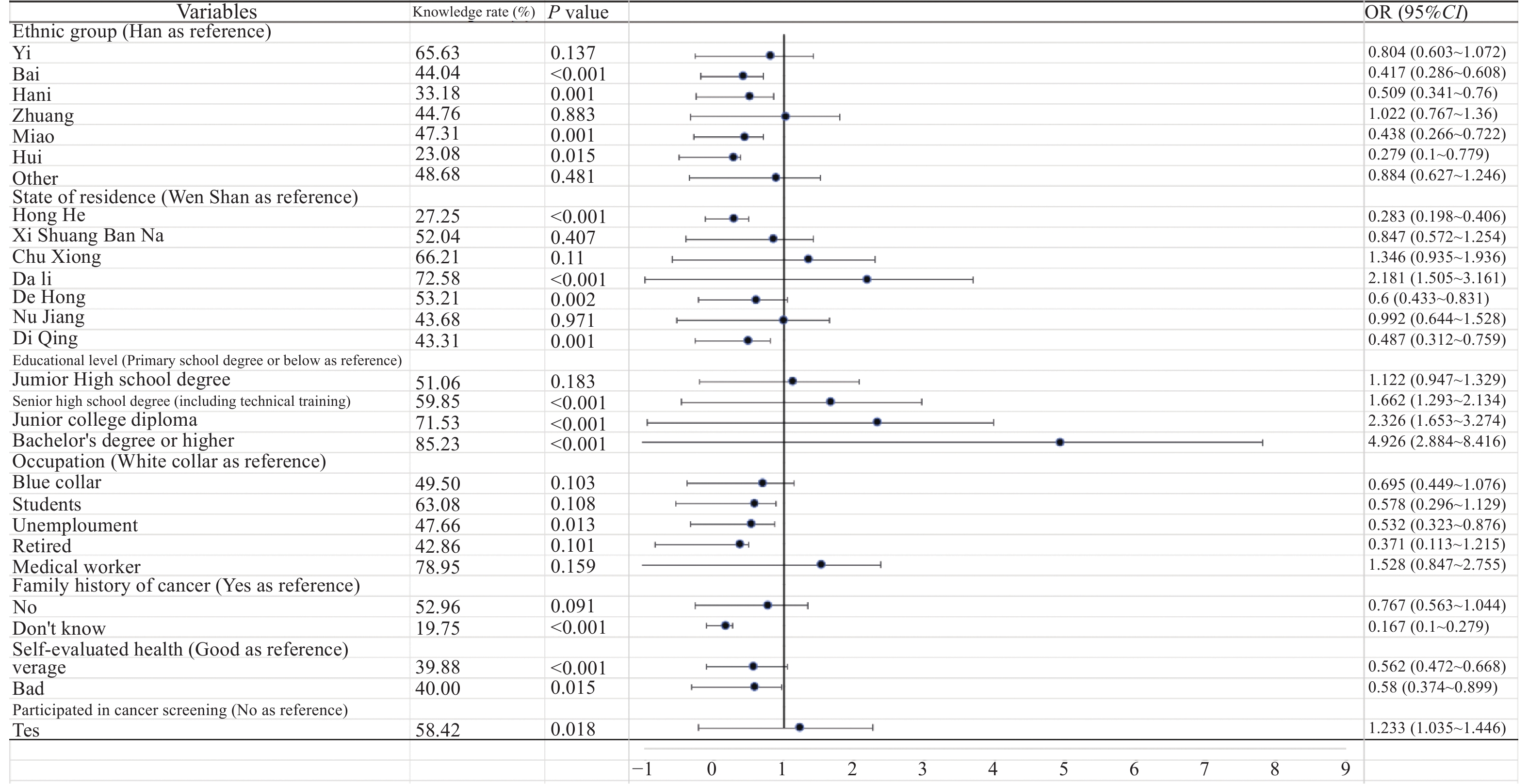
变量 Crude OR Adjust OR 95%CI 民族(参照组=汉族) 彝族 1.349 0.804 0.603~1.072 白族 0.556 0.417 0.286~0.608 哈尼族 0.351 0.509 0.341~0.760 壮族 0.572 1.022 0.767~1.360 苗族 0.634 0.438 0.266~0.722 回族 0.212 0.279 0.100~0.779 其他 0.670 0.884 0.627~1.246 居住地 (参考组=文山州) 红河州 0.254 0.283 0.198~0.406 西双版纳州 0.735 0.847 0.572~1.254 楚雄州 1.327 1.346 0.935~1.936 大理州 1.792 2.181 1.505~3.161 德宏州 0.770 0.600 0.433~0.831 怒江州 0.525 0.992 0.644~1.528 迪庆州 0.517 0.487 0.312~0.759 文化程度 (参考组=小学及以下) 初中 1.341 1.122 0.947~1.329 高中(含职高) 1.916 1.662 1.293~2.134 大专 3.229 2.326 1.653~3.274 本科及以上 7.420 4.926 2.884~8.416 职业(参考组=白领) 蓝领 0.310 0.695 0.449~1.076 学生 0.540 0.578 0.296~1.129 未就业 0.288 0.532 0.323~0.876 离退休 0.237 0.371 0.113~1.215 医务人员 1.186 1.528 0.847~2.755 癌症家族史 (参考组=是) 否 0.669 0.767 0.563~1.044 不知道 0.146 0.167 0.100~0.279 自我健康状况评估(参考组=好) 一般 0.51 0.562 0.472~0.668 差 0.512 0.580 0.374~0.899 参与癌症筛查(参考组=否) 是 1.417 1.223 1.035~1.446
下载: 导出CSV
-
[1] Chen W, Zheng R, Baade P D, et al. Cancer statistics in China, 2015[J]. CA A Cancer J Clinicians, 2016, 66(2): 115-132. [2] Han B, Zheng R, Zeng H, et al. Cancer incidence and mortality in China, 2022[J]. Journal of the National Cancer Center, 2024, 4(1): 47-53. doi: 10.1016/j.jncc.2024.01.006 [3] 健康中国行动——癌症防治行动实施方案(2023—2030年). [J]. 中国肿瘤, 2023.32(12): 887-890. [4] Yang T B, Lin X J, Lin J L, et al. Influencing factors of cancer prevention and control among urban and rural adults in Fujian, China: A cross-sectional survey[J]. Frontiers in Public Health, 2022, 10: 1053183. doi: 10.3389/fpubh.2022.1053183 [5] 王庆生, 陈万青. 癌症防治策略的探索与分析[J]. 中国医学前沿杂志(电子版), 2016, 8(7): 13-16. [6] 张丹, 熊钰, 刘佳惠, 等, 中国居民癌症防治核心知识知晓现状及其影响因素的Meta分析. [J]. 肿瘤预防与治疗, 2023.36(6): 476-485. [7] 丁高恒, 刘玉琴, 李博, 等, 2018年中国上消化道癌高发区居民癌症防治核心知识知晓率及其影响因素分析. [J]. 中华肿瘤防治杂志, 2021.28(21): 1599-1605. [8] 杨璧榕, 余龙涛, 李震萍, 等. 2012—2019年云南省肿瘤登记地区恶性肿瘤的发病与死亡趋势分析J]. 中国肿瘤, 2024, 33(2): 125-133. [9] 查震球, 吕逸丽, 陈叶纪, 等. 安徽省成年居民癌症防治核心知识知晓现状及影响因素分析[J]. 中国肿瘤, 2022, 31(8): 655-662. [10] 司国金, 吕章艳, 李文轩, 等. 天津市肿瘤筛查人群的癌症防治核心知识及健康素养调查分析[J]. 中华肿瘤防治杂志, 2025, 32(1): 1016073. [11] Li H, Zeng H, Zheng R, et al. Association of cancer awareness levels with the risk of cancer in rural China: A population-based cohort study[J]. Cancer, 2020, 126(20): 4563-4571. doi: 10.1002/cncr.33029 [12] 刘成成, 石春雷, 石菊芳, 等. 2015—2017年中国城市居民肿瘤预防意识健康素养及相关因素分析J]. 中华预防医学杂志, 2020, 54(1): 47-53. [13] 朱玲, 赵否曦, 汪姜涛, 等. 2021年贵州省上消化道癌筛查项目点癌症防治核心知识知晓水平及影响因素分析 doi: 10.16168/j.cnki.issn.1002-9982.2024.11.001J]. 中国健康教育, 2024, 40(11): 961-964+970. doi: 10.16168/j.cnki.issn.1002-9982.2024.11.001 [14] 马婧, 乔良, 钟志刚, 等. 基于倾向性评分匹配的四川省居民癌症防治核心知识知晓情况变化分析J]. 肿瘤预防与治疗, 2024, 37(2): 140-148. [15] 胡祖海, 赵胜林, 刘秀, 等. 重庆市居民癌症防治核心知识知晓情况调查分析J]. 中国慢性病预防与控制, 2023, 31(7): 509-513. [16] 周海, 周永春, 姚志红, 等. 2022年昆明市居民癌症防治核心知识知晓现状及影响因素分析J]. 肿瘤综合治疗电子杂志, 2024, 10(2): 99-105. [17] 常鹄, 刘炬, 孙萍, 等. 北京市社区居民肿瘤防治知信行调查及影响因素分析J]. 肿瘤预防与治疗, 2021, 34(7): 664-671. [18] Chen W, Ren H, Wang N, et al. The relationship between socioeconomic position and health literacy among urban and rural adults in regional China[J]. BMC Public Health, 2021, 21(1): 527. doi: 10.1186/s12889-021-10600-7 [19] 滕菲, 李贺, 曹毛毛, 等. 基于中国部分农村上消化道癌筛查地区的癌症防治核心知识知晓情况分析J]. 肿瘤预防与治疗, 2020, 33(6): 493-500. [20] 周海茸, 王巍巍, 缪伟刚, 等. 南京市居民癌症核心知识知晓率及其影响因素研究J]. 中国健康教育, 2024, 40(9): 777-783. [21] Karasiewicz M, Chawłowska E, Lipiak A, et al. How to improve cancer prevention knowledge? A way to identify gaps and tackle the limited availability of health education services in primary health care using the European code against cancer[J]. Frontiers in Public Health, 2022, 10: 878703. doi: 10.3389/fpubh.2022.878703 [22] Kim H K, Lwin M O. Cultural effects on cancer prevention behaviors: Fatalistic cancer beliefs and risk optimism among asians in Singapore[J]. Health Communication, 2017, 32(10): 1201-1209. doi: 10.1080/10410236.2016.1214224 -

 点击查看大图
计量
- 文章访问数: 1128
- HTML全文浏览量: 711
- PDF下载量: 199
- 被引次数: 0
