




Depression,Physical Activity,and Peptic Ulcer Disease: An Association Analysis Using a Prospective Cohort and Mendelian Randomization Study
-
摘要:
目的 探讨欧洲中老年人群抑郁、身体活动(physical activity,PA)与消化性溃疡(peptic ulcer,PU)的因果关联。 方法 采用前瞻性队列研究和孟德尔随机化(mendelian randomization,MR)研究,通过Cox回归分析、中介分析、亚组及敏感性分析证实抑郁、PA与PU之间的因果关联。 结果 参与者基线平均年龄为(65.02 ± 9.02)岁,PU发病率为3.38%(848/25 053)。相较于有抑郁状态+低水平剧烈PA(vigorous-intensity PA,VPA)或中强度PA(moderate-intensity PA,MPA)组,有抑郁状态+中/高水平VPA(HR = 0.68,95%CI:0.56~0.84,P < 0.001)或MPA(HR = 0.77,95%CI:0.61~0.97,P = 0.029)可降低PU发病风险;无抑郁状态+中/高水平VPA(HR = 0.58,95%CI:0.48~0.70,P < 0.001)或MPA(HR = 0.56,95%CI:0.44~0.71,P < 0.001)组PU风险降低最显著。MR分析证实抑郁可增加PU风险(IVW=0.29,95%CI:0.13~0.44,P < 0.001),且与中至剧烈PA(moderate-to-vigorous PA ,MVPA:IVW=-0.05,95%CI:-0.08~-0.02,P = 0.001)和VPA(IVW=-0.01,95%CI:-0.02~0.00,P = 0.046)水平下降也存在因果关联;同时证实MVPA(IVW=-0.48,95%CI:-0.65~-0.31,P < 0.001)和VPA(IVW=-1.14,95%CI:-1.77~-0.51,P < 0.001)对PU具有保护性因果效应。中介分析提示MVPA在抑郁增加PU风险的路径中可能存在一定的中介作用,中介效应值为 0.0200 (P = 0.027),解释了7.01%的总效应。亚组分析揭示抑郁与PA对新发PU在不同人群存在显著差异,且多项敏感性分析证实研究结果的稳健性。结论 欧洲中老年人群进行中/高水平PA可有效降低PU的发病风险,且MVPA在抑郁驱动PU的路径中可能发挥保护效应,强调抑郁人群早期进行较高水平的PA有助于预防PU发生。 Abstract:Objective To investigate the causal relationships among depression, physical activity (PA), and peptic ulcer (PU) in middle-aged and older adults in Europe. Methods A prospective cohort study and a Mendelian randomization (MR) study were conducted. Causal associations among depression, PA, and PU were examined through Cox regression analysis, mediation analysis, subgroup analyses, and sensitivity analyses. Results The mean baseline age of participants was (65.02 ± 9.02) years, and the incidence of PU was 3.38% (848/25, 053). Compared with the group with depression and low-level vigorous-intensity PA (VPA) or moderate-intensity PA (MPA), participants with depression and moderate-to-high levels of VPA (HR = 0.68, 95%CI: 0.56~0.84, P < 0.001) or MPA (HR = 0.77, 95%CI: 0.61~0.97, P = 0.029 ) had a reduced risk of PU. The greatest reduction in PU risk was observed in the group without depression and with moderate-to-high levels of VPA (HR = 0.58, 95%CI: 0.48~0.70, P < 0.001) or MPA (HR = 0.56, 95%CI: 0.44~0.71, P < 0.001). MR analysis confirmed that depression increased the risk of PU (IVW=0.29, 95%CI: 0.13~0.44, P < 0.001), and was associated with decreased levels of moderate-to-vigorous PA (MVPA: IVW: β = -0.05, 95%CI: -0.08~-0.02, P = 0.001) and VPA (IVW=-0.01, 95%CI: -0.02~0.00, P = 0.046). MR analysis further demonstrated that MVPA (IVW = -0.48, 95%CI: -0.65 to -0.31, P < 0.001) and VPA (IVW = -1.14, 95%CI: -1.77 to -0.51, P < 0.001) have protective causal effects on PU. Mediation analysis suggested that MVPA may partially mediate the pathway through which depression increases PU risk, with a mediated effect of 0.0200 (P = 0.027), accounting for 7.01% of the total effect. Subgroup analyses revealed significant heterogeneity in the associations of depression and PA with incident PU across different populations, and multiple sensitivity analyses confirmed the robustness of the findings.Conclusion Moderate-to-high levels of PA among middle-aged and older adults in Europe can effectively reduce the risk of PU. MVPA may exert a protective effect in the pathway through which depression drives PU, underscoring that early engagement in higher levels of PA among individuals with depression may help prevent PU. -
Key words:
- Peptic ulcer /
- Depression /
- Physical activity /
- Causal inference
-
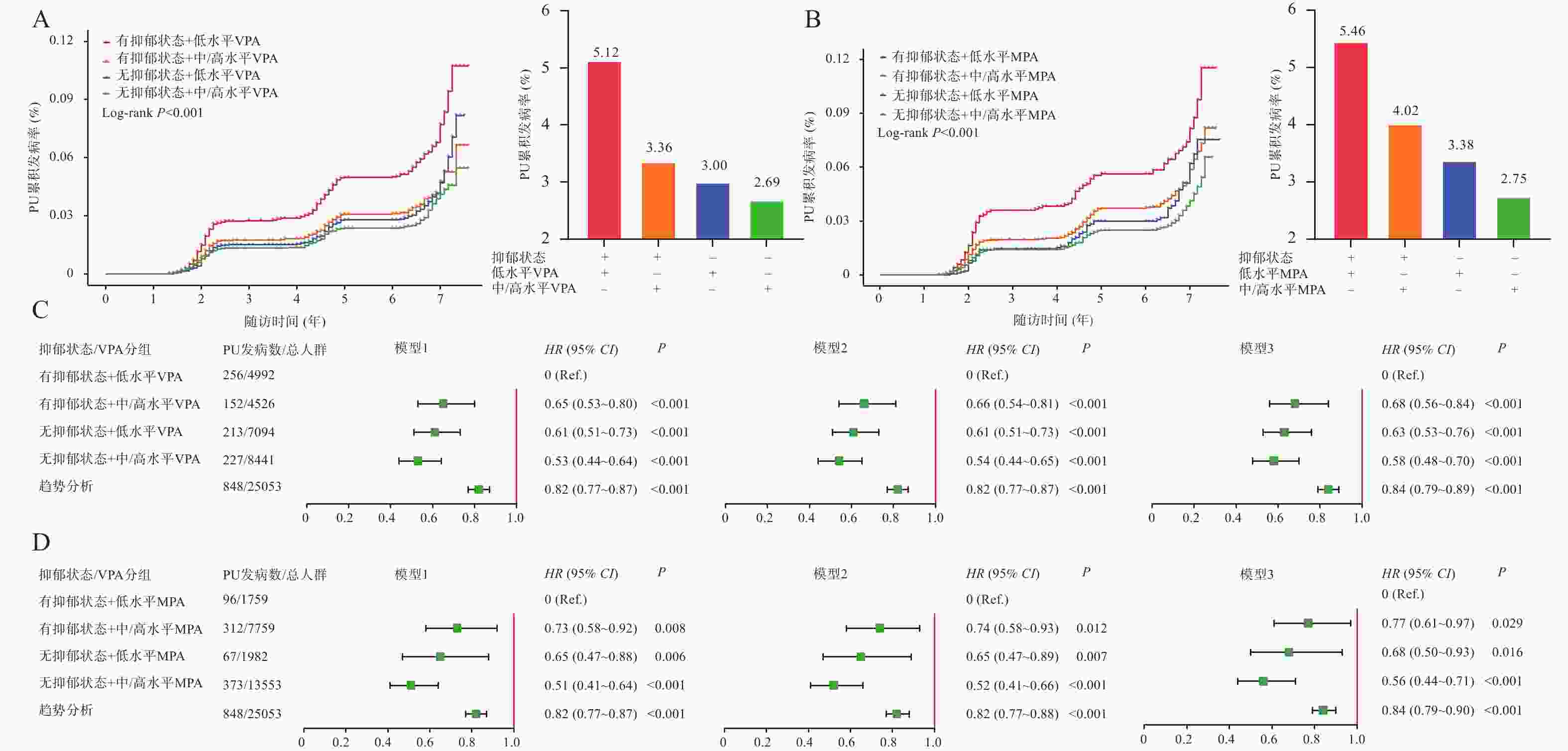
图 1 抑郁/PA与PU的Kaplan-Meier曲线和Cox回归分析
A~B:Kaplan-Meier曲线和PU的累积发病率;C~D:逐步调整协变量的Cox回归分析
Figure 1. Kaplan-Meier curve and Cox regression analysis of depression/PA versus PU
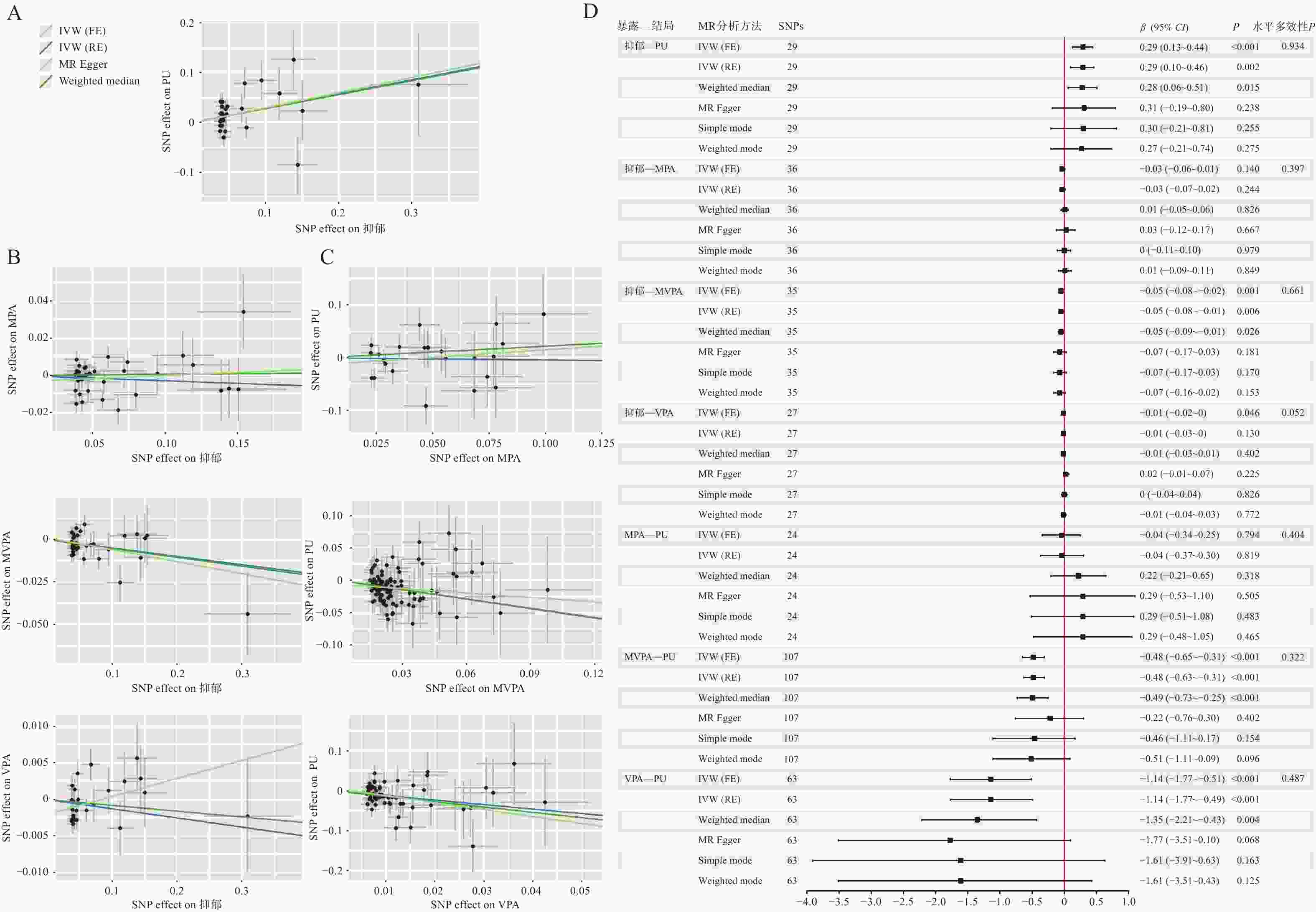
图 2 抑郁、PA与PU的因果关联
A~C:抑郁、PA与PU之间的散点图;D:MR分析结果与水平多效性的森林图
Figure 2. Causal association between depression,PA and PU
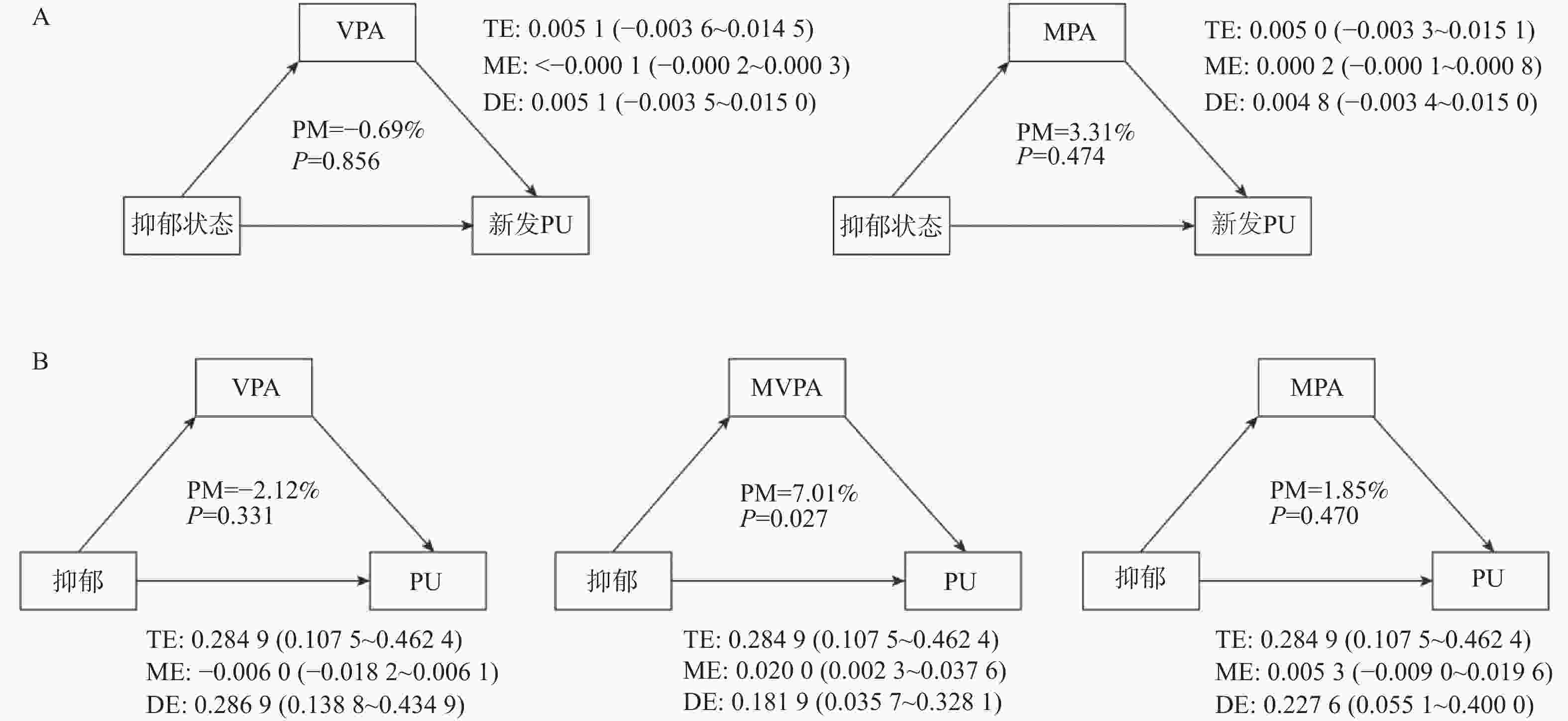
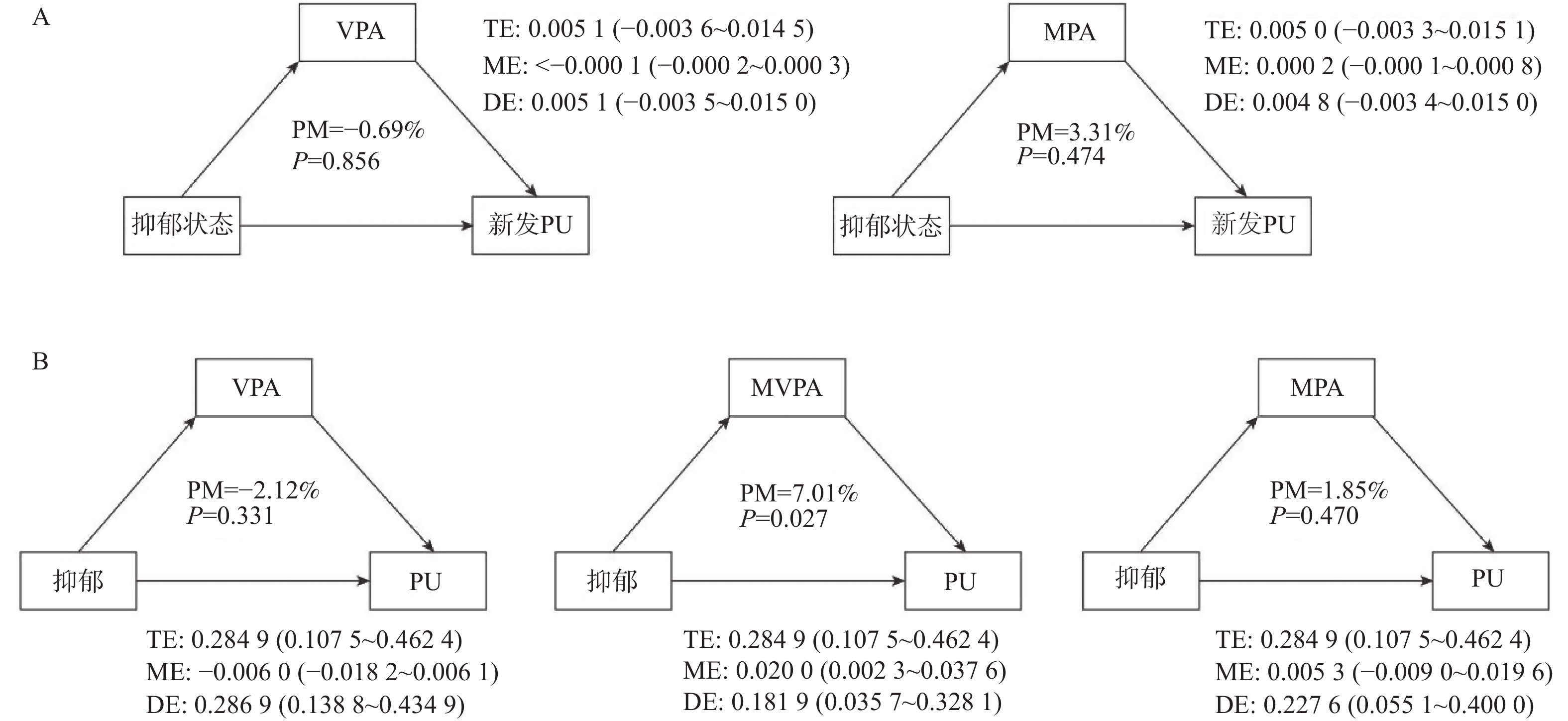
图 3 PA在抑郁与PU之间的中介效应
A:前瞻性队列分析的中介效应;B:MR分析的中介效应
Figure 3. Mediating effect of PA between depression and PU
表 1 参与者按性别分组的基线特征[$ \bar x \pm s $/n(%)]
Table 1. Baseline characteristics of participants by gender [$ \bar x \pm s $/ n(%)]
基线指标 总体(n = 25 053) 女性(n = 11 933) 男性(n = 13 120) P值 统计量 年龄(岁) 65.02 ± 9.02 63.84 ± 8.88 66.09 ± 9.01 <0.001* −19.87a 教育水平 0.799 0.45b 低(ISCED编码 0~2) 9 133(36.45) 4 369(36.61) 4 764(36.31) 中(ISCED编码3和4) 9 920(39.60) 4 727(39.61) 5 193(39.58) 高(ISCED编码5和6) 6 000(23.95) 2 837(23.77) 3 163(24.11) 婚姻 <0.001* 977.56b 已婚并与配偶同居 17 931(71.57) 7 642(64.04) 10 289(78.42) 处于注册的伴侣关系 403(1.61) 191(1.60) 212(1.62) 已婚但与配偶分居 326(1.30) 144(1.21) 182(1.39) 未婚 1 442(5.76) 662(5.55) 780(5.95) 离异 2 371(9.46) 1 416(11.87) 955(7.28) 丧偶 2 580(10.30) 1 878(15.74) 702(5.35) 居住地 <0.001* 22.60b 乡村 7 992(31.90) 3 631(30.43) 4 361(33.24) 城市 17 061(68.10) 8 302(69.57) 8 759(66.76) 国家分组 0.001* 19.40b 组1 2090 (8.34)1 046(8.77) 1 044(7.96) 组2 4 869(19.43) 2 403(20.14) 2 466(18.80) 组3 9 784(39.05) 4 659(39.04) 5 125(39.06) 组4 7 862(31.38) 3 623(30.36) 4 239(32.31) 组5 448(1.79) 202(1.69) 246(1.88) BMI分组(kg/m2) <0.001* 628.59b <25 8 598(34.32) 4 971(41.66) 3 627(27.64) 25~30 10 772(43.00) 4 278(35.85) 6 494(49.50) ≥30 5 683(22.68) 2 684(22.49) 2 999(22.86) 吸烟 <0.001* 561.43b 目前吸烟 1 815(7.24) 862(7.22) 953(7.26) 既往吸烟 18 851(75.24) 8 275(69.35) 10 576(80.61) 从不吸烟 4 387(17.51) 2 796(23.43) 1 591(12.13) 饮酒 <0.001* 733.98b ≥1次/周 1915(7.64) 473(3.96) 1 442(10.99) <1次/周 1 669(6.66) 488(4.09) 1 181(9.00) 从不饮酒 21 469(85.69) 10 972(91.95) 10 497(80.01) VPA <0.001* 41.61b <1次/周 12 086(48.24) 6 012(50.38) 6 074(46.30) ≥1次/周 12 967(51.76) 5 921(49.62) 7 046(53.70) MPA 0.293 1.11b <1次/周 3 741(14.93) 1 812(15.18) 1 929(14.70) ≥1次/周 21312 (85.07)10 121(84.82) 11 191(85.30) 高血压 11 419(45.58) 5 048(42.30) 6 371(48.56) <0.001* 98.37b 糖尿病 3 604(14.39) 1 348(11.30) 2 256(17.20) <0.001* 176.07b 高胆固醇血症 5 991(23.91) 2 837(23.77) 3 154(24.04) 0.634 0.23b 心脏疾病 3 849(15.36) 1 274(10.68) 2 575(19.63) <0.001* 384.30b 卒中 1 342(5.36) 490(4.11) 852(6.49) <0.001* 69.80b 抑郁状态 9 518(37.99) 5 619(47.09) 3 899(29.72) <0.001* 799.62b 高血压药物史 10 484(41.85) 4 678(39.20) 5 806(44.25) <0.001* 65.30b 糖尿病药物史 2 965(11.83) 1 076( 9.02) 1 889(14.40) <0.001* 172.89b 高胆固醇血症药物史 6 043(24.12) 2 574(21.57) 3 469(26.44) <0.001* 80.72b 心脏疾病药物史 3 994(15.94) 1 438(12.05) 2 556(19.48) <0.001* 256.96b 抑郁药物史 1 581(6.31) 1 065(8.92) 516(3.93) <0.001* 262.54b 抑郁状态/VPA组 <0.001* 825.00b 有抑郁状态+低水平VPA 4 992(19.93) 2 981(24.98) 2 011(15.33) 有抑郁状态+中/高水平VPA 4 526(18.07) 2 638(22.11) 1 888(14.39) 无抑郁状态+低水平VPA 7 094(28.32) 3 031(25.40) 4 063(30.97) 无抑郁状态+中/高水平VPA 8 441(33.69) 3 283(27.51) 5 158(39.31) 抑郁状态/MPA分组 <0.001* 801.65b 有抑郁状态+低水平MPA 1 759(7.02) 1 024(8.58) 735(5.60) 有抑郁状态+中/高水平MPA 7 759(30.97) 4 595(38.51) 3 164(24.12) 无抑郁状态+低水平MPA 1 982(7.91) 788(6.60) 1 194(9.10) 无抑郁状态+中/高水平MPA 13 553(54.10) 5 526(46.31) 8 027(61.18) 注:a表示t值,b表示χ2值;*P < 0.05。  下载: 导出CSV
表 2 亚组分析抑郁状态/PA与新发PU的关联
Table 2. Association between depressive status/PA and incident PU in subgroup analyses
亚组 抑郁状态/VPA组 抑郁状态/MPA组 HR (95%CI) P q P交互 HR (95%CI) P q P交互 总体 0.60(0.49~0.74) <0.001* <0.001* 0.66(0.53~0.83) <0.001* <0.001* 年龄(岁) 0.086 0.160 <65 0.62(0.47~0.81) 0.001* 0.001* 0.80(0.56~1.15) 0.236 0.236 ≥65 0.61(0.45~0.82) 0.001* 0.001* 0.59(0.44~0.80) 0.001* 0.001* 性别 0.665 0.864 男性 0.56(0.43~0.73) <0.001* <0.001* 0.63(0.47~0.85) 0.002* 0.002* 女性 0.67(0.49~0.91) 0.010* 0.010* 0.70(0.49~1.01) 0.057 0.057 BMI分组(kg/m2) 0.954 0.855 <25 0.58(0.41~0.83) 0.003* 0.003* 0.60(0.30~0.90) 0.014* 0.014* 25~30 0.67(0.49~0.91) 0.009* 0.009* 0.71(0.49~1.02) 0.063 0.063 ≥30 0.56(0.37~0.85) 0.007* 0.007* 0.71(0.47~1.07) 0.102 0.102 吸烟 0.583 0.781 目前吸烟 0.77(0.53~1.14) 0.195 0.195 0.78(0.51~1.21) 0.273 0.273 既往吸烟 0.55(0.43~0.71) <0.001* <0.001* 0.62(0.46~0.83) 0.001* 0.001* 从不吸烟 0.58(0.32~1.06) 0.076 0.076 0.83(0.40~1.71) 0.616 0.616 饮酒 0.388 0.099 ≥1次/周 0.77(0.37~1.60) 0.481 0.481 0.29(0.14~0.61) 0.001* 0.001* <1次/周 0.44(0.18~1.07) 0.070 0.070 0.40(0.16~1.01) 0.052 0.052 从不饮酒 0.61(0.49~0.75) <0.001* <0.001* 0.74(0.57~0.95) 0.017* 0.034* 高血压 0.586 0.521 是 0.58(0.43~0.78) <0.001* <0.001* 0.63(0.44~0.90) 0.012* 0.012* 否 0.67(0.51~0.88) 0.004* 0.010* 0.71(0.54~0.97) 0.032* 0.053* 糖尿病 0.244 0.227 是 0.57(0.45~0.71) <0.001* <0.001* 0.71(0.55~0.93) 0.012* 0.012* 否 0.92(0.58~1.47) 0.728 0.728 0.59(0.37~0.93) 0.024* 0.053 高胆固醇血症 0.865 0.905 是 0.61(0.48~0.78) <0.001* <0.001* 0.69(0.52~0.91) 0.009* 0.012* 否 0.60(0.41~0.88) 0.008* 0.013* 0.63(0.42~0.93) 0.019* 0.053 心脏疾病 0.210 0.183 是 0.67(0.54~0.84) <0.001* <0.001* 0.61(0.51~0.87) 0.003* 0.008* 否 0.44(0.26~0.73) 0.001* 0.005* 0.74(0.47~1.15) 0.179 0.201 卒中 0.810 0.785 是 0.60(0.49~0.74) <0.001* <0.001* 0.67(0.53~0.85) 0.001* 0.005* 否 0.71(0.31~1.60) 0.407 0.509 0.61(0.29~1.30) 0.201 0.201 注:P表示各个亚组分析的P值;q表示亚组分析经Benjamini-Hochberg (BH)法校正后的P值;P交互表示交互作用的P值;*P < 0.05。
下载: 导出CSV
表 3 抑郁状态/PA与新发PU的敏感性分析
Table 3. Sensitivity analysis of depression/PA and incident PU
抑郁状态/PA组 男性
(n = 13 120)女性
(n = 11 933)至少有1种不良生活方式
(n = 17 707)至少有1种慢性疾病史
(n = 14 227)合并心血管疾病史
(n = 4 675)随访时间 >2年
(n = 22 254)抑郁状态/VPA组 HR (95%CI),P, q HR (95%CI),P, q HR (95%CI),P, q HR (95%CI),P, q HR (95%CI),P, q HR (95%CI),P, q 有抑郁状态+低水平VPA 0.00 (Ref.) 0.00 (Ref.) 0.00 (Ref.) 0.00 (Ref.) 0.00 (Ref.) 0.00 (Ref.) 有抑郁状态+中/高水平VPA 0.73 (0.54~1.01),0.055,0.055 0.65 (0.49~0.85),0.002*,0.002* 0.66 (0.52~0.84),0.001*,0.001* 0.70 (0.53~0.88),0.003*,0.003* 0.51 (0.32~0.79),0.003*,0.003* 0.70 (0.55~0.89),0.004*,0.004* 无抑郁状态+低水平VPA 0.61 (0.47~0.80),<0.001*,<0.001* 0.66 (0.51~0.85),0.001*,0.002* 0.62 (0.50~0.77),<0.001*,<0.001* 0.64 (0.51~0.80),<0.001*,<0.001* 0.55 (0.38~0.79),0.001*,0.002* 0.67 (0.54~0.83),<0.001*,<0.001* 无抑郁状态+中/高水平VPA 0.57 (0.44~0.75),<0.001*,<0.001* 0.58 (0.44~0.76),<0.001*,<0.001* 0.57 (0.46~0.71),<0.001*,<0.001* 0.55 (0.43~0.70),<0.001*,<0.001* 0.60 (0.40~0.89),0.011*,0.011* 0.59 (0.47~0.73),<0.001*,<0.001* 抑郁状态/MPA组 有抑郁状态+低水平VPA 0.00 (Ref.) 0.00 (Ref.) 0.00 (Ref.) 0.00 (Ref.) 0.00 (Ref.) 0.00 (Ref.) 有抑郁状态+中/高水平VPA 0.81 (0.56~1.18),0.277,0.277 0.72 (0.53~0.98),0.037*,0.055 0.77 (0.59~1.01),0.059,0.059 0.73 (0.55~0.97),0.030*,0.045* 0.76 (0.49~1.15),0.196,0.196 0.78 (0.59~1.03),0.085,0.128 无抑郁状态+低水平VPA 0.67 (0.43~1.05),0.082,0.123 0.70 (0.44~1.09),0.113,0.113 0.70 (0.49~1.00),0.048*,0.059 0.69 (0.47~1.00),0.054,0.054 0.56 (0.30~1.03),0.066,0.099 0.79 (0.55~1.12),0.188,0.188 无抑郁状态+中/高水平VPA 0.56 (0.39~0.80),0.002*,0.006* 0.55 (0.40~0.76),<0.001*,<0.001* 0.55 (0.42~0.73),<0.001*,<0.001* 0.52 (0.39~0.69),<0.001*,<0.001* 0.58 (0.38~0.89),0.014*,0.042* 0.57 (0.43~0.76),<0.001*,<0.001* 注:P表示Cox回归分析的P值;q表示组内经Benjamini-Hochberg (BH)法校正后的P值;*P < 0.05。
下载: 导出CSV
-
[1] Almadi M A, Lu Y, Alali A A, et al. Peptic ulcer disease[J]. Lancet, 2024, 404(10447): 68-81. doi: 10.1016/S0140-6736(24)00155-7 [2] Morgan D R, Corral J E, Li D, et al. ACG clinical guideline: Diagnosis and management of gastric premalignant conditions[J]. Am J Gastroenterol, 2025, 120(4): 709-737. doi: 10.14309/ajg.0000000000003350 [3] Arshad S A, Murphy P, Gould J C. Management of perforated peptic ulcer: A review[J]. JAMA Surg, 2025, 160(4): 450-454. doi: 10.1001/jamasurg.2024.6724 [4] Luo K, Zhang M, Tu Q, et al. From gut inflammation to psychiatric comorbidity: Mechanisms and therapies for anxiety and depression in inflammatory bowel disease[J]. J Neuroinflammation, 2025, 22(1): 149. doi: 10.1186/s12974-025-03476-6 [5] Zhou S, Zi J, Hu Y, et al. Genetic correlation, pleiotropic loci and shared risk genes between major depressive disorder and gastrointestinal tract disorders[J]. J Affect Disord, 2025, 374: 84-90. doi: 10.1016/j.jad.2025.01.048 [6] Liu H, Liu Z, Gong Y, et al. Low physical activity-related disease burden, 1990-2021: Assessment of global trends and social determinants based on GBD 2021 data[J]. J Glob Health, 2025, 15: 04314. doi: 10.7189/jogh.15.04314 [7] Shephard R J. Peptic ulcer and exercise[J]. Phys Med, 2017, 47(1): 33-40. [8] Chen M, Hanewald K, Si Y, et al. Intrinsic capacity across 15 countries in the survey of health, aging, and retirement in Europe[J]. JAMA Netw Open, 2025, 8(5): e259792. doi: 10.1001/jamanetworkopen.2025.9792 [9] Peralta M, Nascimento M, Ferrari G, et al. Depression, reduced physical activity and the risk of heart disease: A prospective cohort of European middle-aged and older adults[J]. Br J Sports Med, 2025, 59(12): 848-855. doi: 10.1136/bjsports-2024-108780 [10] Wray N R, Ripke S, Mattheisen M, et al. Genome-wide association analyses identify 44 risk variants and refine the genetic architecture of major depression[J]. Nat Genet, 2018, 50(5): 668-681. doi: 10.1038/s41588-018-0090-3 [11] Doherty A, Smith-Byrne K, Ferreira T, et al. GWAS identifies 14 loci for device-measured physical activity and sleep duration[J]. Nat Commun, 2018, 9: 5257. doi: 10.1038/s41467-018-07743-4 [12] Wang Z, Emmerich A, Pillon N J, et al. Genome-wide association analyses of physical activity and sedentary behavior provide insights into underlying mechanisms and roles in disease prevention[J]. Nat Genet, 2022, 54(9): 1332-1344. doi: 10.1038/s41588-022-01165-1 [13] Klimentidis Y C, Raichlen D A, Bea J, et al. Genome-wide association study of habitual physical activity in over 377, 000 UK Biobank participants identifies multiple variants including CADM2 and APOE[J]. Int J Obes, 2018, 42(6): 1161-1176. doi: 10.1038/s41366-018-0120-3 [14] Zhou W, Nielsen J B, Fritsche L G, et al. Efficiently controlling for case-control imbalance and sample relatedness in large-scale genetic association studies[J]. Nat Genet, 2018, 50(9): 1335-1341. doi: 10.1038/s41588-018-0184-y [15] Marwaha S, Palmer E, Suppes T, et al. Novel and emerging treatments for major depression[J]. Lancet, 2023, 401(10371): 141-153. doi: 10.1016/S0140-6736(22)02080-3 [16] Merlo G, Sugden S, Rosenfeld R M, et al. Lifestyle interventions for major depressive disorder (MDD): An expert consensus statement from the American college of lifestyle medicine[J]. Am J Lifestyle Med, 2026, 20(4): 15598276251408353. [17] Wu Y, Murray G K, Byrne E M, et al. GWAS of peptic ulcer disease implicates Helicobacter pylori infection, other gastrointestinal disorders and depression[J]. Nat Commun, 2021, 12: 1146. doi: 10.1038/s41467-021-21280-7 [18] Kim S Y, Min C, Oh D J, et al. Reciprocal association between depression and peptic ulcers: Two longitudinal follow-up studies using a national sample cohort[J]. Sci Rep, 2020, 10: 1749. doi: 10.1038/s41598-020-58783-0 [19] Zamani M, Alizadeh-Tabari S, Chan W W, et al. Association between anxiety/depression and gastroesophageal reflux: A systematic review and meta-analysis[J]. Am J Gastroenterol, 2023, 118(12): 2133-2143. doi: 10.14309/ajg.0000000000002411 [20] Bourke M, Wang H F W, McNaughton S A, et al. Clusters of healthy lifestyle behaviours are associated with symptoms of depression, anxiety, and psychological distress: A systematic review and meta-analysis of observational studies[J]. Clin Psychol Rev, 2025, 118: 102585. doi: 10.1016/j.cpr.2025.102585 [21] Jiang L, Xue L, Juruena M F. The impact of early life stress on the hypothalamic-pituitary-adrenal axis in unipolar major depression: A systematic review[J]. Psychoneuroendocrinology, 2025, 181: 107607. doi: 10.1016/j.psyneuen.2025.107607 [22] Cao R, Jiang H, Chen P, et al. Role of depression-mediated alterations in pro-inflammatory cytokines in carcinogenesis[J]. Front Immunol, 2025, 16: 1659153. doi: 10.3389/fimmu.2025.1659153 [23] Wessa C, Simon M S, De Picker L. Current evidence on immune-driven depression[J]. Curr Opin Psychiatry, 2026, 39(1): 8-18. doi: 10.1097/YCO.0000000000001047 [24] De Sousa R A L, Rocha-Dias I, de Oliveira L R S, et al. Molecular mechanisms of physical exercise on depression in the elderly: A systematic review[J]. Mol Biol Rep, 2021, 48(4): 3853-3862. doi: 10.1007/s11033-021-06330-z [25] Chen C, Du S, Shao Q, et al. The effects of aerobic exercise for depression: An umbrella review of systematic reviews and meta-analyses[J]. J Bodyw Mov Ther, 2024, 40: 2161-2172. doi: 10.1016/j.jbmt.2024.10.068 [26] Clegg A J, Hill J E, Mullin D S, et al. Exercise for depression[J]. Cochrane Database Syst Rev, 2026, 1(1): CD004366. [27] Singh B, Bennett H, Miatke A, et al. Systematic umbrella review and meta-meta-analysis: Effectiveness of physical activity in improving depression and anxiety in children and adolescents[J]. J Am Acad Child Adolesc Psychiatry, 2026, 65(2): 171-186. doi: 10.1016/j.jaac.2025.04.007 [28] Andersen L L, López-Bueno R, Kandola A, et al. Optimal dose and pattern of physical activity to prevent diagnosed depression: Prospective cohort study[J]. Psychol Med, 2025, 55: e2. doi: 10.1017/S003329172400343X [29] Pearce M, Garcia L, Abbas A, et al. Association between physical activity and risk of depression: A systematic review and meta-analysis[J]. JAMA Psychiatry, 2022, 79(6): 550-559. doi: 10.1001/jamapsychiatry.2022.0609 -

 点击查看大图

计量
- 文章访问数: 3
- HTML全文浏览量: 3
- PDF下载量: 0
- 被引次数: 0
