




Analysis of HPV Positivity Rates and High-Risk Genotypes among Multi-Ethnic Women Aged 35-64 in Lijiang City,Yunnan Province
-
摘要:
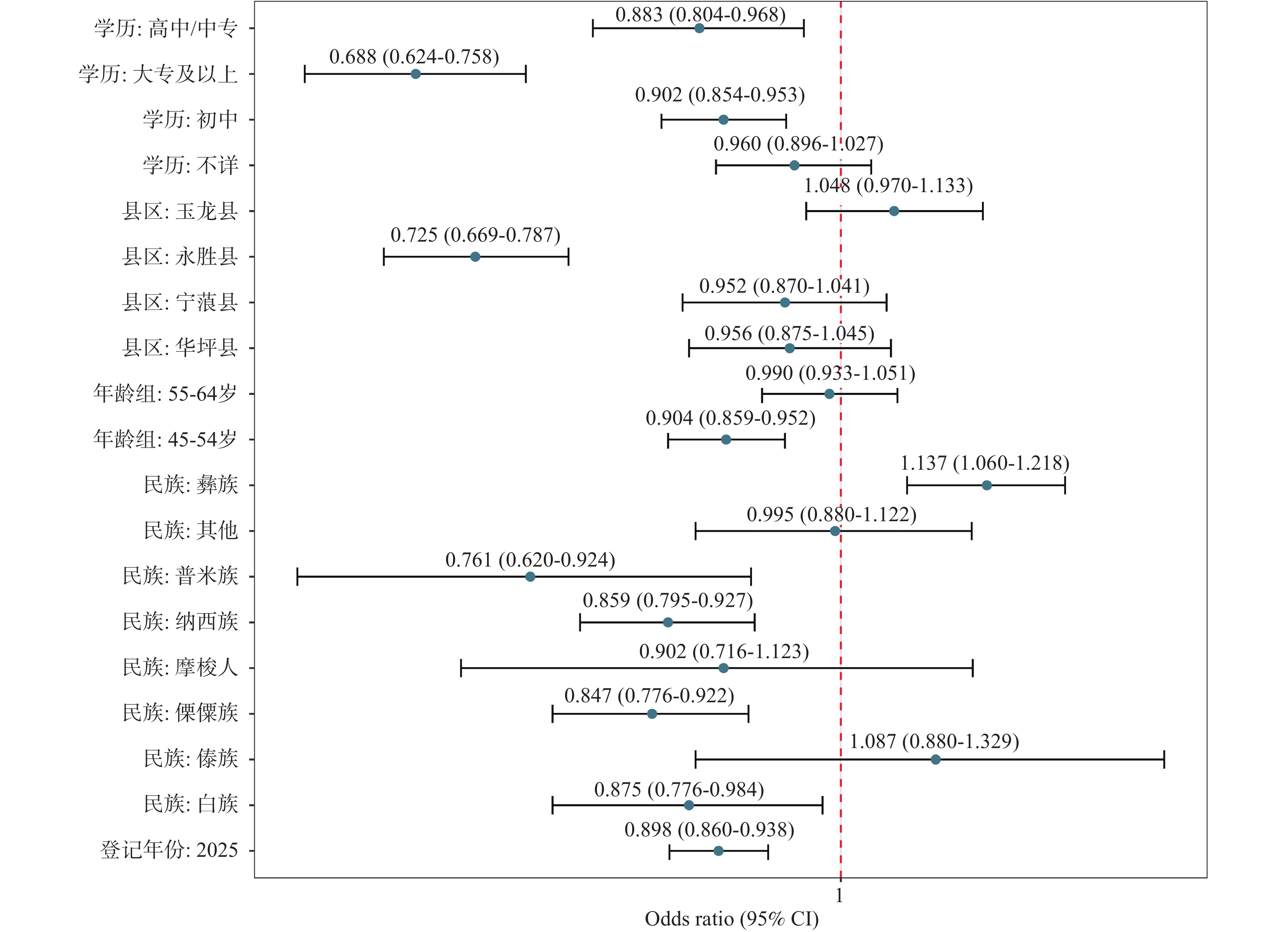
目的 分析丽江地区35~64岁妇女人乳头瘤病毒(human papillomavirus,HPV)感染率及高危型别分布,探讨不同社会人口学因素与HPV感染的关联。 方法 基于2024年1月至2025年12月丽江市“两癌筛查”项目数据的横断面研究,选取35~64岁并完成HPV检测的适龄妇女作为研究对象。采用χ2检验比较不同人群HPV阳性检出率差异,采用多因素Logistic回归模型分析HPV感染相关因素。 结果 本研究共纳入 99981 名女性,平均年龄为(48.57±7.87)岁,HPV阳性检出率为9.25%(95%CI:9.07%~9.43%),HPV16/18型阳性检出率为1.60%。共检测出14种高危型HPV基因型,其中HPV16阳性检出率最高(1.17%),其次为HPV52(0.52%)、HPV18(0.46%)及HPV58(0.30%)。不同年龄组(χ2 = 12.975)、民族(χ2 = 80.695)、文化程度(χ2 = 70.147)、县区(χ2 = 146.518)及医疗机构间(χ2 = 139.640)HPV阳性检出率差异均有统计学意义(均P < 0.05)。55-64岁女性HPV阳性检出率高(9.56%),彝族女性HPV阳性检出率最高(10.97%)。多因素Logistic回归分析显示,与35~44组相比,45~54岁年龄组的女性HPV感染风险降低(OR = 0.904,95%CI: 0.859~0.952);与小学及以下学历者相比,初中(OR = 0.902,95%CI: 0.854~0.953)、高中/中专学历者(OR = 0.883,95%CI: 0.804~0.968)大专及以上(OR = 0.688,95%CI: 0.624~0.758)学历者的感染风险显著降低。与汉族相比,彝族女性的HPV感染风险显著增高(OR = 1.137,95%CI: 1.060~1.218),普米族(OR = 0.761,95%CI: 0.620~0.924)、纳西族(OR = 0.859,95%CI: 0.795~0.927)、傈僳族(OR = 0.847,95%CI: 0.776~0.922)以及白族(OR = 0.875,95%CI: 0.776~0.984)女性的感染风险显著降低。结论 丽江地区35~64岁妇女HPV阳性检出率与中国西南地区既往研究结果总体一致,以HPV16、52、18及58型为主要流行亚型。高龄女性、彝族及低学历女性感染风险相对较高。 Abstract:Objective To analyze the human papillomavirus (HPV) infection rate and high-risk genotype distribution among women aged 35–64 in the Lijiang region, and to explore the association between various sociodemographic factors and HPV infection. Methods A cross-sectional study was conducted based on data from the "Two Cancers Screening" program in Lijiang City from January 2024 to December 2025. Eligible women aged 35–64 who completed HPV testing were selected as study participants. Chi-square tests was used to compare HPV positivity rates across different population groups, and a multivariate logistic regression model was used to analyze factors associated with HPV infection. Results A total of 99, 981 women were included, with an average age of (48.57±7.87) years. The HPV positivity rate was 9.25% (95%CI: 9.07%~9.43%), and the positive rate for HPV16/18 types was 1.60%. Fourteen high-risk HPV genotypes were detected, among which HPV16 had the highest positivity rate (1.17%), followed by HPV52 (0.52%), HPV18 (0.46%), and HPV58 (0.30%). Statistically significant differences in HPV positivity rates were observed across age groups (χ2 = 12.975), ethnic groups (χ2 = 80.695), educational levels (χ2 = 70.147), counties/districts (χ2 = 146.518), and medical institutions (χ2 = 139.640) (all P < 0.05). Women aged 55–64 had a higher HPV positivity rate (9.56%), and Yi women had the highest positivity rate (10.97%). Multivariate logistic regression analysis showed that, compared with the 35~44 age group, women aged 45~54 had a reduced risk of HPV infection (OR = 0.904, 95%CI: 0.859~0.952). Compared with women with primary school education or below, those with junior high school (OR = 0.902, 95%CI: 0.854~0.953), senior high school/secondary vocational education (OR = 0.883, 95% CI: 0.804~0.968), and junior college education or above (OR = 0.688, 95%CI: 0.624~0.758) had significantly lower infection risks. Compared with Han women, Yi women had a significantly higher risk of HPV infection (OR = 1.137, 95%CI: 1.060~1.218), whereas women of the Pumi (OR = 0.761, 95%CI: 0.620~0.924), Naxi (OR = 0.859, 95%CI: 0.795~0.927), Lisu (OR = 0.847, 95%CI: 0.776~0.922), and Bai (OR = 0.875, 95%CI: 0.776~0.984) ethnic groups had significantly lower infection risks. Conclusion The HPV positivity rate among women aged 35~64 in the Lijiang region is generally consistent with previous findings in southwestern China, with HPV types 16, 52, 18, and 58 as the predominant subtypes. Older women, Yi women, and women with lower educational attainment have relatively higher infection risks. -
Key words:
- High-risk human papillomavirus /
- Cervical cancer /
- Genotype /
- Multi-ethnic
-
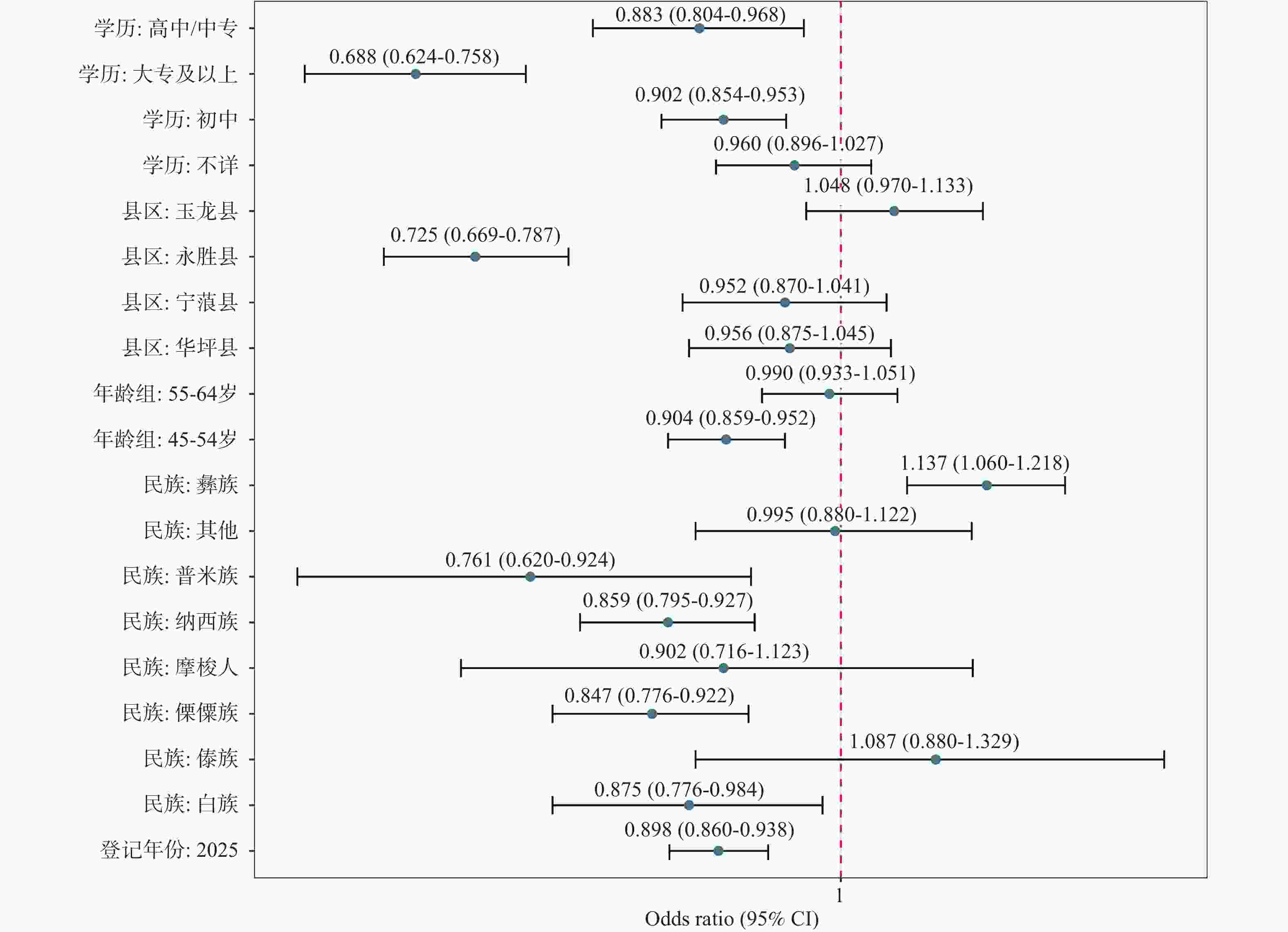
图 1 多因素Logistic回归分析森林图
Figure 1. Forest plot of multivariate Logistic regression analysis
表 1 丽江市不同高危HPV分型感染情况
Table 1. Infection status of different high-risk HPV genotypes in Lijiang City
HPV
亚型阳性人数
(n)阳性检出率
(%)HPV阳性者
中占比(%)排名 HPV16 1171 1.17 12.66 1 HPV52 523 0.52 5.65 2 HPV18 461 0.46 4.98 3 HPV58 301 0.30 3.25 4 HPV51 235 0.24 2.54 5 HPV68 159 0.16 1.72 6 HPV56 119 0.12 1.29 7 HPV59 104 0.10 1.12 8 HPV39 100 0.10 1.08 9 HPV66 96 0.10 1.04 10 HPV33 79 0.08 0.85 11 HPV31 66 0.07 0.71 12 HPV35 45 0.05 0.49 13 HPV45 30 0.03 0.32 14 注:包含多重感染情况;HPV16、18需分型检测,其它高危型别可不分型检测,所以其它高危型别阳性人数被低估。  下载: 导出CSV
表 2 丽江市不同特征人群 HPV 感染情况比较
Table 2. Comparison of HPV infection among populations with different characteristics in Lijiang City
特征 人数 阳性人数 阳性检出率(%) 95%CI χ2 P 年龄组(岁) 12.975 0.002* 35~44 32568 3096 9.51※ 9.19~9.83 45~54 41520 3679 8.86 8.59~9.14 55~64 25893 2475 9.56※ 9.20~9.92 民族 80.695 <0.001* 汉族 50114 4481 8.94# 8.69~9.19 彝族 16375 1797 10.97 10.50~11.46 纳西族 14352 1286 8.96# 8.50~9.44 白族 4052 363 8.96 8.10~9.88 傈僳族 8322 687 8.26# 7.67~8.87 傣族 1067 104 9.75 8.03~11.69 普米族 1418 112 7.90 6.55~9.43 摩梭人 968 90 9.30 7.54~11.30 其他 3313 330 9.96 8.96~11.03 文化程度 70.147 <0.001* 小学及以下 41850 4067 9.72△& 9.44~10.01 初中 30282 2680 8.85△ 8.53~9.18 高中/中专 6941 620 8.93△ 8.27~9.63 大专及以上 7805 558 7.15 6.59~7.74 不详 13103 1325 10.11△& 9.60~10.64 所属县区 146.518 <0.001* 古城区 12900 1210 9.38□○ 8.88~9.90 华坪县 16023 1571 9.80□ 9.35~10.28 宁蒗县 20074 2129 10.61□ 10.18~11.04 永胜县 32567 2522 7.74 7.46~8.04 玉龙县 18417 1818 9.87□ 9.44~10.31 筛查年份 22.961 <0.001* 2024年 52566 5083 9.67 9.42~9.93 2025年 47415 4167 8.79 8.53~9.05 *P < 0.05;与45~54岁组相比,※P < 0.017;与彝族孕妇相比,#P < 0.001;与大专及以上相比,△P < 0.005);与初中组相比,&P < 0.005;与永胜县相比,□P < 0.005);与宁蒗县相比,○P < 0.005。
下载: 导出CSV
表 3 多因素Logistic回归分析赋值表
Table 3. Assignment table for multivariate Logistic regression analysis
变量 赋值 HPV感染状态 0=阴性;1=阳性 年龄组(岁) 0=35~44岁;1=45~54岁;3=55~64岁 民族 0=汉族;1=纳西族;2=彝族;3=白族;4=傈僳族;5=傣族;6=普米族;7=摩梭人;8=其他 学历 0=小学及以下;1=初中;2=高中/中专;3=大专及以上;4=学历不详 县区 0=古城区;1=华坪县;2=宁蒗县;3=永胜县;4=玉龙县 年份(年) 0=2024年;1=2025年
下载: 导出CSV
-
[1] 徐雪琴, 方凤梅. 农村地区两种宫颈癌筛查方案应用效果比较[J]. 预防医学, 2020, 32(3): 315-317. doi: 10.19485/j.cnki.issn2096-5087.2020.03.026 [2] Mai Q, Yang X, Cheng H, et al. Prevalence and genotype distribution of human papillomavirus among women with cervical lesions in Shenzhen city, China[J]. Hum Vaccin Immunother, 2021, 17(4): 965-971. doi: 10.1080/21645515.2020.1805993 [3] Wu J, Jin Q, Zhang Y, et al. Global burden of cervical cancer: Current estimates, temporal trend and future projections based on the GLOBOCAN 2022[J]. J Natl Cancer Cent, 2025, 5(3): 322-329. [4] Zou Z, Fairley C K, Ong J J, et al. Impact of achieving WHO’s 90-70-90 targets on cervical cancer elimination and potential benefits in preventing other HPV-related cancers in China: A modelling study[J]. eClinicalMedicine, 2024, 77: 102878. doi: 10.1016/j.eclinm.2024.102878 [5] Canfell K, Kim J J, Brisson M, et al. Mortality impact of achieving WHO cervical cancer elimination targets: A comparative modelling analysis in 78 low-income and lower-middle-income countries[J]. Lancet, 2020, 395(10224): 591-603. doi: 10.1016/S0140-6736(20)30157-4 [6] 吕凤君, 董微, 张爽, 等. 2018—2023年天津市子宫颈癌筛查结果分析[J]. 中华妇产科杂志, 2025, 60(7): 541-548. doi: 10.3760/cma.j.cn112141-20250409-00139 [7] 员思静, 于学文. 1840例妇女免费两癌筛查结果及相关因素分析[J]. 中国计划生育和妇产科, 2020, 12(11): 33-35, 44. doi: 10.3969/j.issn.1674-4020.2020.11.10 [8] 袁晶, 谷晓琴. 2013—2017年重庆某地区适龄妇女“两癌”检查筛查结果分析与思考[J]. 重庆医学, 2018, 47(19): 2630-2632. doi: 10.3969/j.issn.1671-8348.2018.19.029 [9] 中华预防医学会, 中华预防医学会疫苗与免疫分会, 王华庆, 等. 子宫颈癌等人乳头瘤病毒相关疾病免疫预防专家共识(2025年版)[J]. 中国疫苗和免疫, 2025, 31(3): 245-282. doi: 10.19914/j.CJVI.2025043 [10] 中华医学会妇科肿瘤学分会, 中国优生科学协会阴道镜和宫颈病理学分会. 人乳头瘤病毒疫苗临床应用中国专家共识[J]. 现代妇产科进展, 2021, 30(2): 81-91. doi: 10.13283/j.cnki.xdfckjz.2021.02.001 [11] 郭桂芝, 胡晓燕, 焦薇, 等. 贵阳市宫颈高级别鳞状上皮内病变及宫颈癌患者HPV亚型分布状况及感染状态分析[J]. 中国妇产科临床杂志, 2020, 21(5): 464-466. doi: 10.13390/j.issn.1672-1861.2020.05.006 [12] 王妮, 余翠玲, 冷丽, 等. 2021—2023年曲靖市女性人乳头瘤病毒基因分型检测结果分析[J]. 妇儿健康导刊, 2025, 4(22): 177-181. doi: 10.3969/j.issn.2097-115X.2025.22.036 [13] 杨刚, 滕毅, 刘梅, 等. 2022—2024年云南14个地区女性HPV体检筛查结果调查分析[J]. 海南医学, 2025, 36(20): 3002-3009. doi: 10.3969/j.issn.1003-6350.2025.20.021 [14] 唐海先, 洪颖, 周力, 等. 昆明部分地区女性HPV感染情况的调查研究[J]. 分子诊断与治疗杂志, 2023, 15(5): 876-879. doi: 10.3969/j.issn.1674-6929.2023.05.038 [15] 杨玉崟, 彭泱泱, 唐玲, 等. 云南省德宏州各民族子宫颈人乳头瘤病毒感染相关因素分析[J]. 中国实用妇科与产科杂志, 2023, 39(3): 350-352. doi: 10.19538/j.fk2023030120 [16] 曹杰贤, 李雪菲, 沈国玲, 等. 云南7个地区女性HPV亚型感染情况调查[J]. 检验医学与临床, 2021, 18(6): 789-792. doi: 10.3969/j.issn.1672-9455.2021.06.018 [17] 舒婷, 兰志鹏, 巫霞, 等. 宫颈癌筛查妇女高危型人乳头瘤病毒感染现状及影响因素研究: 基于成都市45万人群[J]. 中国全科医学, 2025, 28(2): 213-219. doi: 10.12114/j.issn.1007-9572.2024.0269 [18] 李新毅, 赵钟鸣, 范丽梅, 等. 云南省20012名农村妇女HPV新发感染状况研究[J]. 现代预防医学, 2022, 49(14): 2565-2569. doi: 10.20043/j.cnki.MPM.202105216 [19] Bray F, Laversanne M, Sung H, et al. Global cancer statistics 2022: GLOBOCAN estimates of incidence and mortality worldwide for 36 cancers in 185 countries[J]. CA Cancer J Clin, 2024, 74(3): 229-263. [20] Yang D, Zhang J, Cui X, et al. Risk factors associated with human papillomavirus infection, cervical cancer, and precancerous lesions in large-scale population screening[J]. Front Microbiol, 2022, 13: 914516. doi: 10.3389/fmicb.2022.914516 [21] Zhao X L, Hu S Y, Zhang Q, et al. High-risk human papillomavirus genotype distribution and attribution to cervical cancer and precancerous lesions in a rural Chinese population[J]. J Gynecol Oncol, 2017, 28(4): e30. doi: 10.3802/jgo.2017.28.e30 [22] Jiang H, Ding J, Wang H, et al. Prevalence and characteristics of cervical human papillomavirus genotypes and cervical lesions among 58630 women from Guangzhou, China[J]. J Infect Public Health, 2023, 16(10): 1531-1536. doi: 10.1016/j.jiph.2023.07.013 [23] Zhang L, Zhang Q, Pang B, et al. Epidemiological characteristics and risk factors of high-risk HPV infection, cervical cancer, and precancerous lesions among women in Southwestern China[J]. Front Oncol, 2025, 15: 1645748. doi: 10.3389/fonc.2025.1645748 [24] Zhu B, Liu Y, Zuo T, et al. The prevalence, trends, and geographical distribution of human papillomavirus infection in China: The pooled analysis of 1.7 million women[J]. Cancer Med, 2019, 8(11): 5373-5385. doi: 10.1002/cam4.2017 [25] 林威, 王月云, 刘植华, 等. 深圳地区普通女性人群HPV认知及其外生殖器疣患病情况[J]. 中国艾滋病性病, 2019, 25(11): 1167-1169, 1171. doi: 10.13419/j.cnki.aids.2019.11.19 [26] 林威, 刘植华, 王月云, 等. 深圳地区女性流动人群HPV预防性疫苗接种意愿调查及影响因素分析[J]. 现代预防医学, 2019, 46(22): 4094-4098, 4140. [27] 徐源佑, 朱健, 陈永胜, 等. 1972—2021年江苏省启东市育龄妇女恶性肿瘤死亡率趋势分析及2022—2031年变化趋势预测[J]. 中国肿瘤, 2026, 35(1): 48-54. doi: 10.11735/j.issn.1004-0242.2026.01.A007 [28] 张金丽, 刘燕青. 2020—2024年滕州市适龄妇女“两癌”筛查结果分析[J]. 中国初级卫生保健, 2025, 39(8): 23-27. doi: 10.3969/j.issn.1001-568X.2025.08.0006 [29] Zu Y, Ou Z, Wu D, et al. Genetic characteristics of human papillomavirus type 16, 18, 52 and 58 in Southern China[J]. Genomics, 2021, 113(6): 3895-3906. doi: 10.1016/j.ygeno.2021.09.006 [30] 王利琼, 杨雅嵋, 江毅敏, 等. 宫颈癌患者HPV基因型分布及HPV52编码基因突变情况分析[J]. 中国病原生物学杂志, 2022, 17(7): 810-813. doi: 10.13350/j.cjpb.220714 [31] Han S, Lin M, Liu M, et al. Prevalence, trends, and geographic distribution of human papillomavirus infection in Chinese women: A summative analysis of 2, 728, 321 cases[J]. BMC Med, 2025, 23(1): 158. doi: 10.1186/s12916-025-03975-6 [32] Shen X, Guo W, Yao C, et al. Epidemiological analysis of human papillomavirus and its subtype infections in 36, 248 women in Wuhan, China[J]. Front Public Health, 2026, 14: 1745604. doi: 10.3389/fpubh.2026.1745604 [33] de Sanjosé S, Brotons M, Pavón M A. The natural history of human papillomavirus infection[J]. Best Pract Res Clin Obstet Gynaecol, 2018, 47: 2-13. doi: 10.1016/j.bpobgyn.2017.08.015 [34] Zhang W, Guo N, Li B, et al. Prevalence and genotype distribution of human papillomavirus infections in Beijing, China between 2016 and 2020[J]. Virol J, 2023, 20(1): 11. doi: 10.1186/s12985-023-01959-7 [35] 赵兴坤, 李敏, 闫倩倩, 等. 阴道微生态异常与生殖道高危型人乳头瘤病毒感染相关性研究[J]. 中国实用妇科与产科杂志, 2024, 40(12): 1245-1248. doi: 10.19538/j.fk2024120118 [36] 陈少强, 吴颖, 谢艳, 等. 2020—2022年湖南省326 824名宫颈癌筛查和健康体检者HPV感染率及亚型分布[J]. 中华肿瘤防治杂志, 2024, 31(7): 399-404. doi: 10.16073/j.cnki.cjcpt.2024.07.02 [37] 窦倩如, 黄翠敏, 王晓黎, 等. 2023—2024年海南省35~64岁女性宫颈部位高危型HPV感染情况及相关因素[J]. 中国艾滋病性病, 2026, 32(4): 465-470. doi: 10.13419/j.cnki.aids.2026.04.13 [38] Zhao M, Gu R Y, Ding S R, et al. Risk factors of cervical cancer among ethnic minorities in Yunnan Province, China: A case-control study[J]. Eur J Cancer Prev, 2022, 31(3): 287-292. doi: 10.1097/CEJ.0000000000000704 [39] Zhao M, Pu X, Yan Y J, et al. The quality of life in women with cervical cancer and precancerous lesions of Han and ethnic minorities in Southwest China[J]. BMC Cancer, 2021, 21(1): 1110. doi: 10.1186/s12885-021-08856-8 [40] 徐潇雅, 闫琪, 杨楠, 等. 2021—2024年乌鲁木齐某三甲医院成年女性HPV感染特征及变化趋势[J]. 热带医学杂志, 2026, 26(3): 396-400. doi: 10.3969/j.issn.1672-3619.2026.03.020 -

 点击查看大图
计量
- 文章访问数: 4
- HTML全文浏览量: 3
- PDF下载量: 0
- 被引次数: 0
