




Expression of USP8,USP15,and USP21 in Nasopharyngeal Carcinoma Tissues and Their Association with Prognosis
-
摘要:
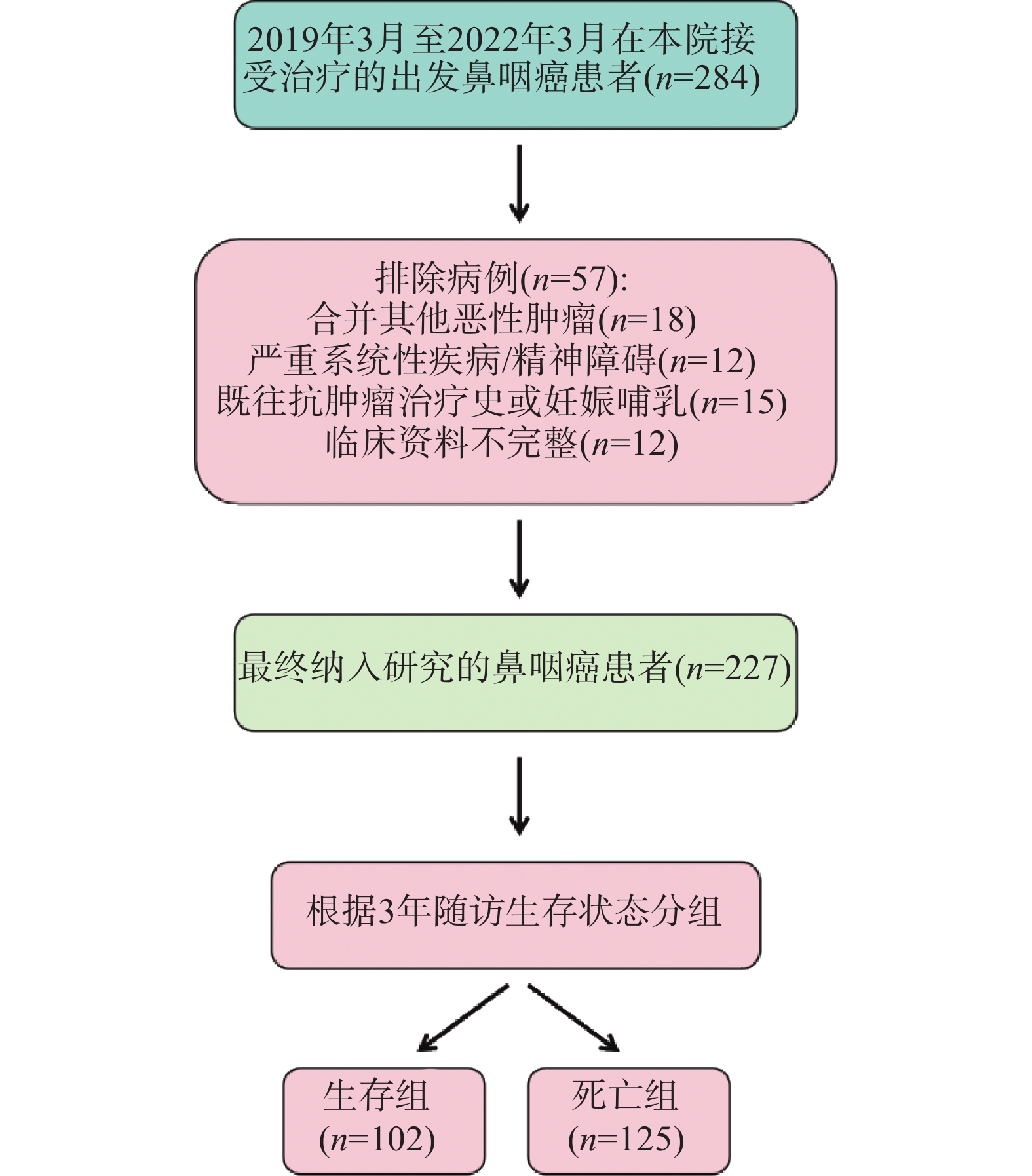
目的 探讨鼻咽癌(nasopharyngeal carcinoma,NPC)组织中泛素特异性蛋白酶8(ubiquitin-specific protease 8,USP8)、USP15、USP21表达及其与预后的关系。 方法 回顾性选取2019年3月至2022年3月在四川省中西医结合医院接受治疗的227例NPC患者为研究对象,并采集所有患者的NPC组织及癌旁正常组织(配对设计)。根据免疫组织化学法(immunohistochemistry,IHC)评分将患者分为USP8高表达组(n = 159)和低表达组(n = 68)、USP15高表达组(n = 168)和低表达组(n = 59)、USP21高表达组(n = 174)和低表达组(n = 53);根据3年随访结局将患者分为生存组(n = 102)和死亡组(n = 125)。采用逆转录实时定量聚合酶链反应(reverse transcription quantitative real-time polymerase chain reaction,RT-qPCR)、蛋白免疫印迹法(western blotting,WB)及免疫组织化学法(immunohistochemistry,IHC)检测NPC组织和癌旁组织中USP8、USP15、USP21表达;并比较不同病理特征NPC患者USP8、USP15、USP21表达情况;通过单因素和多因素Cox回归分析影响NPC患者预后的相关因素;采用Kaplan-Meier曲线方法和log-rank检验手段分析USP8、USP15、USP21表达与NPC患者预后的关系。采用受试者工作特征曲线(receiver operating characteristic curve,ROC)评估USP8、USP15、USP21对NPC患者不良预后的预测效能。 结果 与配对的癌旁正常组织相比,NPC组织中USP8、USP15和USP21的mRNA、蛋白表达及高表达比例均显著升高(P < 0.05)。与无淋巴结转移、病灶部位(顶侧壁)、临床Ⅰ~Ⅱ分期、无肿瘤残余、肿瘤T1~T2分期、肿瘤中/高分化程度、无远处转移的患者相比,有淋巴结转移、病灶部位(咽隐窝)、临床Ⅲ~Ⅳ分期、有肿瘤残余、肿瘤T3~T4分期、肿瘤低分化程度、有远处转移的患者USP8、USP15、USP21高表达占比明显升高(P < 0.05)。多因素Cox回归分析表明,病灶部位(咽隐窝)、临床Ⅲ-Ⅳ期、低分化程度、发生远处转移、USP8高表达、USP15高表达、USP21高表达均为NPC患者预后不良的独立危险因素(P < 0.05)。Kaplan-Meier生存曲线结果显示,USP8、USP15、USP21高表达和低表达组比较差异均具有统计学意义(log-rank χ2=10.097、12.429、6.122,P < 0.001)。ROC曲线结果显示,USP8、USP15、USP21联合预测NPC患者不良预后的曲线下面积(area under the curve,AUC)为0.987,明显高于USP8(Z = 2.492,P = 0.012)、USP15(Z = 5.734,P < 0.001)、USP21(Z = 6.115,P < 0.001)单一指标单独诊断时的AUC。 结论 USP8、USP15和USP21在NPC组织中表达显著上调,且高表达患者的3年总生存期(overall survival,OS)显著低于低表达患者,表明USP8/USP15/USP21联合检测可能成为预测NPC疾病进展和不良预后的新型分子标志物组合。 Abstract:Objective To investigate the expression of ubiquitin-specific protease 8 (USP8), USP15, and USP21 in nasopharyngeal carcinoma (NPC) tissues and their relationship with prognosis. Methods A total of 227 patients with NPC who received treatment at Sichuan Provincial Hospital of Integrated Traditional Chinese and Western Medicine from March 2019 to March 2022 were retrospectively selected as the study subjects, and paired NPC tissues and adjacent non-tumor tissues were collected from all patients. Based on immunohistochemistry (IHC) scores, the patients were divided into a USP8 high-expression group (n=159) and a low-expression group (n=68), a USP15 high-expression group (n=168) and a low-expression group (n=59), and a USP21 high-expression group (n=174) and a low-expression group (n=53). According to the 3-year follow-up outcomes, the patients were divided into a survival group (n=102) and a death group (n=125). Expression levels of USP8, USP15, and USP21 in nasopharyngeal carcinoma (NPC) tissues and adjacent non-tumor tissues were detected using reverse transcription quantitative real-time polymerase chain reaction (RT-qPCR), Western blotting (WB), and immunohistochemistry (IHC); the expression of USP8, USP15, and USP21 in NPC patients with different pathological characteristics was compared; the relevant factors affecting the prognosis of NPC patients were analyzed by unifactorial and multifactorial Cox regression; and the Kaplan-Meier curve method and log-rank test were used to analyze the relationship between the expression of USP8, USP15, USP21 and the prognosis of NPC patients. The predictive efficacy of USP8, USP15, and USP21 for poor prognosis in NPC patients was evaluated using receiver operating characteristic (ROC) curve analysis. Results Compared with paired adjacent non-tumor tissues, mRNA and protein expression levels, as well as the proportion of high expression, of USP8, USP15, and USP21 were significantly elevated in NPC tissues (P < 0.05). Compared with patients without lymph node metastasis, with lesions located in the pharyngeal recess (vs. superior/lateral wall), with clinical stage III–IV (vs. stage I–II), without tumor residue, with tumor T3–T4 classification (vs. T1-T2), with moderately/well-differentiated tumors (vs. moderate/well-differentiated), and without distant metastasis, the proportions of high expression of USP8, USP15, and USP21 were significantly increased in patients with lymph node metastasis, with lesions located in the pharyngeal recess, with clinical stage III–IV, with tumor residue, with tumor T3–T4 stage, with poorly differentiated tumors, and with distant metastasis (all P < 0.05). Multifactorial Cox regression analysis showed that lesion site (pharyngeal crypt), clinical stage III-IV, poor differentiation, distant metastasis, high expression of USP8, high expression of USP15, and high expression of USP21 were all independent risk factors for poor prognosis of patients with NPC (P < 0.05).The results of the Kaplan-Meier survival curves showed that the differences between the high-expression and low-expression groups of USP8, USP15, USP21 were statistically significant (log-rank χ2 = 10.097, 12.429, 6.122, P < 0.001). ROC curve analysis showed that the combined AUC of USP8, USP15, and USP21 for predicting poor prognosis in NPC patients was 0.987, which was significantly higher than that of USP8 alone (Z = 2.492, P = 0.012), USP15 alone (Z = 5.734, P < 0.001), or USP21 alone (Z = 6.115, P < 0.001). Conclusion USP8, USP15, and USP21 were significantly upregulated in NPC tissues, and patients with high expression exhibited a significantly shorter 3-year overall survival (OS) compared with those with low-expression patients, suggesting that combined detection of USP8/USP15/USP21 may become a novel molecular biomarker panel for predicting disease progression and poor prognosis in NPC. -
Key words:
- Nasopharyngeal carcinoma /
- USP8 /
- USP15 /
- USP21 /
- Prognosis
-
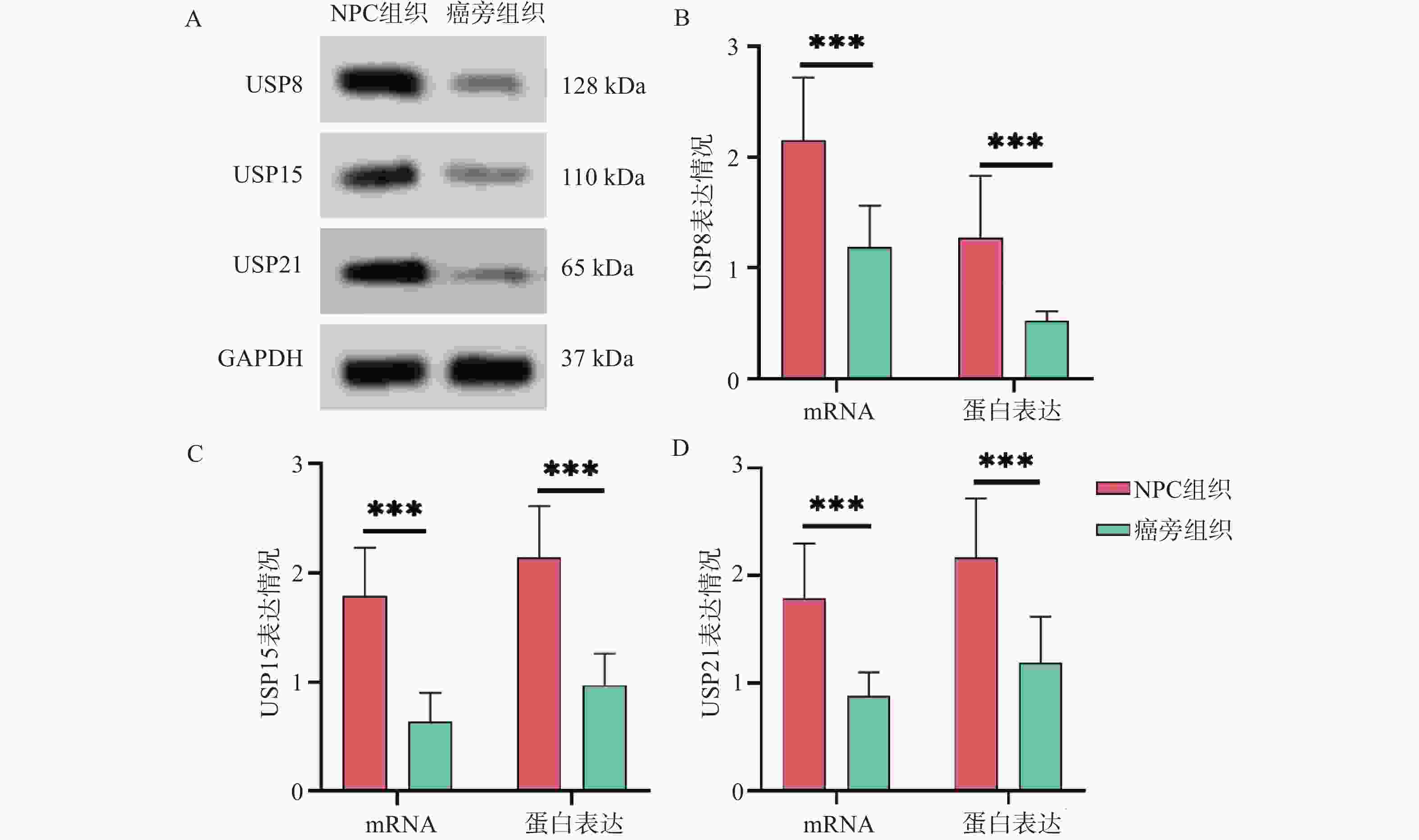
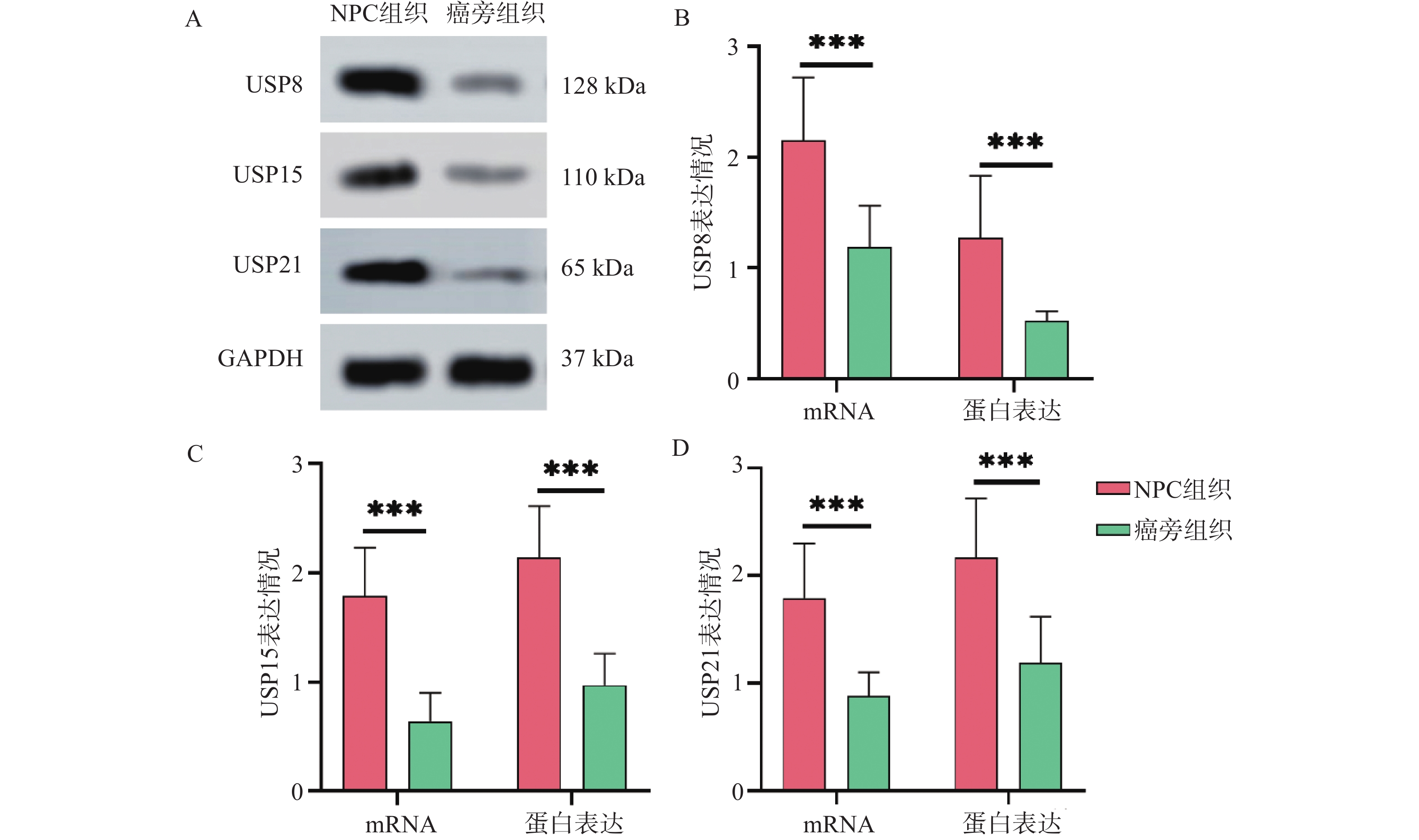
图 2 不同组织中USPs表达情况($ \bar x \pm s $,n = 227)
A:USP8、USP15、USP21蛋白条带图;B:USP8 mRNA相对表达量及蛋白统计图;C:USP15 mRNA相对表达量及蛋白统计图;D:USP21 mRNA相对表达量及蛋白统计图;与癌旁组织相比,***P < 0.001。
Figure 2. Expression of USPs in different tissues ($ \bar x \pm s $,n = 227)
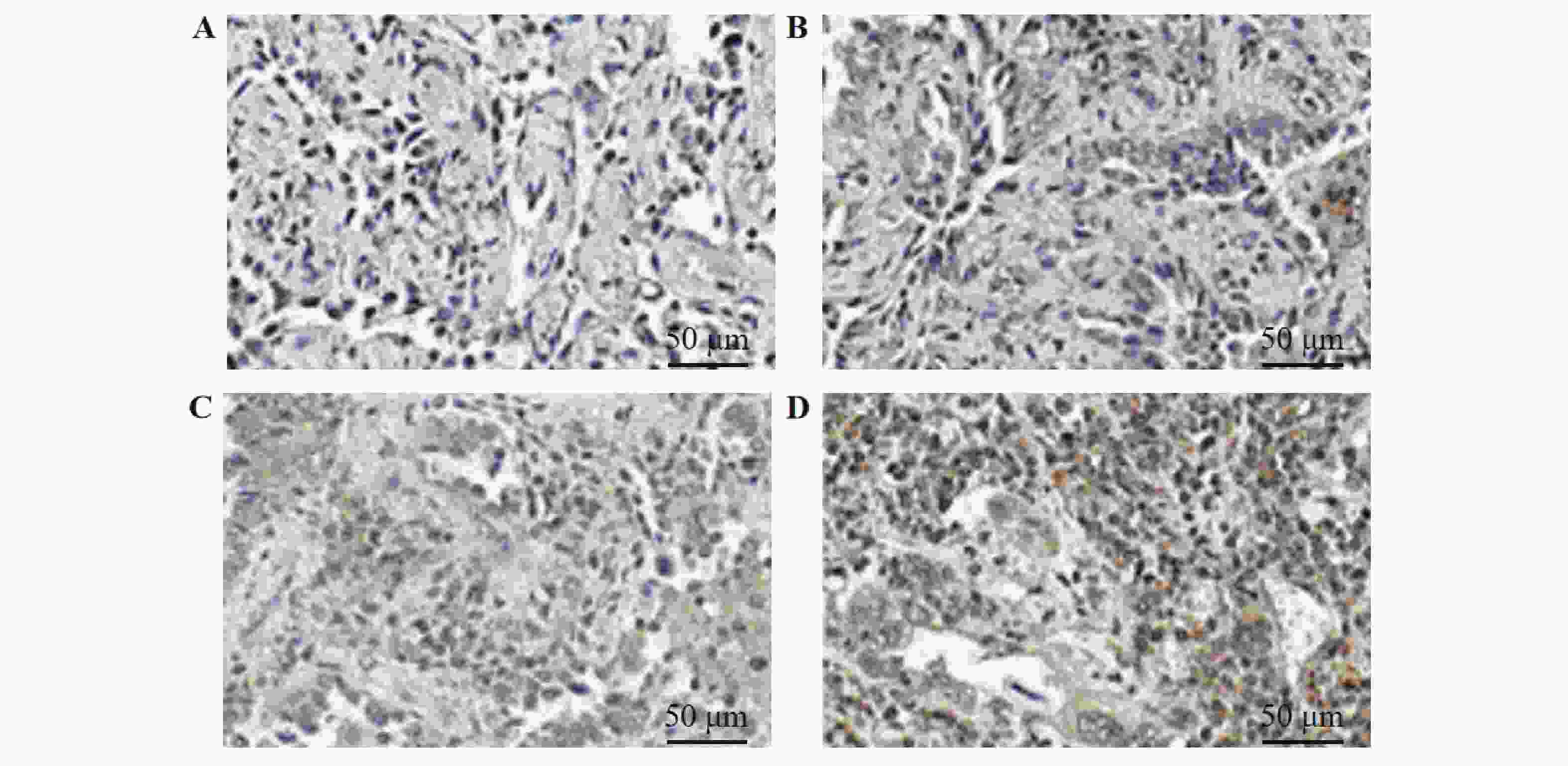
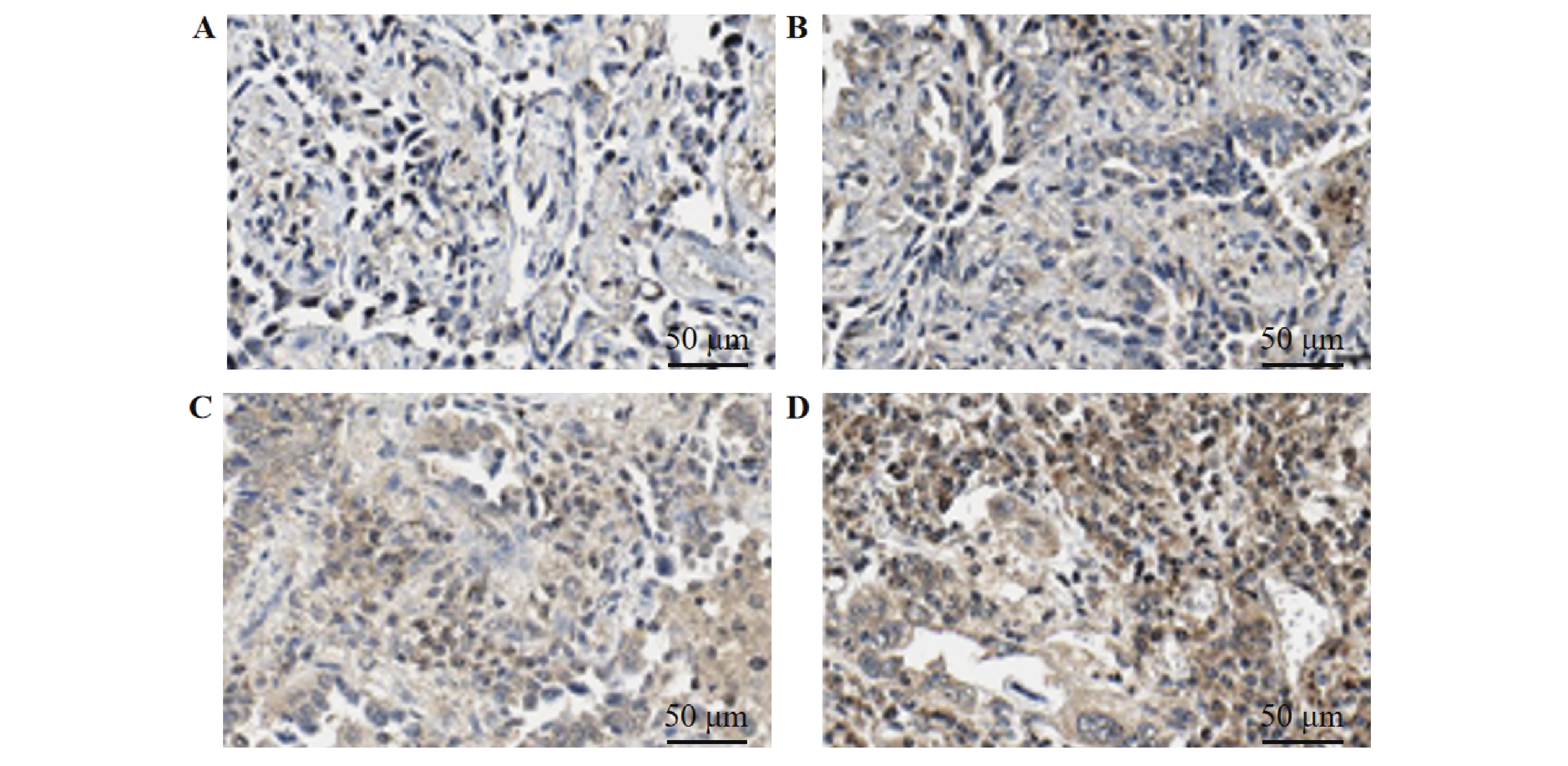
图 3 IHC法检测USP8、USP15、USP21在不同组织中的阳性表达情况(×200)
A:癌旁组织;B:USP8(胞质);C:USP15(胞质);D:USP21(胞核)。
Figure 3. Positive expression of USP8,USP15,and USP21 in different tissues detected by immunohistochemistry (IHC) (×200)
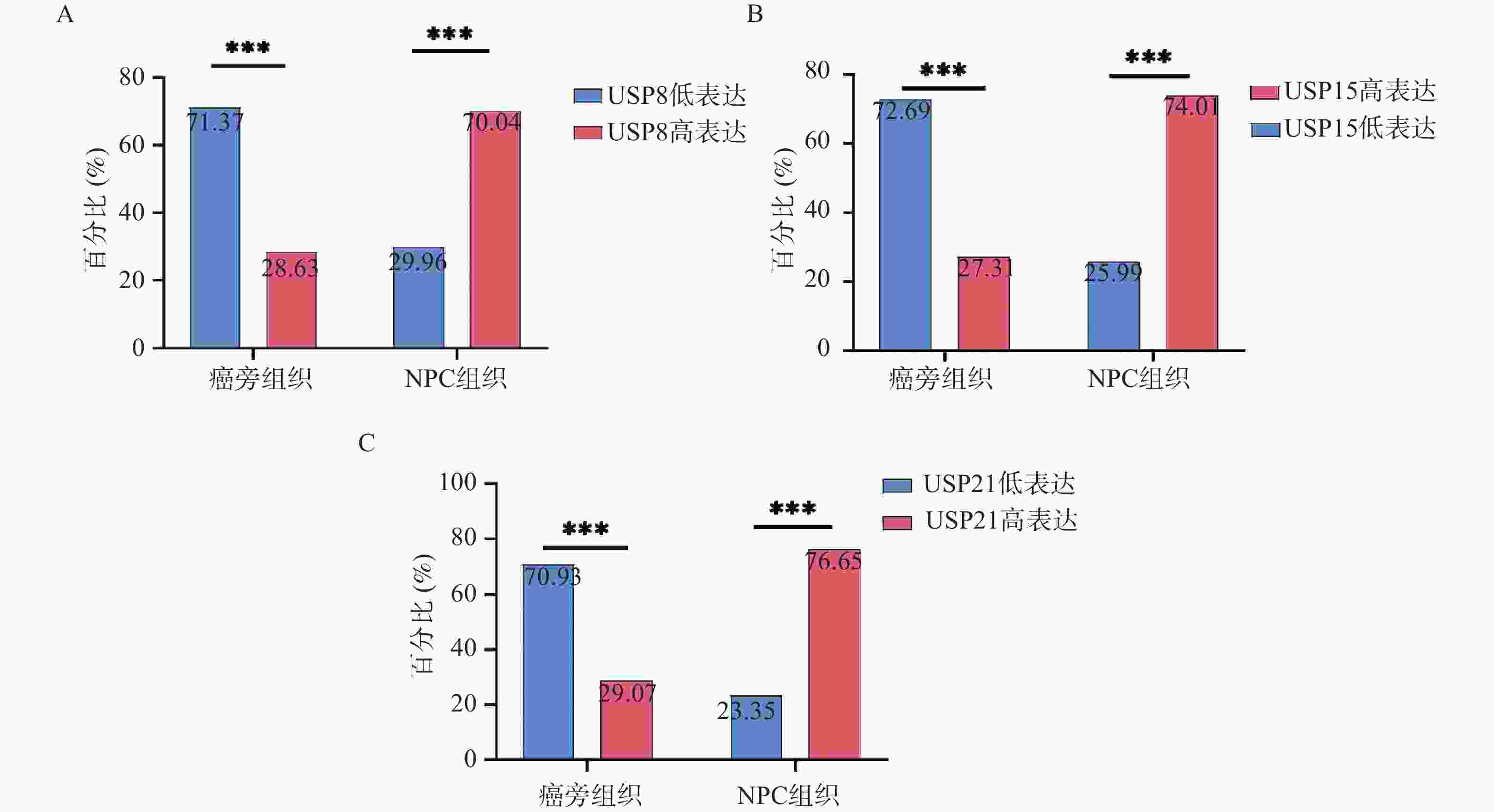
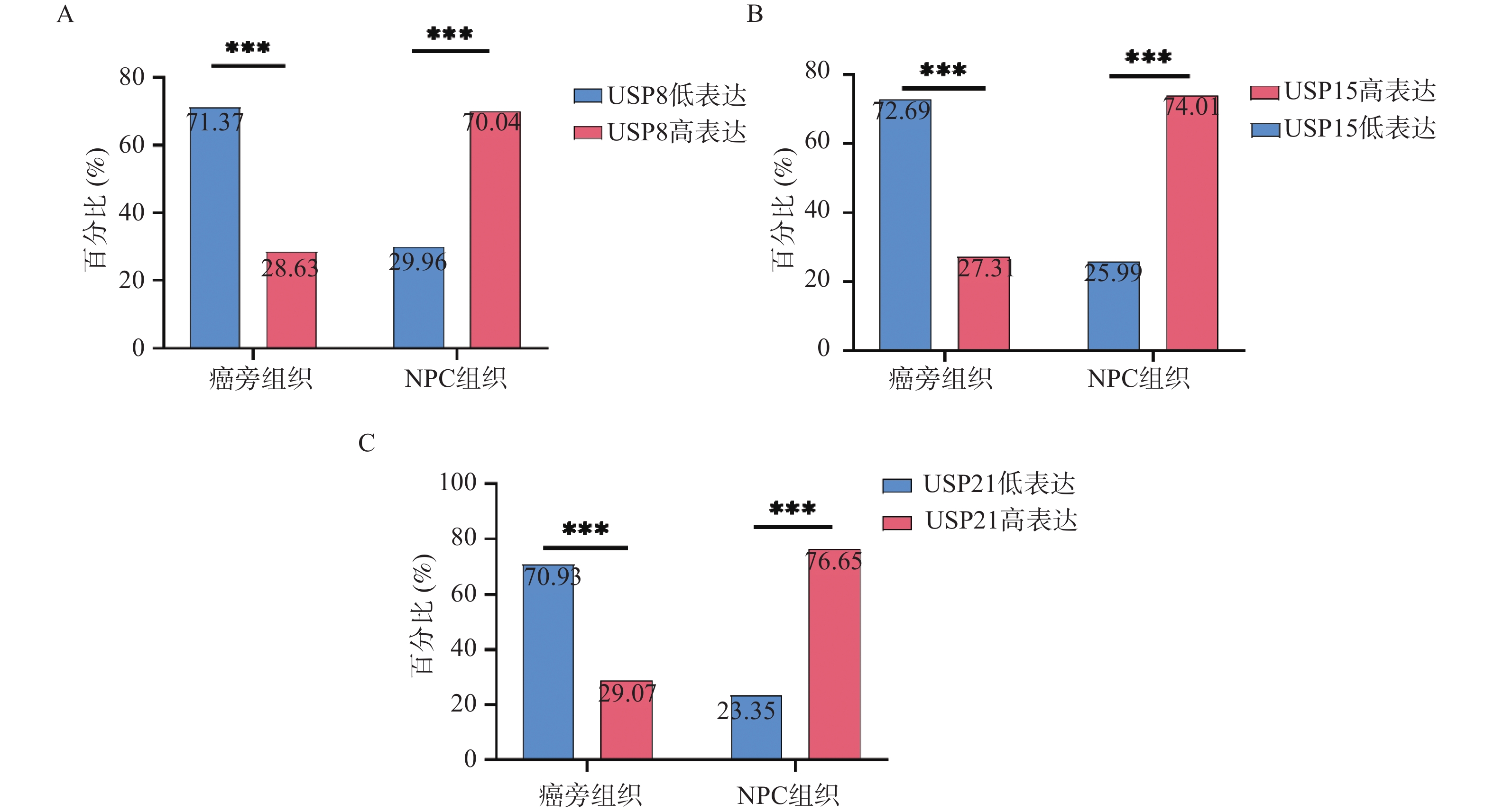
图 4 NPC组织、癌旁组织中USPs表达情况(n = 227)
A:USP8、B:USP15、C:USP21;***P < 0.001
Figure 4. the expression of USPs in NPC tissues and adjacent tissues (n = 227)
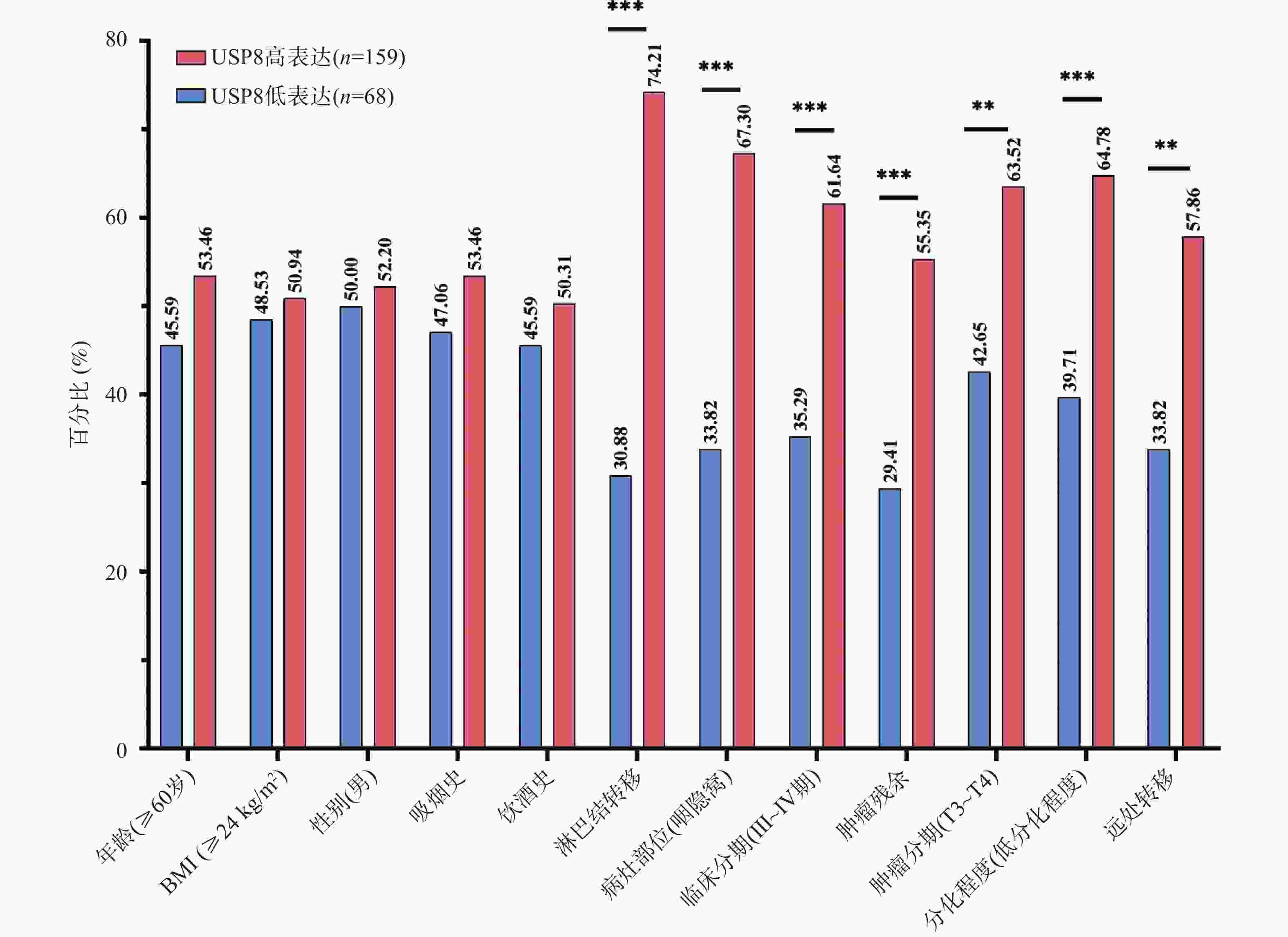
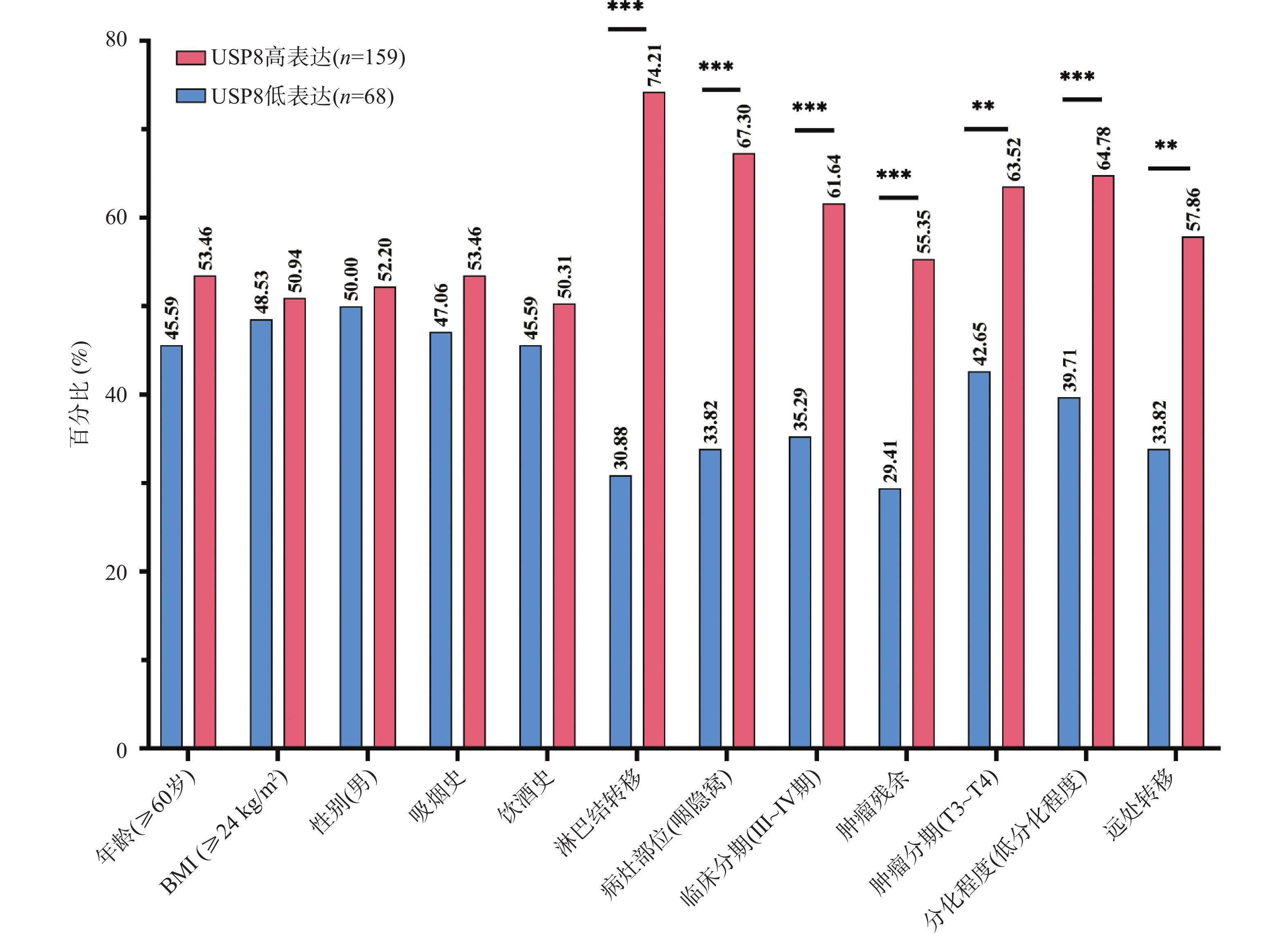
图 5 不同病理特征NPC患者USP8表达情况比较
**P < 0.01;***P < 0.001。
Figure 5. Comparison of USP8 expression among NPC patients with different pathological features
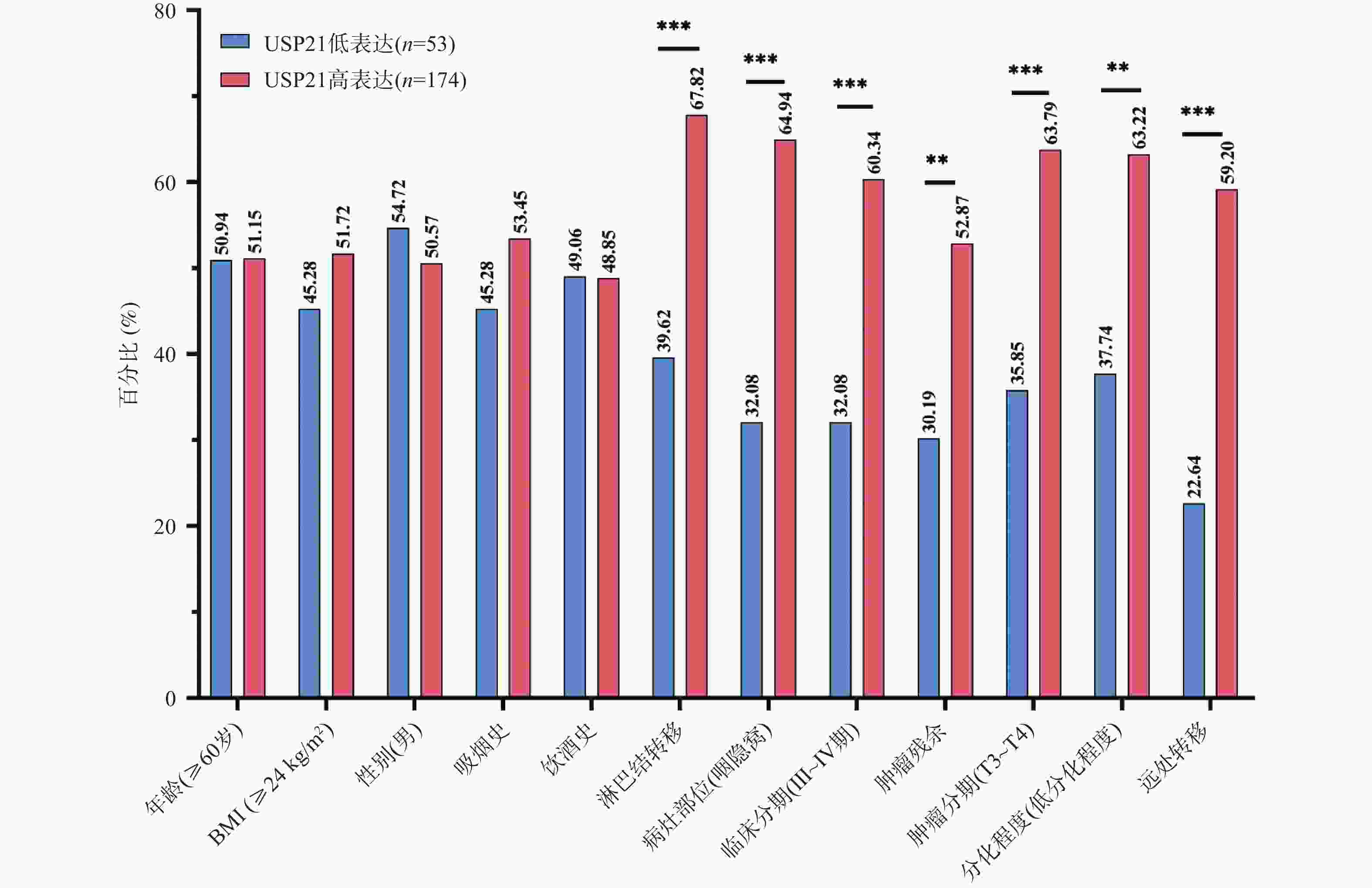
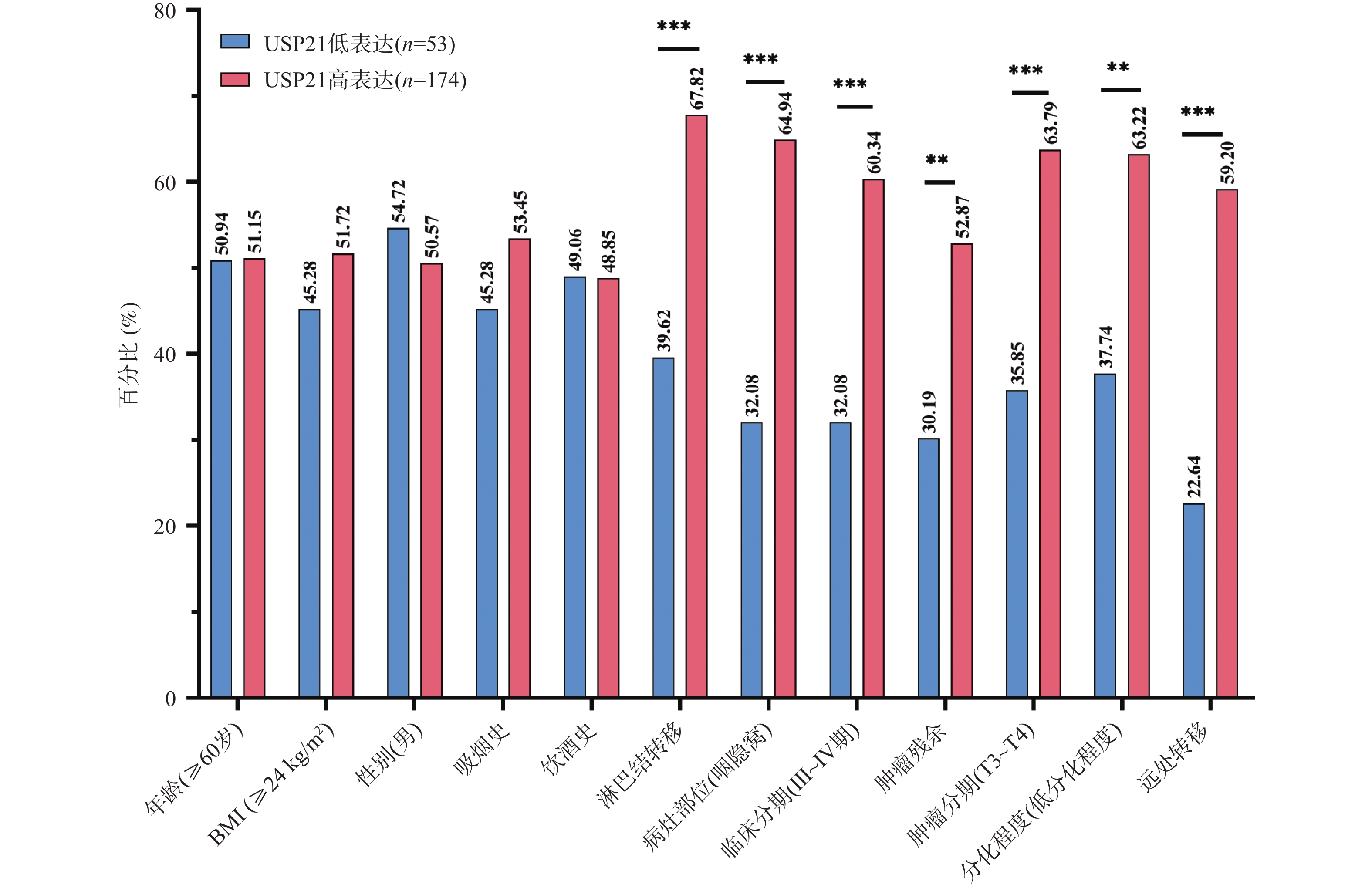
图 7 不同病理特征NPC患者USP21表达情况比较
**P < 0.01;***P < 0.001。
Figure 7. Comparison of USP21 expression in NPC patients with different pathological features
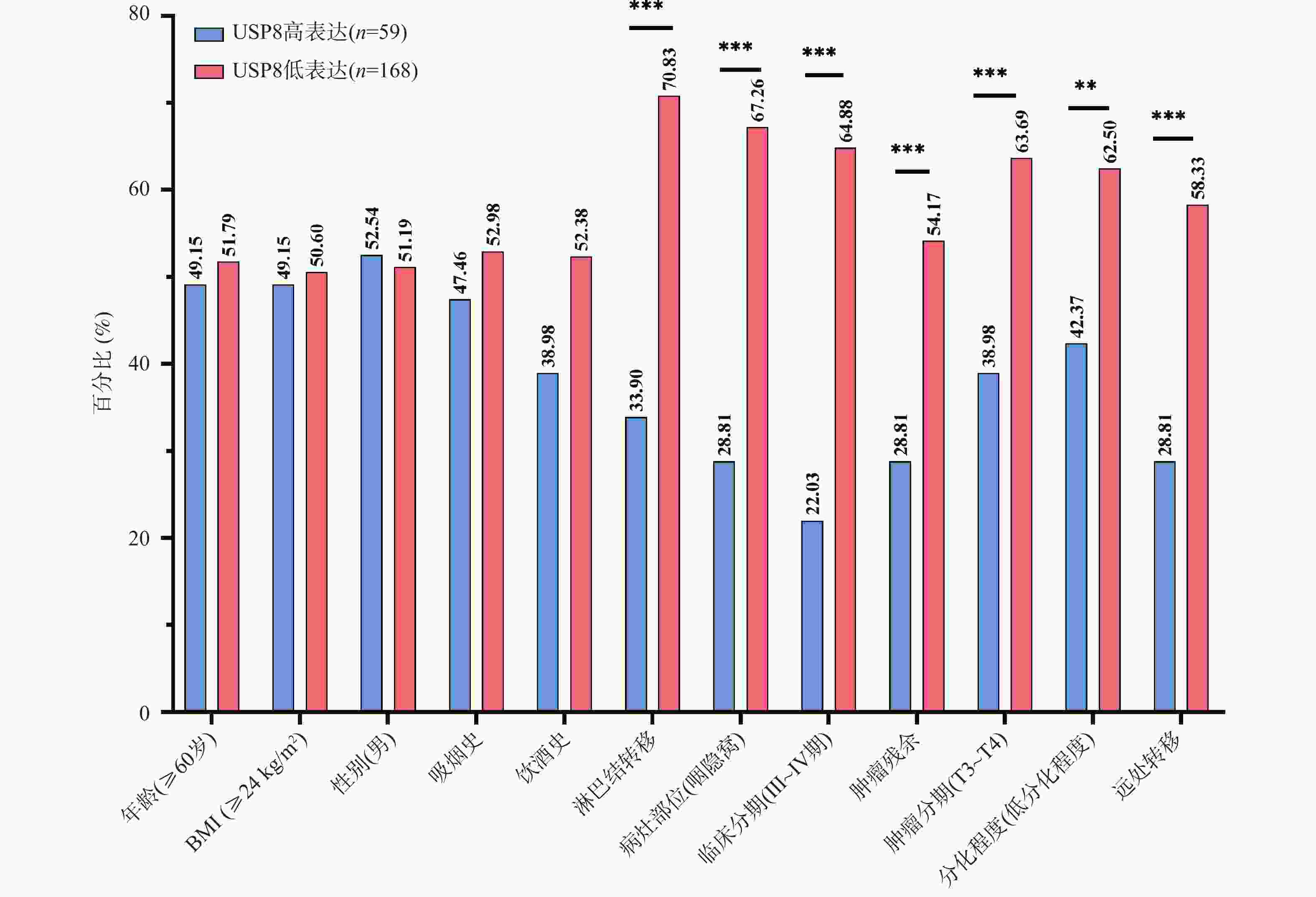
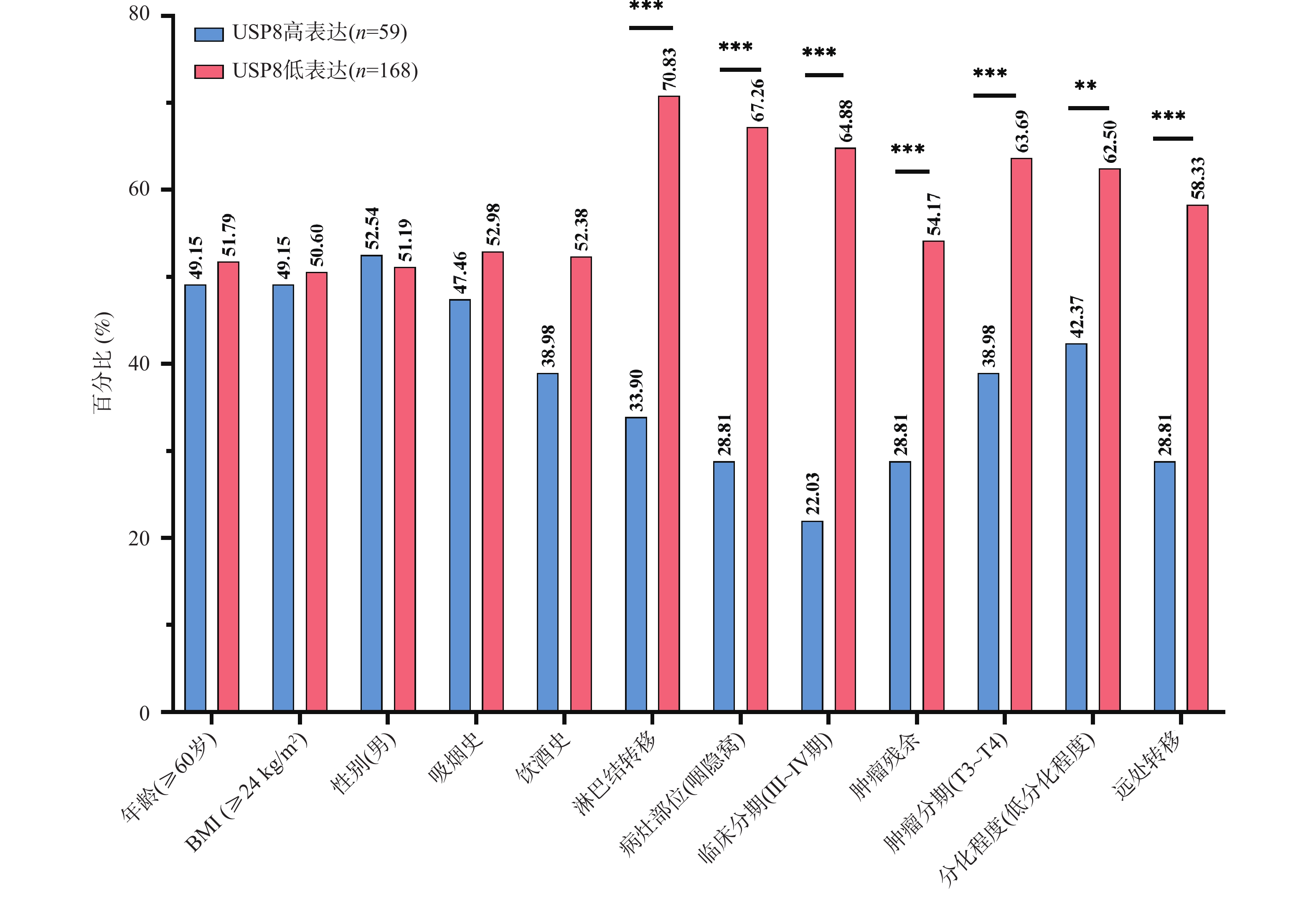
图 6 不同病理特征NPC患者USP15表达情况比较
**P < 0.01;***P < 0.001
Figure 6. Comparison of USP15 expression among NPC patients with different pathological features
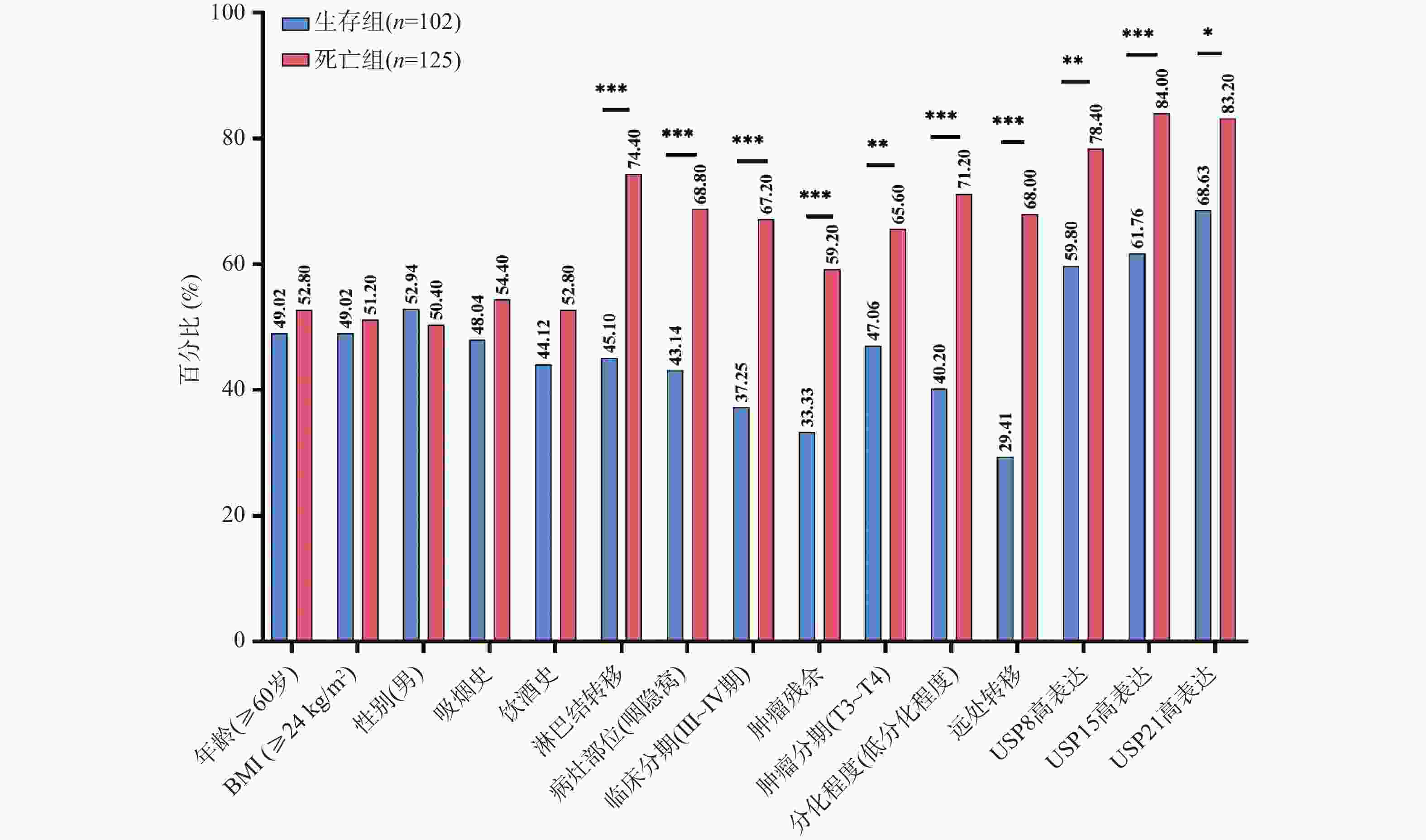
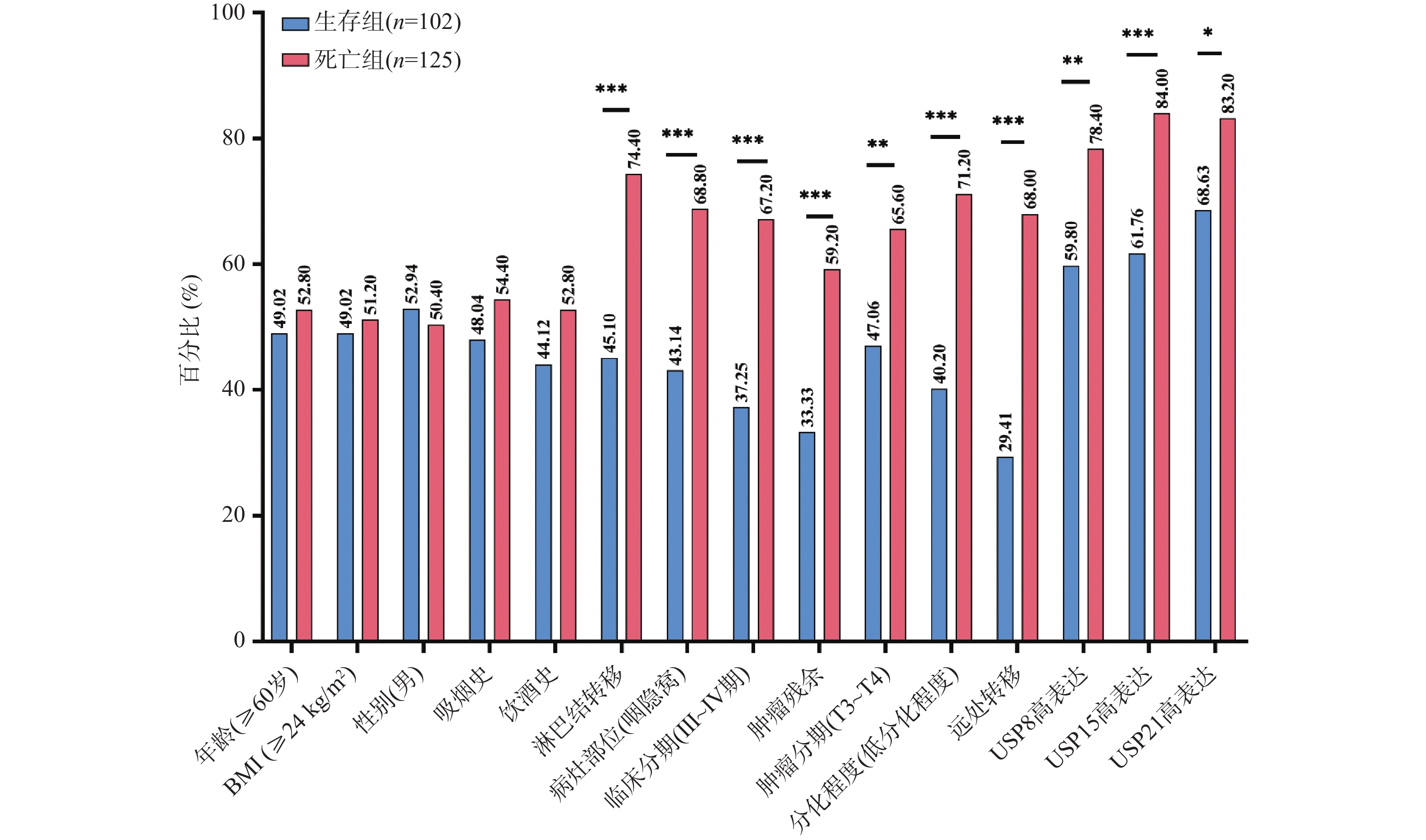
图 8 NPC患者生存组与死亡组临床病理特征的比较
*P < 0.05;**P < 0.01;***P < 0.001。
Figure 8. Comparison of clinicopathological features between the survival and death groups of NPC patients
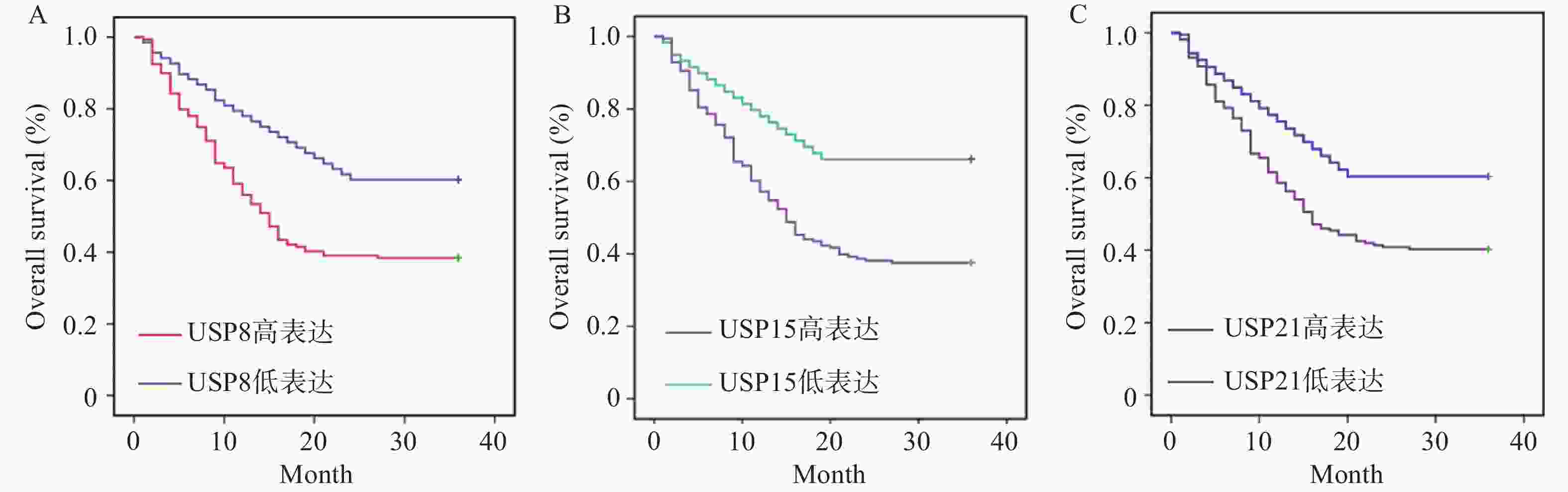
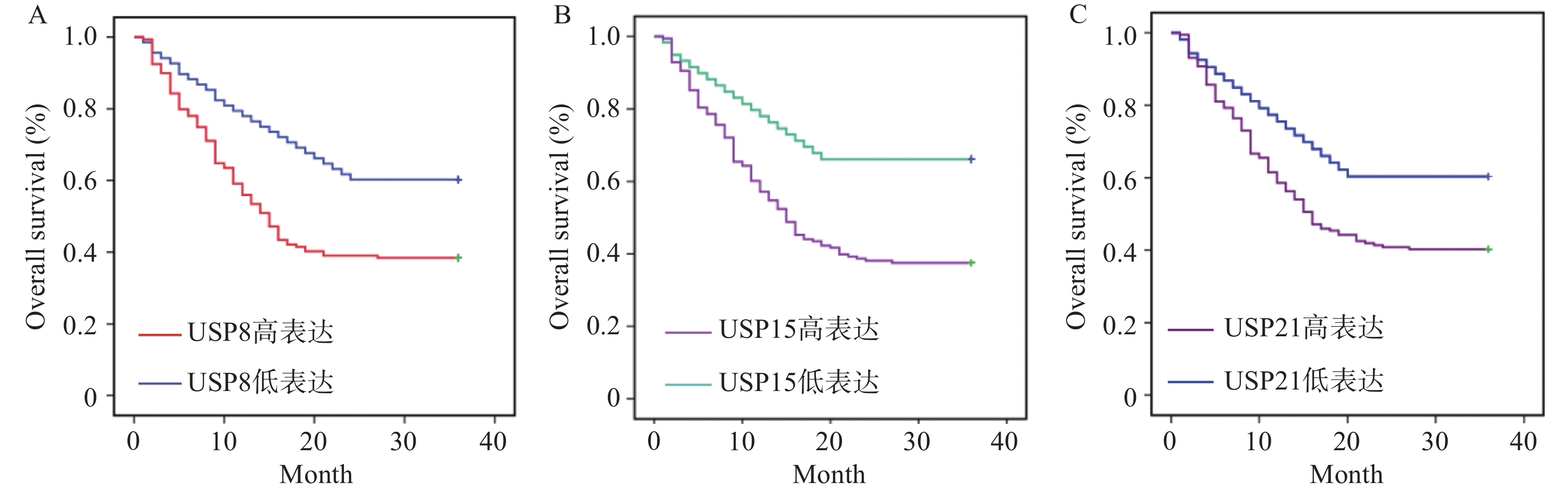
图 9 USPs表达对NPC患者的Kaplan-Meier生存曲线
A:不同USP8表达Kaplan-Meier生存曲线;B:不同USP15表达Kaplan-Meier生存曲线;C:不同USP21表达Kaplan-Meier生存曲线。
Figure 9. Kaplan-Meier survival curves of NPC patients stratified by USPs expression
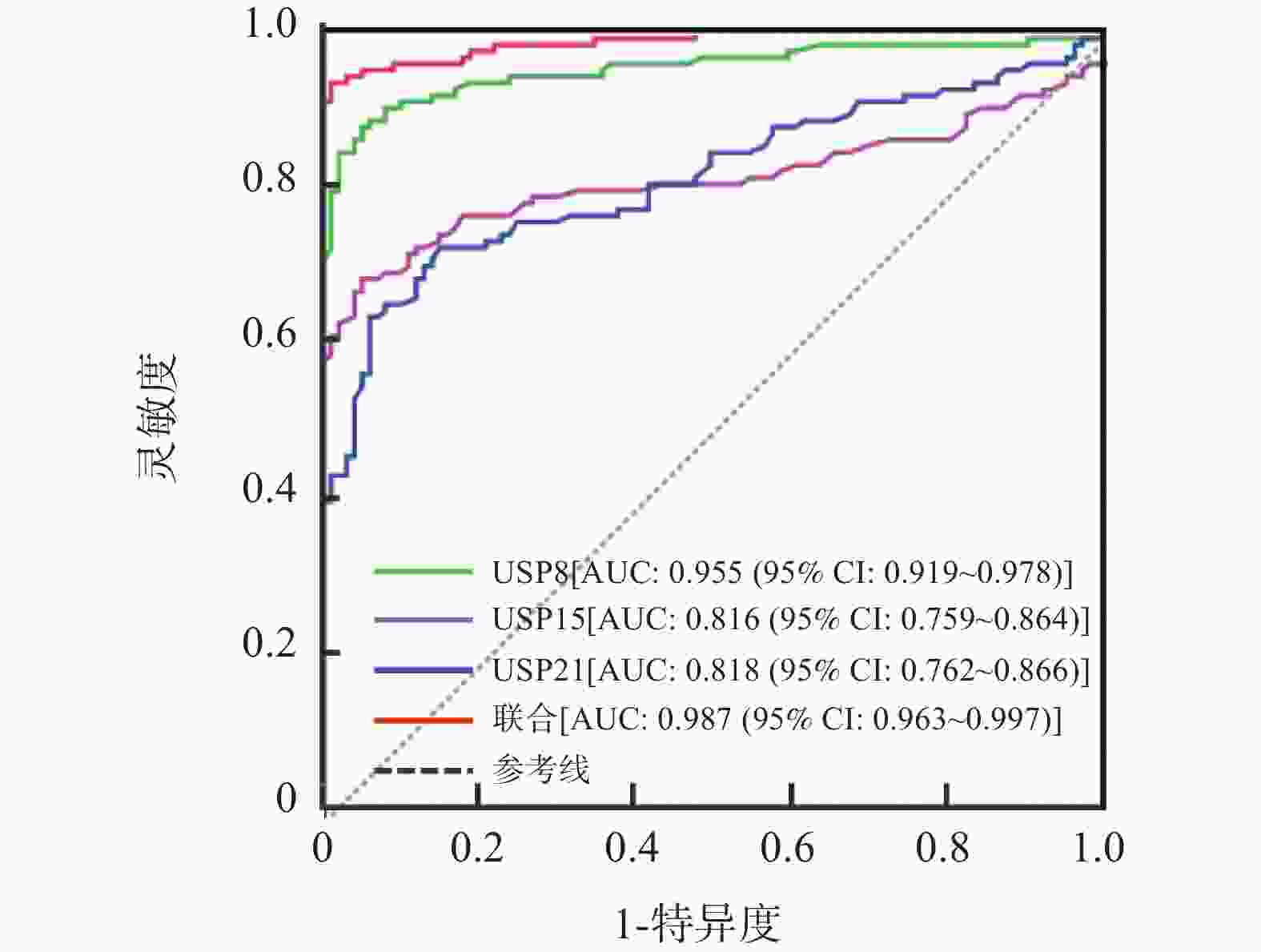
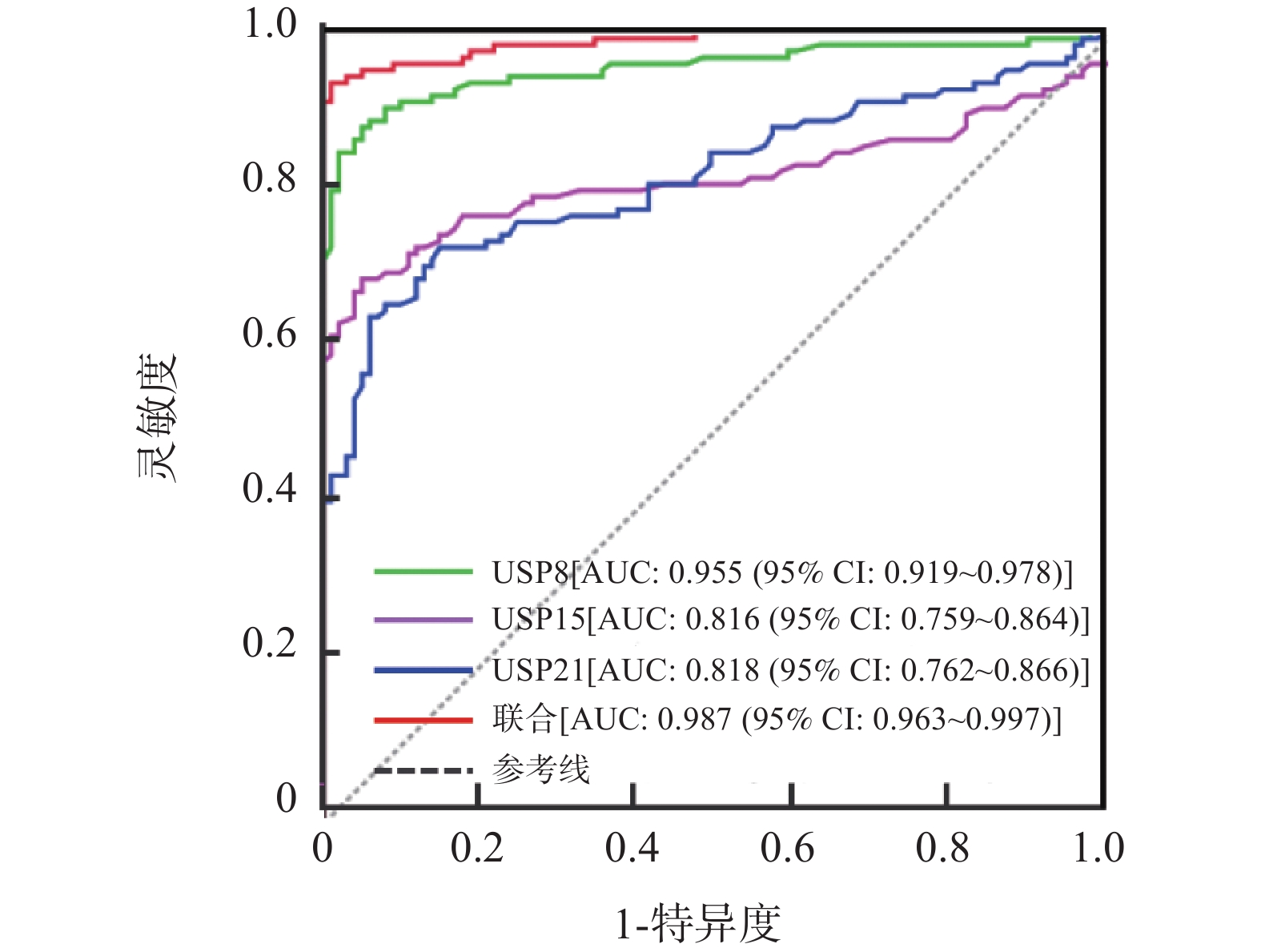
图 10 USP8、USP15、USP21对NPC患者预后的ROC曲线
Figure 10. ROC curves of USP8,USP15,and USP21 for the prognosis of NPC patients
表 1 引物序列
Table 1. Primer sequences
引物序列 正向 反向 USP8 5'-CCGGCGTCACGGAAAGAA-3' 5'-CAGGGCACTGTGCACATAA-3' USP21 5'-GTATGCCCTTTGCAACCACT-3' 5'-GGTGCCAGCATTAGAGGTG-3' USP15 5'-ACCAGACAGCACCATTCAGG-3' 5'-GATGCACCTGGGGACTTAGG-3' GAPDH 5'-GTCGCCAGCCGAGCC-3' 5'-AGTTAAAAGCAGCCCTGGTGA-3'  下载: 导出CSV
表 2 USP8、USP15、USP21在NPC组织、癌旁组织中的表达[n(%)]
Table 2. Expression of USP8,USP15,and USP21 in NPC versus adjacent non-tumor tissues[n(%)]
蛋白 癌旁组织/NPC组织 NPC组织低表达 NPC组织高表达 合计 配对χ2 P 一致性百分比 USP8 癌旁组织低表达 50(22.03) 112(49.34) 162(71.37) 67.969 <0.001* 42.73% 癌旁组织高表达 18(7.93) 47(20.70) 65(28.63) 合计 68(29.96) 159(70.04) 227(100.00) USP15 癌旁组织低表达 45(6.17) 120(52.86) 165(72.69) 83.851 <0.001* 40.97% 癌旁组织高表达 14(25.99) 48(21.15) 62(27.31) 合计 59(25.99) 168(74.01) 227(100.00) USP21 癌旁组织低表达 40(17.62) 121(53.30) 161(70.93) 87.045 <0.001* 40.97% 癌旁组织高表达 13(5.73) 53(23.35) 66(29.07) 合计 53(23.35) 174(76.65) 227(100.00) *P < 0.05。
下载: 导出CSV
表 3 不同病理特征NPC患者USP8表达情况比较[n(%)]
Table 3. Comparison of USP8 expression among NPC patients with different pathological features[n(%)]
参数 n USP8 χ2 P 低表达(n = 68) 高表达(n = 159) 年龄(岁) <60 111 37(54.41) 74(46.54) 1.181 0.277 ≥60 116 31(45.59) 85(53.46) BMI(kg/m2) <24 113 35(51.47) 78(49.06) 0.111 0.739 ≥24 114 33(48.53) 81(50.94) 性别 女 110 34(50.00) 76(47.80) 0.092 0.761 男 117 34(50.00) 83(52.20) 吸烟史 否 110 36(52.94) 74(46.54) 0.781 0.377 是 117 32(47.06) 85(53.46) 饮酒史 否 116 37(54.41) 79(49.69) 0.426 0.514 是 111 31(45.59) 80(50.31) 淋巴结转移 无 88 47(69.12) 41(25.79) 37.674 <0.001* 有 139 21(30.88) 118(74.21) 病灶部位 顶侧壁 97 45(66.18) 52(32.70) 21.806 <0.001* 咽隐窝 130 23(33.82) 107(67.30) 临床分期 Ⅰ~Ⅱ期 105 44(64.71) 61(38.36) 13.294 <0.001* Ⅲ~Ⅳ期 122 24(35.29) 98(61.64) 肿瘤残余 无 119 48(70.59) 71(44.65) 12.844 <0.001* 有 108 20(29.41) 88(55.35) 肿瘤分期 T1~T2 97 39(57.35) 58(36.48) 8.481 0.004* T3~T4 130 29(42.65) 101(63.52) 分化程度 中/高分化 97 41(60.29) 56(35.22) 12.237 <0.001* 低分化 130 27(39.71) 103(64.78) 远处转移 无 112 45(66.18) 67(42.14) 11.011 0.001* 有 115 23(33.82) 92(57.86) *P < 0.05。
下载: 导出CSV
表 5 不同病理特征NPC患者USP21表达情况比较[n(%)]
Table 5. Comparison of USP21 expression among NPC patients with different pathological features[n(%)]
参数 n USP21 χ2 P 低表达(n = 53) 高表达(n = 174) 年龄(岁) <60 111 26(49.06) 85(48.85) 0.001 0.979 ≥60 116 27(50.94) 89(51.15) BMI(kg/m2) <24 113 29(54.72) 84(48.28) 0.674 0.412 ≥24 114 24(45.28) 90(51.72) 性别 女 110 24(45.28) 86(49.43) 0.279 0.597 男 117 29(54.72) 88(50.57) 吸烟史 否 110 29(54.72) 81(46.55) 1.084 0.298 是 117 24(45.28) 93(53.45) 饮酒史 否 116 27(50.94) 89(51.15) 0.001 0.979 是 111 26(49.06) 85(48.85) 淋巴结转移 无 88 32(60.38) 56(32.18) 13.603 <0.001* 有 139 21(39.62) 118(67.82) 病灶部位 顶侧壁 97 36(67.92) 61(35.06) 17.933 <0.001* 咽隐窝 130 17(32.08) 113(64.94) 临床分期 Ⅰ~Ⅱ期 105 36(67.92) 69(39.66) 13.060 <0.001* Ⅲ~Ⅳ期 122 17(32.08) 105(60.34) 肿瘤残余 无 119 37(69.81) 82(47.13) 8.382 0.004* 有 108 16(30.19) 92(52.87) 肿瘤分期 T1~T2 97 34(64.15) 63(36.21) 12.963 <0.001* T3~T4 130 19(35.85) 111(63.79) 分化程度 中/高分化 97 33(62.26) 64(36.78) 10.780 0.001* 低分化 130 20(37.74) 110(63.22) 远处转移 无 112 41(77.36) 71(40.80) 21.717 <0.001* 有 115 12(22.64) 103(59.20)
下载: 导出CSV
表 4 不同病理特征NPC患者USP15表达情况比较[n(%)]
Table 4. Comparison of USP15 expression among NPC patients with different pathological features [n(%)]
参数 n USP15 χ2 P 低表达(n = 59) 高表达(n = 168) 年龄(岁) <60 111 30(50.85) 81(48.21) 0.121 0.728 ≥60 116 29(49.15) 87(51.79) BMI(kg/m2) <24 113 30(50.85) 83(49.40) 0.036 0.849 ≥24 114 29(49.15) 85(50.60) 性别 女 110 28(47.46) 82(48.81) 0.032 0.858 男 117 31(52.54) 86(51.19) 吸烟史 否 110 31(52.54) 79(47.02) 0.532 0.466 是 117 28(47.46) 89(52.98) 饮酒史 否 116 36(61.02) 80(47.62) 3.137 0.077 是 111 23(38.98) 88(52.38) 淋巴结转移 无 88 39(66.10) 49(29.17) 25.094 <0.001* 有 139 20(33.90) 119(70.83) 病灶部位 顶侧壁 97 42(71.19) 55(32.74) 26.377 <0.001* 咽隐窝 130 17(28.81) 113(67.26) 临床分期 Ⅰ~Ⅱ期 105 46(77.97) 59(35.12) 32.246 <0.001* Ⅲ~Ⅳ期 122 13(22.03) 109(64.88) 肿瘤残余 无 119 42(71.19) 77(45.83) 11.253 <0.001 有 108 17(28.81) 91(54.17) 肿瘤分期 T1~T2 97 36(61.02) 61(36.31) 10.892 <0.001* T3~T4 130 23(38.98) 107(63.69) 分化程度 中/高分化 97 34(57.63) 63(37.50) 7.228 0.007* 低分化 130 25(42.37) 105(62.50) 远处转移 无 112 42(71.19) 70(41.67) 15.223 <0.001* 有 115 17(28.81) 98(58.33) *P < 0.05。
下载: 导出CSV
表 6 NPC患者生存组与死亡组临床病理特征的比较[n(%)]
Table 6. Comparison of clinical and pathological characteristics between the survival and mortality groups of patients with NPC[n(%)]
参数 n 生存组(n = 102) 死亡组(n = 125) χ2 P 年龄(岁) <60 111 52(50.98) 59(47.20) 0.321 0.571 ≥60 116 50(49.02) 66(52.80) BMI(kg/m2) <24 113 52(50.98) 61(48.80) 0.107 0.744 ≥24 114 50(49.02) 64(51.20) 性别 女 110 48(47.06) 62(49.60) 0.145 0.703 男 117 54(52.94) 63(50.40) 吸烟史 否 110 53(51.96) 57(45.60) 0.910 0.340 是 117 49(48.04) 68(54.40) 饮酒史 否 116 57(55.88) 59(47.20) 1.694 0.193 是 111 45(44.12) 66(52.80) 淋巴结转移 无 88 56(54.90) 32(25.60) 20.316 <0.001* 有 139 46(45.10) 93(74.40) 病灶部位 顶侧壁 97 58(56.86) 39(31.20) 15.116 <0.001* 咽隐窝 130 44(43.14) 86(68.80) 临床分期 Ⅰ~Ⅱ期 105 64(62.75) 41(32.80) 20.260 <0.001* Ⅲ~Ⅳ期 122 38(37.25) 84(67.20) 肿瘤残余 无 119 68(66.67) 51(40.80) 15.068 <0.001* 有 108 34(33.33) 74(59.20) 肿瘤分期 T1~T2 97 54(52.94) 43(34.40) 7.890 0.005* T3~T4 130 48(47.06) 82(65.60) 分化程度 中/高分化 97 61(59.80) 36(28.80) 22.062 <0.001* 低分化 130 41(40.20) 89(71.20) 远处转移 无 112 72(70.59) 40(32.00) 33.460 <0.001* 有 115 30(29.41) 85(68.00) USP8 低表达 68 41(40.20) 27(21.60) 9.257 0.002* 高表达 159 61(59.80) 98(78.40) USP15 低表达 59 39(38.24) 20(16.00) 14.436 <0.001* 高表达 168 63(61.76) 105(84.00) USP21 低表达 53 32(31.37) 21(16.80) 6.665 0.010* 高表达 174 70(68.63) 104(83.20) *P < 0.05。
下载: 导出CSV
表 7 影响NPC患者预后的多因素Cox回归分析
Table 7. Multivariate Cox regression analysis of factors affecting the prognosis of NPC patients
参数 β SE Wald HR 95%CI P 病灶部位(咽隐窝) 0.965 0.194 24.637 2.624 1.793~3.841 <0.001* 临床Ⅲ~Ⅳ期 0.975 0.192 25.803 2.650 1.819~3.960 <0.001* 低分化程度 1.144 0.199 32.933 3.138 2.123~4.637 <0.001* 发生远处转移 1.047 0.193 29.315 2.848 1.950~4.160 <0.001* USP8高表达 0.667 0.218 9.382 1.949 1.272~2.988 0.002* USP15高表达 0.823 0.244 11.332 2.277 1.410~3.676 0.001* USP21高表达 0.574 0.240 5.742 1.775 1.110~2.839 0.017* *P < 0.05。
下载: 导出CSV
表 8 USP8、USP15、USP21表达与预后的关系[n(%)]
Table 8. Correlation between the expression of USP8,USP15,and USP21 and prognosis [n(%)]
指标 0个月生存率 12个月生存率 24个月生存率 36个月生存率 USP8 低表达 68(100.00) 53(77.94) 49(72.06) 41(60.29) 高表达 159(100.00) 93(58.49) 81(50.94) 61(38.36) USP15 低表达 59(100.00) 50(84.75) 42(71.19) 39(66.10) 高表达 168(100.00) 147(87.50) 125(74.40) 63(37.50) USP21 低表达 53(100.00) 47(88.68) 40(75.47) 32(60.38) 高表达 174(100.00) 115(66.09) 95(54.60) 70(40.23)
下载: 导出CSV
表 9 USP8、USP15、USP21对NPC患者预后的预测价值
Table 9. Predictive value of USP8,USP15,and USP21 for prognosis of NPC patients
变量 AUC 最佳Cut off值 95%CI 灵敏度(%) 特异度(%) 约登指数 USP8 0.955 >2.08 0.919~0.978 88.00 95.10 0.8310 USP15 0.816 >1.65 0.759~0.864 68.80 95.10 0.6390 USP21 0.818 >1.96 0.762~0.866 64.00 94.12 0.5812 联合 0.987 >0.613 0.963~0.997 93.60 99.02 0.9262
下载: 导出CSV
-
[1] Tong X, Xiang Y, Hu Y, et al. NSUN2 promotes tumor progression and regulates immune infiltration in nasopharyngeal carcinoma[J]. Front Oncol, 2022, 12: 788801. doi: 10.3389/fonc.2022.788801 [2] Tian Y, Huang W Z, Zeng L, et al. The failure patterns of nasopharygeal carcinoma after intensity-modulated radiotherapy and implications for surveillance[J]. Cancer Manag Res, 2022, 14: 2813-2823. doi: 10.2147/CMAR.S347864 [3] Kim Y, Kim E K, Jang H H. Fine-tuning protein fate: Mechanisms of E1, E2, and E3 enzymes and deubiquitinases in cell signaling[J]. Int J Mol Sci, 2026, 27(8): 3404. doi: 10.3390/ijms27083404 [4] Islam M T, Chen F, Chen H. The oncogenic role of ubiquitin specific peptidase (USP8) and its signaling pathways targeting for cancer therapeutics[J]. Arch Biochem Biophys, 2021, 701: 108811. doi: 10.1016/j.abb.2021.108811 [5] Li Y, Jiang C, Liu Q, et al. USP15 facilitates the progression of bladder cancer by amplifying the activation of the NF-κB signaling pathway[J]. Aging, 2024, 16(8): 6757-6772. doi: 10.18632/aging.205696 [6] Xu X, Chen Y, Shao S, et al. USP21 deubiquitinates and stabilizes HSP90 and ENO1 to promote aerobic glycolysis and proliferation in cholangiocarcinoma[J]. Int J Biol Sci, 2024, 20(4): 1492-1508. [7] 康敏, 王仁生, 潘建基, 等. 中国鼻咽癌放射治疗指南(2022版)[J]. 中华肿瘤防治杂志, 2022, 29(9): 611-622. [8] Ren Y, Qiu H, Yuan Y, et al. Evaluation of 7th edition of AJCC staging system for nasopharyngeal carcinoma[J]. J Cancer, 2017, 8(9): 1665-1672. [9] 陈意晴, 艾文彬, 谢蕙一, 等. DSCR1在鼻咽癌组织中的表达情况及临床意义[J]. 中南医学科学杂志, 2026, 54(2): 241-243+283. doi: 10.15972/j.cnki.43-1509/r.2026.02.012 [10] Chen Z, Liang Z, Chen K, et al. Serum ferritin predicted prognosis in patients with nasopharyngeal carcinoma[J]. Sci Rep, 2024, 14(1): 4311. doi: 10.1038/s41598-024-54627-3 [11] Zhao Y, Peng D, Liu Y, et al. Usp8 promotes tumor cell migration through activating the JNK pathway[J]. Cell Death Dis, 2022, 13(3): 286. doi: 10.1038/s41419-022-04749-1 [12] Niederkorn M, Ishikawa C, M Hueneman K, et al. The deubiquitinase USP15 modulates cellular redox and is a therapeutic target in acute myeloid leukemia[J]. Leukemia, 2022, 36(2): 438-451. doi: 10.1038/s41375-021-01394-z [13] Xia X, Huang C, Liao Y, et al. The deubiquitinating enzyme USP15 stabilizes ERα and promotes breast cancer progression[J]. Cell Death Dis, 2021, 12(4): 329. doi: 10.1038/s41419-021-03607-w [14] Yao P, Li X, Chai J, et al. METTL3-mediated M6A methylation of USP21 contributes to hepatocellular carcinoma progression by stabilizing H2BFS through deubiquitination[J]. Biochem Genet, 2025, 63(6): 5462-5479. doi: 10.1007/s10528-024-10992-2 [15] Yang L, Sui H, Ding Y, et al. Disulfiram impairs USP21-mediated MOF-K257 deubiquitination to inhibit esophageal squamous cell carcinoma progression[J]. Cancer Lett, 2025, 611: 217419. doi: 10.1016/j.canlet.2024.217419 [16] Li X, Li X. USP21 promotes the progression of nasopharyngeal carcinoma by regulating FOXM1[J]. Stem Cells Int, 2023, 2023: 9196583. [17] 陈璀璀, 李永磊, 芦二永. miR-9、miR-194在鼻咽癌组织中的表达及与其预后的关系[J]. 实用癌症杂志, 2024, 39(3): 438-442. doi: 10.3969/j.issn.1001-5930.2024.03.021 -

 点击查看大图
计量
- 文章访问数: 3
- HTML全文浏览量: 3
- PDF下载量: 0
- 被引次数: 0
