




Memory Reconsolidation and Intervention in Drug Addiction
-
摘要: 药物成瘾相关线索可通过唤起持久的药物奖赏记忆诱发渴求与复吸,靶向记忆再巩固被认为是削弱此类病理性记忆的重要策略。梳理药物成瘾记忆再巩固的时间边界、脑区网络和分子机制,并比较药理学、提取-消退及神经调控等干预的临床转化证据。现有研究提示,记忆提取后形成的短暂易损状态受预测误差、提取时长、记忆年龄和强度等边界条件制约;杏仁核、海马、前额叶皮层与伏隔核在该时间窗内形成动态网络,NMDAR、mTORC1、BDNF-TrkB、泛素-蛋白酶体系统及单胺递质共同参与记忆去稳定化与再稳定。动物研究证据较充分,而人体研究主要集中于普萘洛尔、氯胺酮和提取-消退程序,小样本、结局异质性及长期随访不足限制了证据确定性。本文进一步提出“边界条件—神经环路—分子可塑性—干预策略—临床结局”的多层级调控框架,以期为成瘾记忆精准干预和临床试验设计提供依据。Abstract: Drug-associated cues can evoke cravings and lead to relapse by reactivating persistent reward memories. Targeting memory reconsolidation is considered an important strategy for weakening these pathological memories. This article reviews the temporal boundaries, brain networks, and molecular mechanisms drug addiction memory reconsolidation, and compares the evidence for clinical translation of pharmacological, retrieval-extinction, and neuromodulatory interventions. Current research suggests that the transient state of vulnerability following memory retrieval is constrained by boundary conditions, including prediction error, retrieval duration, and memory age and strength. During this time window, the amygdala, hippocampus, prefrontal cortex, and nucleus accumbens form a dynamic network, while NMDAR, mTORC1, BDNF-TrkB, the ubiquitin-proteasome system, and monoaminergic neurotransmission jointly regulate destabilization and restabilization. Evidence from animal studies is relatively robust, whereas human research has focused primarily on propranolol, ketamine, and retrieval-extinction procedures. Small sample sizes, heterogeneous outcomes, and insufficient long-term follow-up limit the certainty of the evidence. This article further proposes a multilevel regulatory framework—“boundary conditions–neural circuits–molecular plasticity–intervention strategies–clinical outcomes”—to inform precision interventions for addiction-related memories and the design of clinical trials.
-
Key words:
- Drug addiction /
- Memory reconsolidation /
- Relapse /
- Cue-induced craving /
- Intervention strategies /
- Neuroplasticity
-
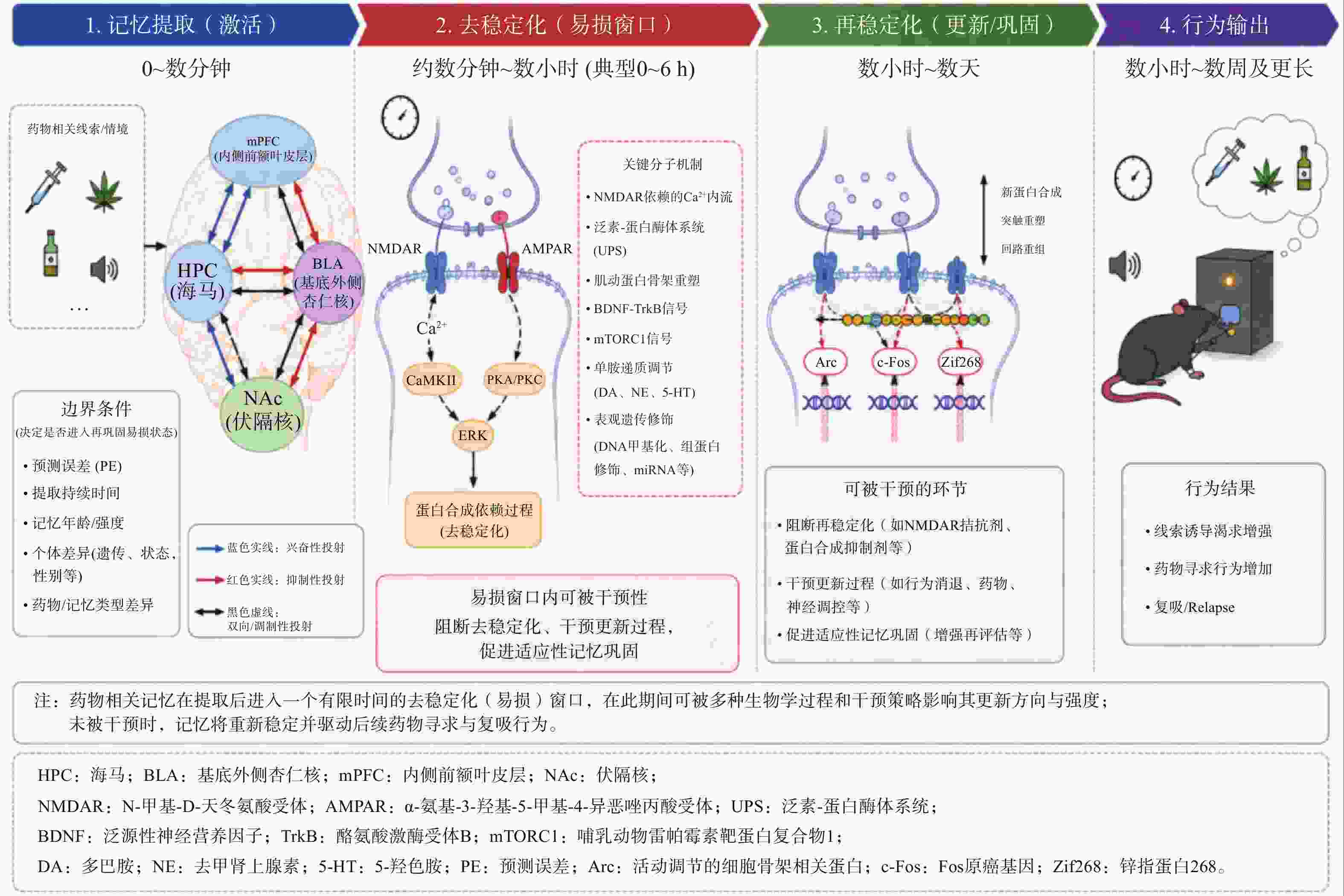
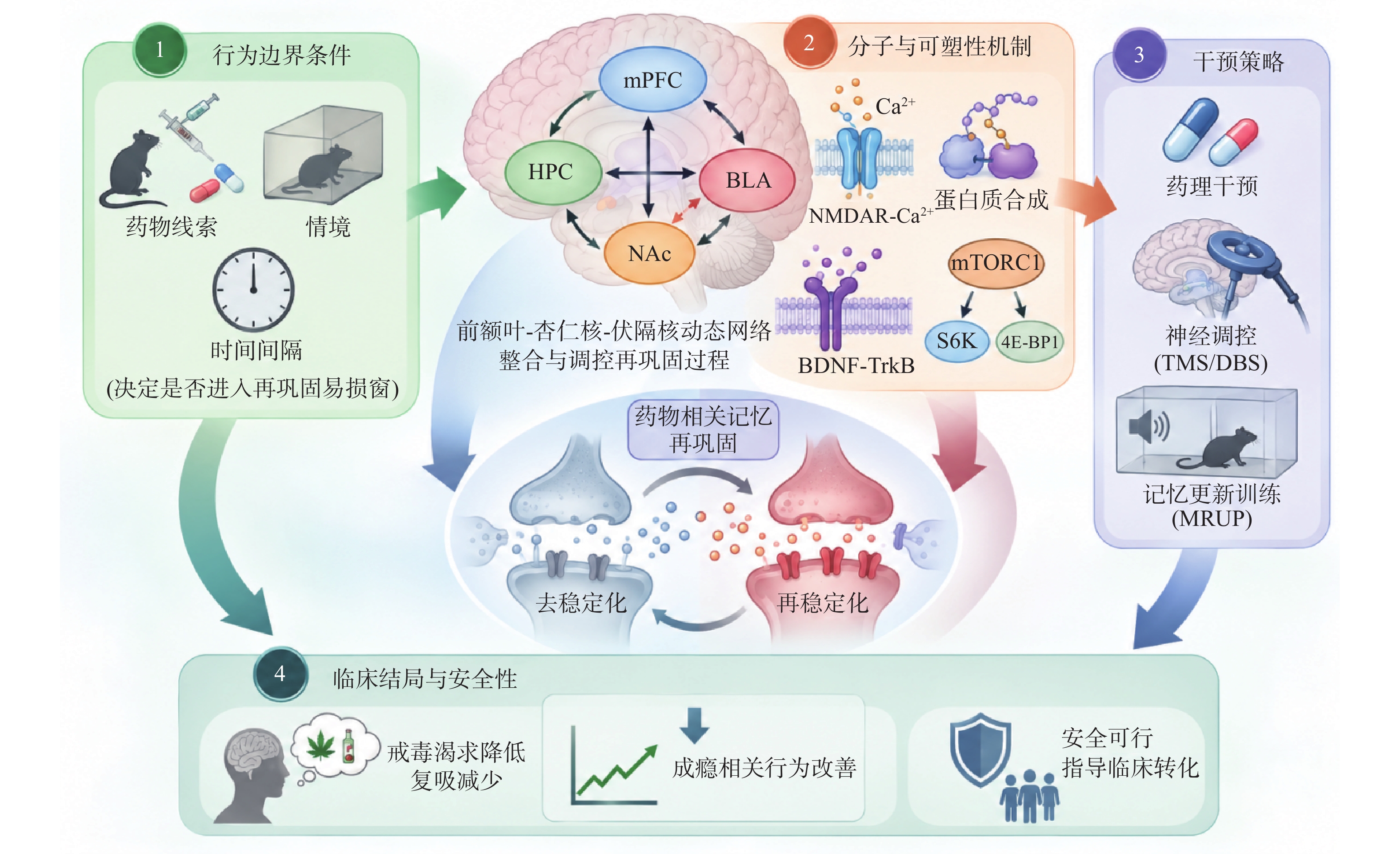
图 1 药物记忆再巩固的时间—环路—分子机制整合示意图
Figure 1. Integrated schematic of temporal,circuit,and molecular mechanisms underlying drug memory reconsolidation
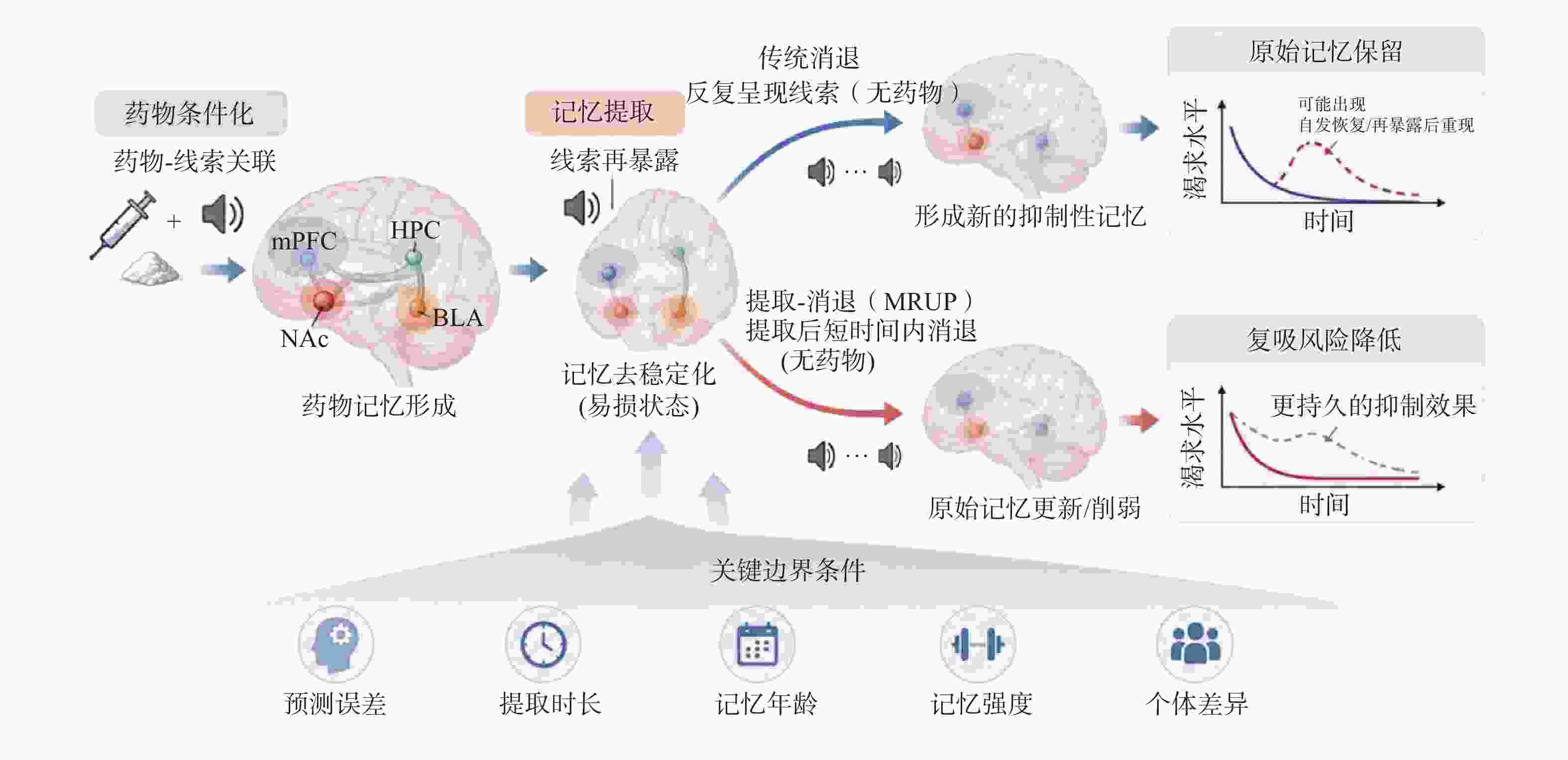
图 2 传统消退与MRUP的时间流程及关键边界条件
Figure 2. Temporal procedures and key boundary conditions of conventional extinction and retrieval-extinction (MRUP)
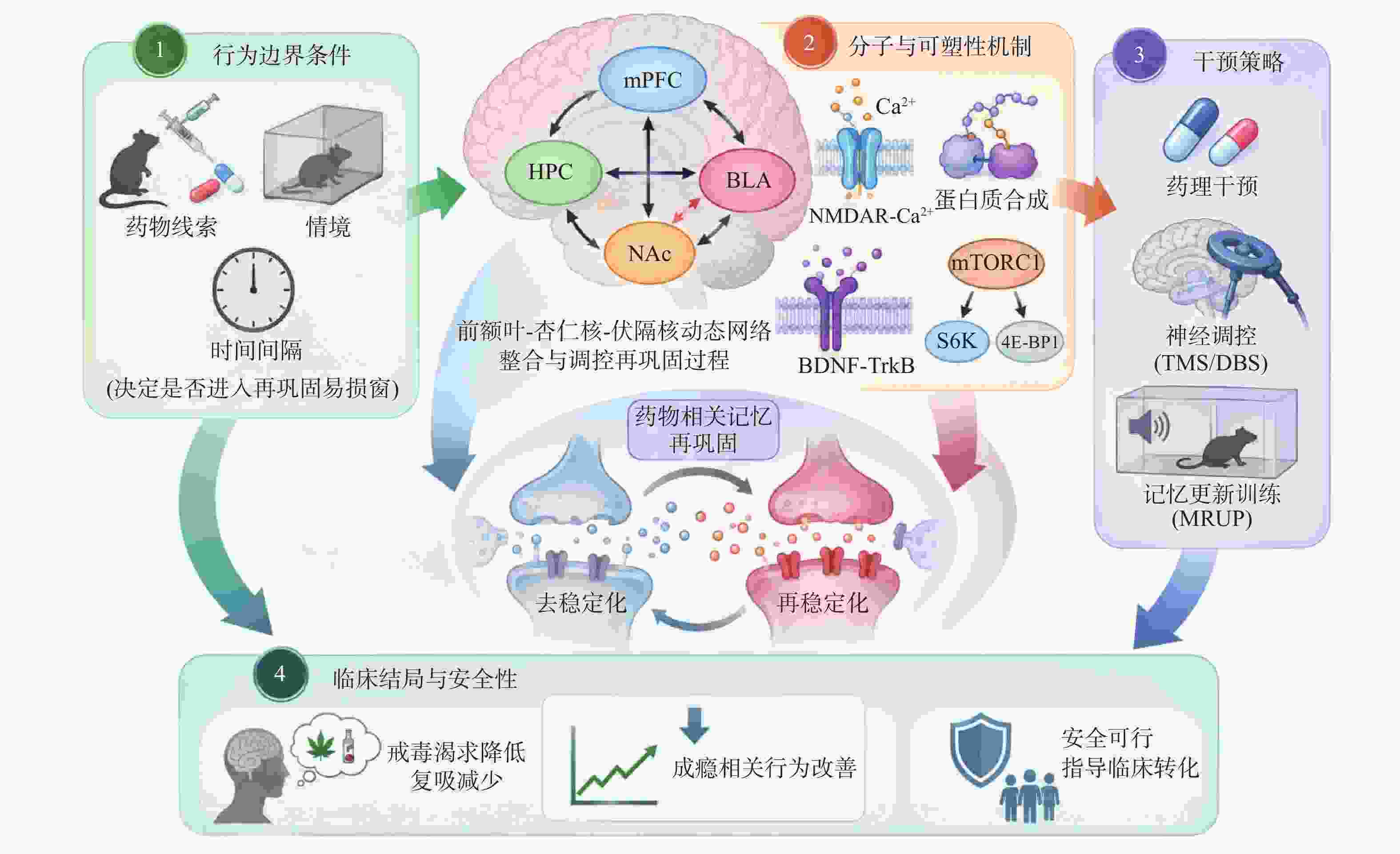
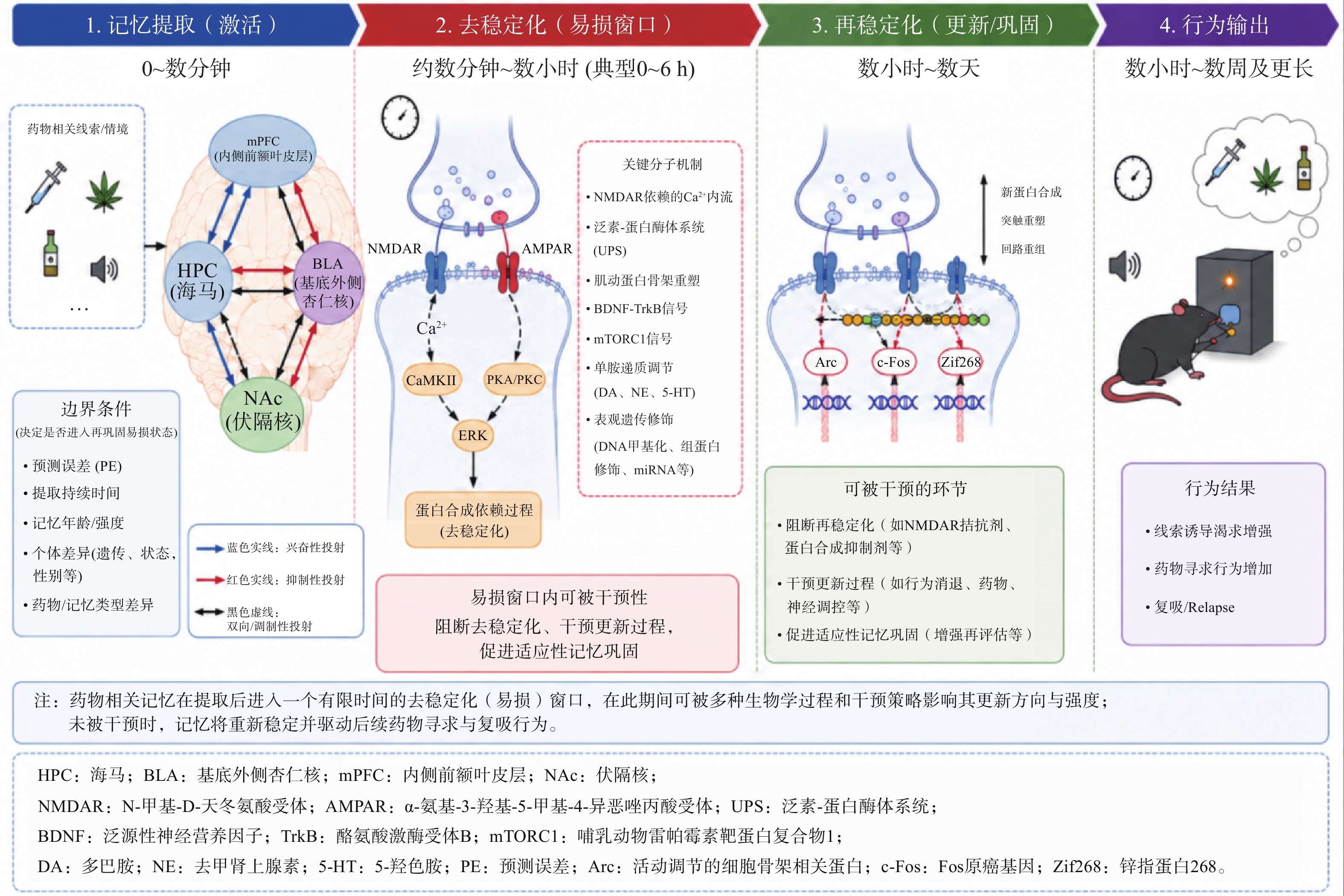
图 3 药物成瘾记忆再巩固的多层级调控模型
Figure 3. Multilevel regulatory model of memory reconsolidation in drug addiction
表 1 不同靶向记忆再巩固干预策略的比较
Table 1. Comparison of intervention strategies targeting memory reconsolidation
干预策略 具体方法/药物 主要靶点/机制 优势与局限 证据来源与确定性 药理学
干预普萘洛尔(β-AR拮抗剂) 阻断去甲肾上腺素信号,抑制杏仁核再巩固所需的蛋白合成 优点:操作简便,起效快,多项人类研究阳性结果
局限性:存在禁忌症(哮喘、低血压等);个体差异大;可能影响其他情绪记忆低:人体小样本RCT结果不一致,长期复吸结局不足 NMDAR拮抗剂(MK-801、氯胺酮) 阻断谷氨酸能信号,破坏记忆不稳定化 优点:动物模型效果明确
局限性:精神副作用(解离、幻觉)显著,临床转化困难低:成瘾记忆证据以动物为主;氯胺酮有人体转化研究但外推受限 mTOR抑制剂(雷帕霉素) 抑制再巩固所需的新蛋白合成 优点:选择性高,动物模型效果好
局限性:免疫抑制作用;人类研究极少极低:主要为动物研究,缺乏成瘾患者RCT 行为学
干预提取-消退联合训练(MRUP) 先利用提取使记忆进入易损窗,再行消退,实现记忆更新 优点:非侵入性,无药物
副作用;已在小规模临床研究中验证
局限性:操作时机(窗口期)要求严格;提取范式需精确设计;效果可能受个体差异影响低-中:有人体对照研究和较长随访,但样本量及范式异质性较大 厌恶对抗条件(如LiCl配对) 在再巩固窗口内将线索与厌恶结果重新配对,替换奖赏值 优点:动物模型中效果持久(14d以上)
局限性:厌恶刺激(如LiCl)人体不可接受;仅限动物实验极低:动物实验为主,人体可接受性差 物理干预 TMS
(经颅磁刺激)调节前额叶等脑区兴奋性,可能干扰再巩固过程 优点:无创,靶点精确,可与提取-消退联用
局限性:设备昂贵;参数未标准化;独立干预效果证据不足极低-低:TMS有成瘾临床研究,但再巩固特异性设计不足  下载: 导出CSV
表 2 靶向药物相关记忆再巩固的代表性人体对照研究及证据特征
Table 2. Representative controlled human studies targeting drug-related memory reconsolidation and their evidence characteristics
研究 研究对象/设计 样本量 干预方案 主要结果/效应量 随访 证据评价 Xue等[47] 戒断海洛因使用者;三组对照 n=66(各组22) 线索提取后10 min消退 vs 6 h消退 vs 无提取消退 10 min组线索诱导渴求和血压反应降低;6 h组未显示同等效应 1、30、180 d 低-中:时间窗对照明确且随访较长;主要结局为渴求,非真实复吸 Saladin等[38] 可卡因依赖;双盲随机安慰剂对照 n=50 线索提取后普萘洛尔40 mg vs 安慰剂 24 h时渴求及心血管线索反应下降更明显;1周组间差异消失,未证实可卡因使用减少 24 h、1周 低:小样本、实验室线索结局,疗效未持续 Pachas等[39] 吸烟者;随机双盲安慰剂对照 n=54 记忆再激活前单次普萘洛尔 vs 安慰剂 1周后生理反应、负性情绪及渴求均未见普萘洛尔优势 1周 低:阴性RCT;提示单次给药/提取范式可能不足 Jobes等[40] 美沙酮维持的阿片依赖合并可卡因使用者;随机双盲 n=33 个体化可卡因脚本再激活前普萘洛尔40 mg vs 安慰剂 未观察到稳定的线索渴求或可卡因使用获益 1周、5周 低:小样本、复杂共病/多药使用,但为重要阴性证据 Lonergan等[41] 治疗寻求型物质依赖;先导随机双盲安慰剂对照 n=17(9/8) 6次个体化成瘾记忆再激活前普萘洛尔 vs 安慰剂 组×时间交互F(1,14)=5.68,P=0.03;普萘洛尔组渴求d=1.40 无长期随访 极低:效应量大,但样本极小且缺乏随访 Germeroth等[48] 尼古丁依赖吸烟者;随机临床试验 n=88随机;72完成1个月随访 吸烟记忆提取-消退 vs 中性提取-消退 1个月线索渴求d=0.44;每日吸烟量d=0.50;复吸/戒断天数及尿可替宁无显著差异 1个月 低-中:RCT、行为结局较直接;复吸指标阴性且随访仍较短 Xue等[42] 男性吸烟者;动物-人体转化随机对照 n=96入组;69纳入分析 普萘洛尔40 mg + 尼古丁UCS记忆提取,并设置时序对照 既有线索诱导渴求d=0.64;尼古丁启动诱导渴求d=1.15;多项线索偏好d≈0.57-0.92 短期实验随访 低:存在效应量支持,但仅男性、脱落较多、缺乏戒烟/复吸终点 Das等[45] 有害饮酒者;随机单盲安慰剂对照 n=90(3组各30) 酒精奖赏记忆提取后静脉氯胺酮 vs 提取+安慰剂/无提取+氯胺酮 提取+氯胺酮组短期酒精强化价值及饮酒量下降;部分改善延续数月 最长9个月 低-中:RCT且随访较长;对象为有害饮酒者而非典型治疗寻求型AUD Lin等[37] 男性吸烟者;随机、盲法、安慰剂对照 n=52(27/25) 尼古丁相关记忆提取前单次普萘洛尔 组×时间交互F(1,50)=9.55,P=0.003,η2=0.162;渴求下降并伴随脑功能连接改变 约3 d 低:有人体随机与影像学证据,但单中心、随访短且仅男性 Yu等[43] 酒精依赖患者;随机安慰剂对照 n=40(20/20) CS记忆提取后普萘洛尔20 mg vs 安慰剂 普萘洛尔组VAS渴求下降F=56.017,P<0.001;安慰剂组F=0.183,P>0.05 短期测试 低:直接临床证据,但样本量小、缺乏长期饮酒/复吸结局 Yue等[49] 甲基苯丙胺使用障碍;单中心三组随机对照 n=98分析 提取+10 min+消退 vs 提取+6 h+消退 vs 中性提取+10 min+消退 10 min组在随访中持续降低线索渴求(组×时间×线索F(2,94)=14.32,P<0.001)及皮质醇反应 34 d、184 d 中等偏低:直接检验时间窗、6个月随访;单中心且主要为替代结局 注:GRADE严格用于针对特定结局的“证据体”,而非对单篇研究机械分级[8]。本表的“证据评价”仅作叙述性判断,综合考虑随机化/盲法、样本量与不精确性、结局直接性、随访长度以及研究间一致性,用于显示证据强弱及主要降级原因,不替代正式系统评价中的GRADE证据概况。
下载: 导出CSV
-
[1] Huang S, Liu X, Li Z, et al. Memory reconsolidation updating in substance addiction: Applications, mechanisms, and future prospects for clinical therapeutics[J]. Neurosci Bull, 2025, 41(2): 289-304. doi: 10.1007/s12264-024-01294-z [2] de Almeida-Antunes N A, Sampaio A C S, Crego M A B, et al. Tackling addictive behaviors through memory suppression: A scoping review and perspective[J]. Alcohol Clin Exp Res, 2024, 48(8): 1421-1442. doi: 10.1111/acer.15381 [3] Walsh K H, Das R K, Saladin M E, et al. Modulation of naturalistic maladaptive memories using behavioural and pharmacological reconsolidation-interfering strategies: A systematic review and meta-analysis of clinical and ‘sub-clinical’ studies[J]. Psychopharmacology, 2018, 235(9): 2507-2527. doi: 10.1007/s00213-018-4983-8 [4] Das R K, Freeman T P, Kamboj S K. The effects of N-methyl d-aspartate and B-adrenergic receptor antagonists on the reconsolidation of reward memory: A meta-analysis[J]. Neurosci Biobehav Rev, 2013, 37(3): 240-255. doi: 10.1016/j.neubiorev.2012.11.018 [5] Milton A L. Drug memory reconsolidation: From molecular mechanisms to the clinical context[J]. Transl Psychiatry, 2023, 13: 370. doi: 10.1038/s41398-023-02666-1 [6] Xu R, Shi D, Wang K, et al. Progress in spatiotemporal regulation of fear memory: Neural circuit mechanisms and implications for PTSD[J]. Gen Psychiatry, 2025, 38(4): e102224. doi: 10.1136/gpsych-2025-102224 [7] Conde-Dusman, María J et al. Control of protein synthesis and memory by GluN3A-NMDA receptors through inhibition of GIT1/mTORC1 assembly[J]. eLife vol. 10 e71575. [8] Balshem H, Helfand M, Schünemann H J, et al. GRADE guidelines: 3. Rating the quality of evidence[J]. J Clin Epidemiol, 2011, 64(4): 401-406. [9] Li J, Dong Y, Chen W, et al. Exploring post-retrieval strategies to reduce drug craving in methamphetamine use disorders[J]. Addict Biol, 2025, 30(6): e70049. doi: 10.1111/adb.70049 [10] Tronson N C, Taylor J R. Addiction: A drug-induced disorder of memory reconsolidation[J]. Curr Opin Neurobiol, 2013, 23(4): 573-580. doi: 10.1016/j.conb.2013.01.022 [11] Sorg B A. Reconsolidation of drug memories[J]. Neurosci Biobehav Rev, 2012, 36(5): 1400-1417. doi: 10.1016/j.neubiorev.2012.02.004 [12] Nader K, Schafe G E, Le Doux J E. Fear memories require protein synthesis in the amygdala for reconsolidation after retrieval[J]. Nature, 2000, 406(6797): 722-726. doi: 10.1038/35021052 [13] Nader K, Schafe G E, LeDoux J E. The labile nature of consolidation theory[J]. Nat Rev Neurosci, 2000, 1(3): 216-219. doi: 10.1038/35044580 [14] Misanin J R, Miller R R, Lewis D J. Retrograde Amnesia produced by electroconvulsive shock after reactivation of a consolidated memory trace[J]. Science, 1968, 160(3827): 554-555. doi: 10.1126/science.160.3827.554 [15] Barak S, Liu F, Ben Hamida S, et al. Disruption of alcohol-related memories by mTORC1 inhibition prevents relapse[J]. Nat Neurosci, 2013, 16(8): 1111-1117. doi: 10.1038/nn.3439 [16] Tang Q, Li Z, Zhang F, et al. Disruption of relapse to cocaine and morphine seeking by LiCl-induced aversive counterconditioning following memory retrieval[J]. Prog Neuro Psychopharmacol Biol Psychiatry, 2024, 135: 111094. doi: 10.1016/j.pnpbp.2024.111094 [17] Sevenster D, Beckers T, Kindt M. Prediction error demarcates the transition from retrieval, to reconsolidation, to new learning[J]. Learn Mem, 2014, 21(11): 580-584. doi: 10.1101/lm.035493.114 [18] Kindt M, Soeter M, Vervliet B. Beyond extinction: Erasing human fear responses and preventing the return of fear[J]. Nat Neurosci, 2009, 12(3): 256-258. doi: 10.1038/nn.2271 [19] Lee J L C, Nader K, Schiller D. An update on memory reconsolidation updating[J]. Trends Cogn Sci, 2017, 21(7): 531-545. doi: 10.1016/j.tics.2017.04.006 [20] Monfils M H, Holmes E A. Memory boundaries: Opening a window inspired by reconsolidation to treat anxiety, trauma-related, and addiction disorders[J]. Lancet Psychiatry, 2018, 5(12): 1032-1042. doi: 10.1016/S2215-0366(18)30270-0 [21] Merlo E, Milton A L, Goozée Z Y, et al. Reconsolidation and extinction are dissociable and mutually exclusive processes: Behavioral and molecular evidence[J]. J Neurosci, 2014, 34(7): 2422-2431. doi: 10.1523/JNEUROSCI.4001-13.2014 [22] Lee J L C, Milton A L, Everitt B J. Cue-induced cocaine seeking and relapse are reduced by disruption of drug memory reconsolidation[J]. J Neurosci, 2006, 26(22): 5881-5887. doi: 10.1523/JNEUROSCI.0323-06.2006 [23] Milton A L, Everitt B J. The psychological and neurochemical mechanisms of drug memory reconsolidation: Implications for the treatment of addiction[J]. Eur J Neurosci, 2010, 31(12): 2308-2319. doi: 10.1111/j.1460-9568.2010.07249.x [24] Lintas A, Chi N, Lauzon N M, et al. Identification of a dopamine receptor-mediated opiate reward memory switch in the basolateral amygdala-nucleus accumbens circuit[J]. J Neurosci, 2011, 31(31): 11172-11183. doi: 10.1523/JNEUROSCI.1781-11.2011 [25] Lee S H, Choi J H, Lee N, et al. Synaptic protein degradation underlies destabilization of retrieved fear memory[J]. Science, 2008, 319(5867): 1253-1256. doi: 10.1126/science.1150541 [26] Sun Y, Giocomo L M. Neural circuit dynamics of drug-context associative learning in the mouse hippocampus[J]. Nat Commun, 2022, 13: 6721. doi: 10.1038/s41467-022-34114-x [27] Otis J M, Dashew K B, Mueller D. Neurobiological dissociation of retrieval and reconsolidation of cocaine-associated memory[J]. J Neurosci, 2013, 33(3): 1271-181a. doi: 10.1523/JNEUROSCI.3463-12.2013 [28] Hu Y B, Deng X, Liu L, et al. Distinct roles of excitatory and inhibitory neurons in the medial prefrontal cortex in the expression and reconsolidation of methamphetamine-associated memory in male mice[J]. Neuropsychopharmacology, 2024, 49(12): 1827-1838. doi: 10.1038/s41386-024-01879-2 [29] Zhao H, Li H, Meng L, et al. Disrupting heroin-associated memory reconsolidation through actin polymerization inhibition in the nucleus accumbens core[J]. Int J Neuropsychopharmacol, 2024, 28(1): pyae065. doi: 10.1093/ijnp/pyae065 [30] Hoeffer C A, Klann E. mTOR signaling: At the crossroads of plasticity, memory and disease[J]. Trends Neurosci, 2010, 33(2): 67-75. doi: 10.1016/j.tins.2009.11.003 [31] Khamsing D, Lebrun S, Fanget I, et al. A role for BDNF- and NMDAR-induced lysosomal recruitment of mTORC1 in the regulation of neuronal mTORC1 activity[J]. Mol Brain, 2021, 14(1): 112. doi: 10.1186/s13041-021-00820-8 [32] Chang R, Zhu S, Peng J, et al. The hippocampal FTO-BDNF-TrkB pathway is required for novel object recognition memory reconsolidation in mice[J]. Transl Psychiatry, 2023, 13(1): 349. doi: 10.1038/s41398-023-02647-4 [33] Estrada-Medina R, Briones-Llamoctanta B E, Turpo-Chaparro J E. Neuroplasticity and recovery of the brain affected by substance use disorder: Multilevel mechanisms and new therapeutic strategies (2020-2025)[J]. Front Mol Neurosci, 2026, 19: 1760387. doi: 10.3389/fnmol.2026.1760387 [34] Alaghband Y, Marshall J F. Common influences of non-competitive NMDA receptor antagonists on the consolidation and reconsolidation of cocaine-cue memory[J]. Psychopharmacology, 2013, 226(4): 707-719. doi: 10.1007/s00213-012-2793-y [35] Yan Y, Newman A H, Xu M. Dopamine D1 and D3 receptors mediate reconsolidation of cocaine memories in mouse models of drug self-administration[J]. Neuroscience, 2014, 278: 154-164. doi: 10.1016/j.neuroscience.2014.08.008 [36] Guo X, Yuan Y, Su X, et al. Different projection neurons of basolateral amygdala participate in the retrieval of morphine withdrawal memory with diverse molecular pathways[J]. Mol Psychiatry, 2024, 29(3): 793-808. doi: 10.1038/s41380-023-02371-x [37] Lin X, Deng J, Yuan K, et al. Neural substrates of propranolol-induced impairments in the reconsolidation of nicotine-associated memories in smokers[J]. Transl Psychiatry, 2021, 11: 441. doi: 10.1038/s41398-021-01566-6 [38] Saladin M E, Gray K M, McRae-Clark A L, et al. A double blind, placebo-controlled study of the effects of post-retrieval propranolol on reconsolidation of memory for craving and cue reactivity in cocaine dependent humans[J]. Psychopharmacology, 2013, 226(4): 721-737. doi: 10.1007/s00213-013-3039-3 [39] Pachas G N, Gilman J, Orr S P, et al. Single dose propranolol does not affect physiologic or emotional reactivity to smoking cues[J]. Psychopharmacology, 2015, 232(9): 1619-1628. doi: 10.1007/s00213-014-3797-6 [40] Jobes M L, Aharonovich E, Epstein D H, et al. Effects of prereactivation propranolol on cocaine craving elicited by imagery script/cue sets in opioid-dependent polydrug users: A randomized study[J]. J Addict Med, 2015, 9(6): 491-498. doi: 10.1097/ADM.0000000000000169 [41] Lonergan M, Saumier D, Tremblay J, et al. Reactivating addiction-related memories under propranolol to reduce craving: A pilot randomized controlled trial[J]. J Behav Ther Exp Psychiatry, 2016, 50: 245-249. doi: 10.1016/j.jbtep.2015.09.012 [42] Xue Y X, Deng J H, Chen Y Y, et al. Effect of selective inhibition of reactivated nicotine-associated memories with propranolol on nicotine craving[J]. JAMA Psychiatry, 2017, 74(3): 224-232. [43] Yu S, Xu P J, Shi L, et al. Effect of inhibition of reactivated alcohol-associated memories with propranolol on alcohol craving[J]. BMC Psychiatry, 2025, 25(1): 453. doi: 10.1186/s12888-025-06904-2 [44] Brown T E, Lee B R, Sorg B A. The NMDA antagonist MK-801 disrupts reconsolidation of a cocaine-associated memory for conditioned place preference but not for self-administration in rats[J]. Learn Mem, 2008, 15(12): 857-865. doi: 10.1101/lm.1152808 [45] Das R K, Gale G, Walsh K, et al. Ketamine can reduce harmful drinking by pharmacologically rewriting drinking memories[J]. Nat Commun, 2019, 10: 5187. doi: 10.1038/s41467-019-13162-w [46] Lin J, Liu L, Wen Q, et al. Rapamycin prevents drug seeking via disrupting reconsolidation of reward memory in rats[J]. Int J Neuropsychopharmacol, 2014, 17(1): 127-136. doi: 10.1017/S1461145713001156 [47] Xue Y X, Luo Y X, Wu P, et al. A memory retrieval-extinction procedure to prevent drug craving and relapse[J]. Science, 2012, 336(6078): 241-245. doi: 10.1126/science.1215070 [48] Germeroth L J, Carpenter M J, Baker N L, et al. Effect of a brief memory updating intervention on smoking behavior: A randomized clinical trial[J]. JAMA Psychiatry, 2017, 74(3): 214-223. doi: 10.1001/jamapsychiatry.2016.3148 [49] Yue J L, Wang R J, Chen S J, et al. Effect of conditioned stimuli-triggered memory retrieval-extinction in patients with methamphetamine use disorder[J]. Transl Psychiatry, 2025, 15: 249. doi: 10.1038/s41398-025-03474-5 [50] Camprodon J A, Martínez-Raga J, Alonso-Alonso M, et al. One session of high frequency repetitive transcranial magnetic stimulation (rTMS) to the right prefrontal cortex transiently reduces cocaine craving[J]. Drug Alcohol Depend, 2007, 86(1): 91-94. doi: 10.1016/j.drugalcdep.2006.06.002 [51] Hanlon C A, Dowdle L T, Correia B, et al. Left frontal pole Theta burst stimulation decreases orbitofrontal and Insula activity in cocaine users and alcohol users[J]. Drug Alcohol Depend, 2017, 178: 310-317. doi: 10.1016/j.drugalcdep.2017.03.039 [52] Sevenster D, Beckers T, Kindt M. Prediction error governs pharmacologically induced Amnesia for learned fear[J]. Science, 2013, 339(6121): 830-833. doi: 10.1126/science.1231357 [53] Suzuki A, Josselyn S A, Frankland P W, et al. Memory reconsolidation and extinction have distinct temporal and biochemical signatures[J]. J Neurosci, 2004, 24(20): 4787-4795. doi: 10.1523/JNEUROSCI.5491-03.2004 [54] Haubrich J, Bernabo M, Nader K. Noradrenergic projections from the locus coeruleus to the amygdala constrain fear memory reconsolidation[J]. eLife, 2020, 9: e57010. doi: 10.7554/eLife.57010 -

 点击查看大图
计量
- 文章访问数: 7
- HTML全文浏览量: 3
- PDF下载量: 1
- 被引次数: 0
