




Expression and Clinical Significance of ROR1,EGFR and Ki-67 in Lung Adenocarcinoma with Different Histological Types
-
摘要:
目的 研究受体酪氨酸激酶样孤儿受体1(receptor tyrosine kinase-like orphan rectetpor 1,ROR1)、表皮生长因子受体(epidermal growth factor receptor,EGFR)和细胞增殖核抗原(cell proliferation nuclear antigen,Ki-67)在不同分化程度浸润性肺腺癌组织中表达的临床意义及三者的相关性,探索三者在辅助判断肺腺癌病理组织分级中的应用价值。 方法 选取2019年6月至2021年6月昆明医科大学第一附属医院收治并经病理确诊的290例浸润性肺腺癌,采集癌组织标本行HE染色后,采用IASLC标准进行组织学分级,通过免疫组化染色,使用半定量法判读ROR1,EGFR和Ki-67的表达水平,统计分析ROR1,EGFR和Ki-67高表达与不同病理特征的关系及三者的相关性。 结果 ROR1,EGFR和Ki-67均高表达于低分化的浸润性肺腺癌,在高、中、低分化组间的表达存在差异且有统计学意义(P < 0.05);三者的表达水平与患者的性别、年龄和吸烟史无关(P > 0.05),与肿瘤直径、组织学形态、淋巴结转移、神经侵犯、脉管侵犯及胸膜侵犯等侵袭性生物学行为相关(P < 0.05);ROR1与EGFR的表达呈正相关(C = 0.342,P < 0.001);ROR1与Ki-67的表达呈正相关(C = 0.287,P < 0.001)。 结论 ROR1可以联合EGFR和Ki-67判断肿瘤的分化程度及肿瘤生物学特征,为肺腺癌患者预后判断与治疗方案选择提供参考依据。 Abstract:Objective To investigate the clinical significance of receptor tyrosine kinase-like orphan receptor 1 (ROR1), epidermal growth factor receptor (EGFR), and cell proliferation nuclear antigen (Ki-67) expression in invasive pulmonary adenocarcinoma (IPA) of different histological grades, and to explore their value in assisting the pathological grading of IPA. Methods A total of 290 patients with pathologically confirmed IPA admitted to the First Affiliated Hospital of Kunming Medical University from June 2019 to June 2021 were enrolled. Cancer tissue specimens were collected and stained with hematoxylin and eosin (HE). Histological grading was performed according to the International Association for the Study of Lung Cancer (IASLC) criteria. The expression levels of ROR1, EGFR and Ki-67 were determined by immunohistochemical staining using a semi-quantitative scoring method. Statistical analyses were conducted to evaluate the association of high expression of ROR1, EGFR and Ki-67 with different clinicopathological features and the correlations among these three markers. Results High expression levels of ROR1, EGFR and Ki-67 were observed in poorly differentiated IPA, and significant differences in expression were found among well-differentiated, moderately differentiated, and poorly differentiated groups (P < 0.05). The expression levels of these markers were not associated with patient sex, age, or smoking history (P > 0.05), but were significantly correlated with aggressive biological behaviors including tumor diameter, histological morphology, lymph node metastasis, nerve invasion, vascular invasion, and pleural invasion (P < 0.05). Positive correlations were found between ROR1 and EGFR expression (C = 0.342, P < 0.001) and between ROR1 and Ki-67 expression (C = 0.287, P < 0.001). Conclusion ROR1 in combination with EGFR and Ki-67 may help determine the differentiation degree and biological characteristics of IPA, providing reference evidence for prognosis assessment and treatment decision-making in patients with pulmonary adenocarcinoma. -
Key words:
- Lung adenocarcinoma /
- ROR1 /
- EGFR /
- Ki-67 /
- Degree of differentiation.
-

图 1 不同分化程度肺腺癌组织的HE染色(HE染色,×200)
Figure 1. HE staining of lung adenocarcinoma tissues with different degrees of differentiation(HE staining,×200)
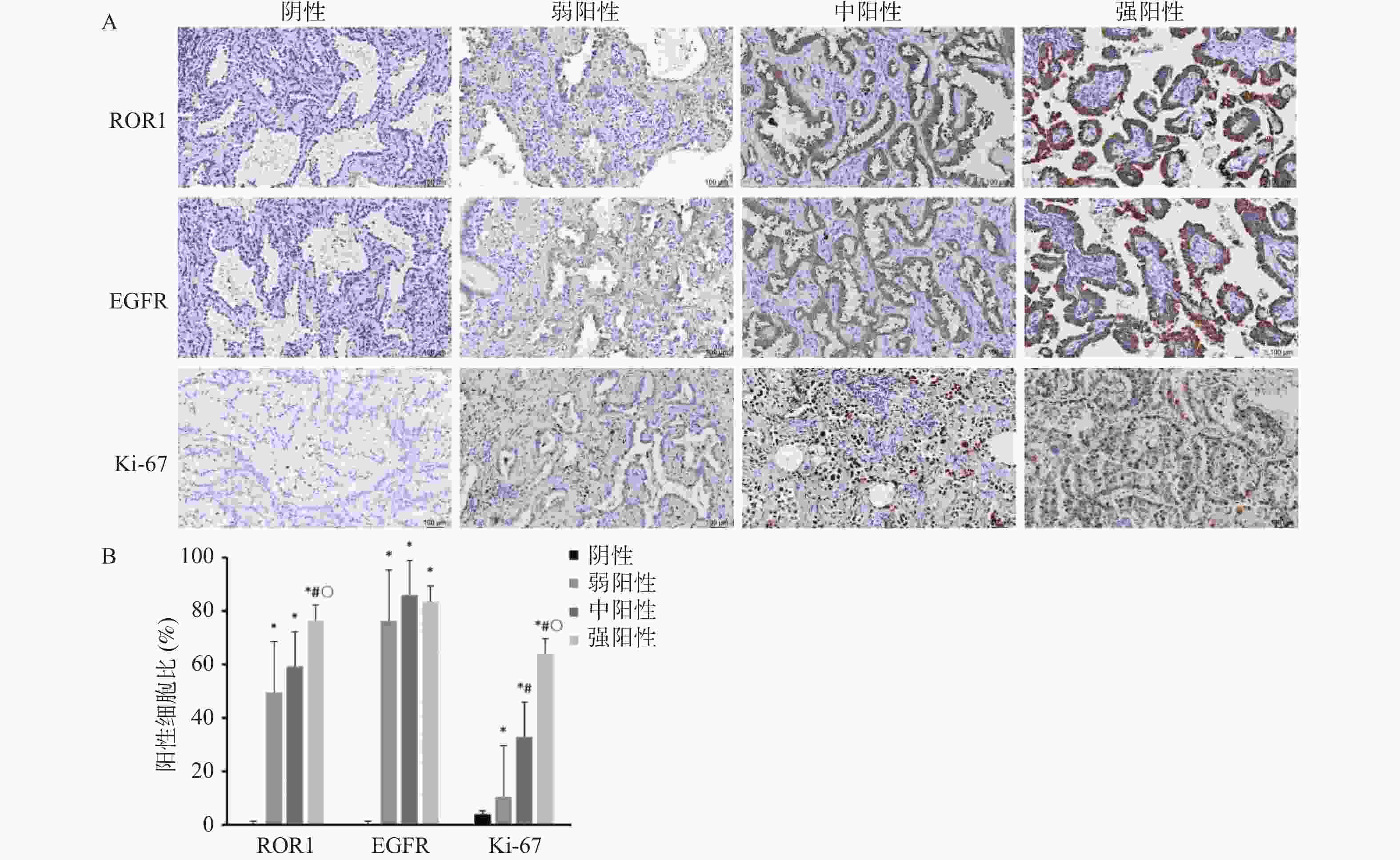
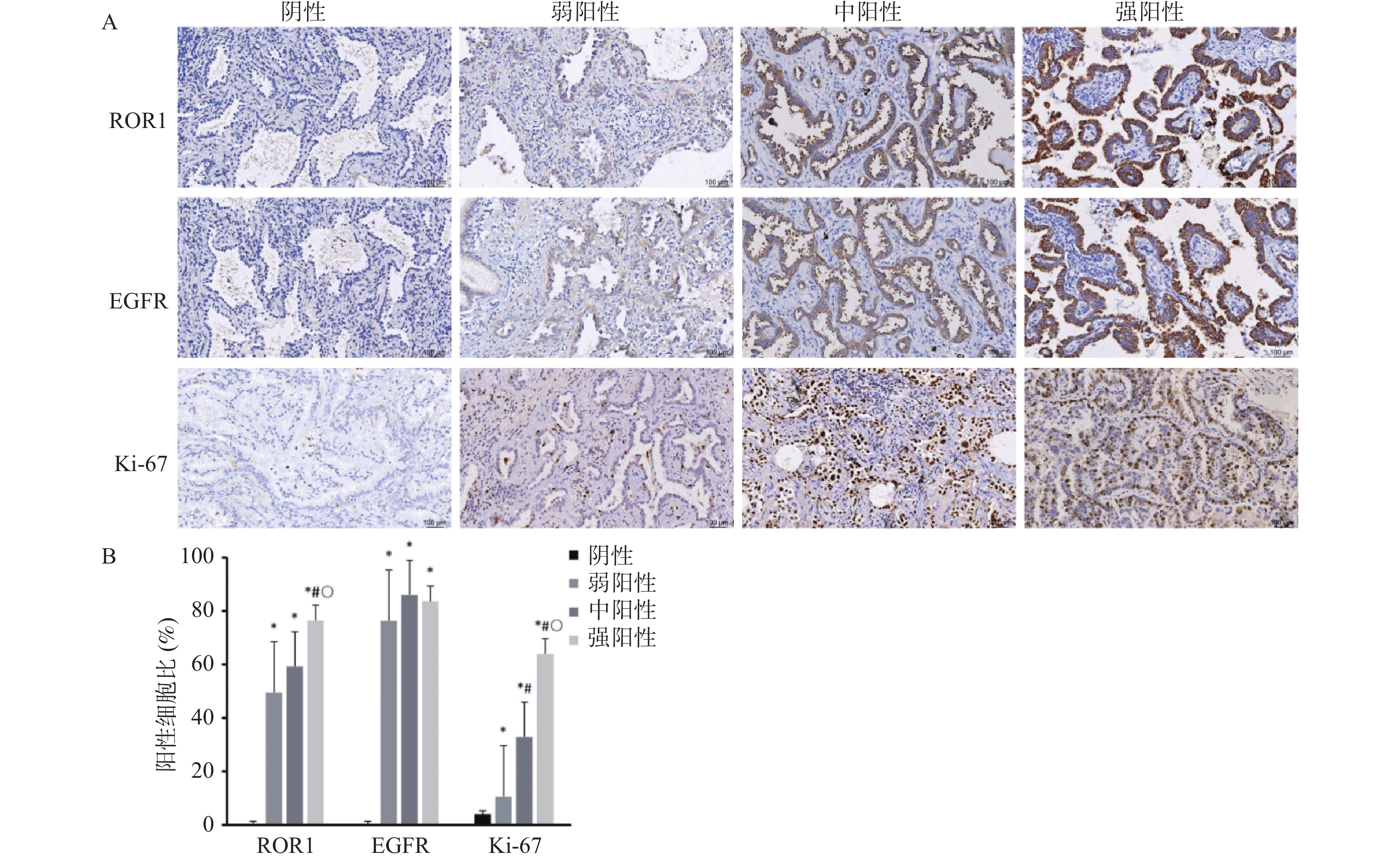
图 2 ROR1,EGFR和Ki-67在肺腺癌组织中的表达[($ \bar x \pm s $),n = 290]
A:免疫组化染色(200×);B:ROR1,EGFR和Ki-67阳性细胞比的统计分析;与阴性组相比,*P < 0.05;与弱阳性组相比,#P < 0.05;与中阳性组相比,○P < 0.05。
Figure 2. Expression of ROR1,EGFR and Ki-67 in lung adenocarcinoma[($ \bar x \pm s $),n = 290]
表 1 肺腺癌临床病理学特征与ROR1,EGFR和Ki-67表达水平的关系 [n(%)]
Table 1. Relationship between clinicopathological features and expression levels of ROR1,EGFR and Ki-67 in lung adenocarcinoma [n(%)]
临床病理特征 n ROR1 EGFR Ki-67 高表达 χ2 P 高表达 χ2 P 高表达 χ2 P 性别 0.78 0.421 3.11 0.115 0.02 1.000 男 120 91(75.8) 110(91.7) 24(20.0) 女 170 121(71.2) 164(96.5) 33(19.4) 年龄(岁) 0.39 0.631 0.85 0.536 0.73 0.475 <65 227 164(72.2) 213(93.8) 47(20.7) ≥65 63 48(76.2) 61(96.8) 10(15.9) 肿瘤直径(cm) 6.71 0.012* 5.19 0.028* 26.05 <0.001* ≤2.5 222 154(69.4) 206(92.8) 29(13.1) >2.5 68 58(85.3) 68(100.0) 28(41.2) 组织学形态 73.92 <0.001* 28.90 <0.001* 139.35 <0.001* 贴壁型 54 16(29.6) 43(79.6) 0(0.0) 腺泡型 125 97(77.6) 121(96.8) 11(8.8) 乳头型 49 38(77.6) 48(98.0) 4(8.2) 微乳头型 30 30(100.0) 30(100.0) 13(43.3) 实体型 32 31(96.9) 32(100.0) 29(90.6) 淋巴结转移 7.32 0.007* 4.05 0.048* 8.95 0.005* 无 234 163(69.7) 218(93.2) 38(16.2) 有 56 49(87.5) 56(100.0) 19(33.9) 神经侵犯 21.36 <0.001* 4.42 0.050 237.06 <0.001* 无 230 154(67.0) 214(93.0) 3(1.3) 有 60 58(96.7) 60(100.0) 54(90.0) 脉管侵犯 38.28 <0.001* 5.07 0.026* 109.23 <0.001* 无 198 123(62.1) 183(92.4) 6(3.0) 有 92 89(96.7) 91(98.9) 51(55.4) 胸膜侵犯 24.67 <0.001* 4.45 0.045* 107.83 <0.001* 无 204 132(64.7) 189(92.6) 8(3.9) 有 86 80(93.0) 85(98.8) 49(57.0) 与ROR1低表达组、EGFR低表达组和Ki-67低表达组比较,*P < 0.05。  下载: 导出CSV
表 2 不同分化程度肺腺癌中ROR1的表达[n(%)]
Table 2. Expression of ROR1 in lung adenocarcinoma with different degrees of differentiation [n(%)]
肺腺癌病理分级 n ROR1 χ2 P 高表达 低表达 高分化 57 18(31.58) 39(68.42) 63.991 <0.001* 中分化 203 166(81.77) 37(18.23) 低分化 30 28(93.33) 2(6.67) *P < 0.05。
下载: 导出CSV
表 3 不同分化程度肺腺癌中EGFR的表达[n(%)]
Table 3. Expression of EGFR in lung adenocarcinoma with different degrees of differentiation [n(%)]
肺腺癌病理分级 n EGFR χ2 P 高表达 低表达 高分化 57 46(80.70) 11(19.30) 26.151 <0.001* 中分化 203 198(97.54) 5(2.46) 低分化 30 30(100.00) 0(0.00) *P < 0.05。
下载: 导出CSV
表 4 不同分化程度肺腺癌中Ki-67的表达[n(%)]
Table 4. Expression of Ki-67 in lung adenocarcinoma with different degrees of differentiation[n(%)]
肺腺癌病理分级 n Ki-67 χ2 P 高表达 低表达 高分化 57 2(3.51) 55(96.49) 98.423 <0.001* 中分化 203 29(14.29) 174(85.71) 低分化 30 26(86.67) 4(13.33) *P < 0.05。
下载: 导出CSV
表 5 ROR1和EGFR、Ki-67在肺腺癌中表达的相关性
Table 5. Correlation of ROR1and EGFR,Ki-67 expression in lung adenocarcinoma
组别 EGFR高表达(n = 274) EGFR低表达(n = 16) Ki-67高表达(n = 57) Ki-67低表达(n = 233) ROR1高表达(n = 212) 211 1 57 155 ROR1低表达(n = 78) 63 15 0 78 χ2/P 38.493/P < 0.001* 26.102/P < 0.001* C/P 0.342/P < 0.001* 0.287/P < 0.001* *P < 0.05。
下载: 导出CSV
-
[1] Han B, Zheng R, Zeng H, et al. Cancer incidence and mortality in China, 2022[J]. J Natl Cancer Cent, 2024, 4(1): 47-53. [2] Siegel R L, Giaquinto A N, Jemal A. Cancer statistics, 2024[J]. CA A Cancer J Clin, 2024, 74(1): 12-49. [3] 滕熠, 张晓丹, 夏昌发, 等. 中国与全球癌症发病、死亡和患病对比及其预测分析: GLOBOCAN 2022数据解读[J]. 中华肿瘤防治杂志, 2024, 31(23): 1413-1420. doi: 10.16073/j.cnki.cjcpt.2024.23.01 [4] Zhang Y, Vaccarella S, Morgan E, et al. Global variations in lung cancer incidence by histological subtype in 2020: A population-based study[J]. Lancet Oncol, 2023, 24(11): 1206-1218. doi: 10.1016/S1470-2045(23)00444-8 [5] Charpidou A, Hardavella G, Boutsikou E, et al. Unravelling the diagnostic pathology and molecular biomarkers in lung cancer[J]. Breathe (Sheffield), 2024, 20(2): 230192. doi: 10.1183/20734735.0192-2023 [6] Sharma J, Zhou F, Moreira L A. Pulmonary adenocarcinoma updates: Histology, cytology, and grading[J]. Arch Pathol Lab Med, 2025, 149(4): e82-e86. [7] 刘芮, 商建峰, 朴颖实, 等. TTF-1和p40共表达的非小细胞肺癌5例临床病理分析[J]. 临床与实验病理学杂志, 2025, 41(12): 1600-1605. doi: 10.13315/j.cnki.cjcep.2025.12.011 [8] 任丽丽, 金发光, 刘小北. 早期肺癌检测的研究进展[J/OL]. 中华肺部疾病杂志(电子版), 2018, 11(4): 481-485. [9] Schilsky J B, Ni A, Ahn L, et al. Prognostic impact of TTF-1 expression in patients with stage IV lung adenocarcinomas[J]. Lung Cancer, 2017, 108: 205-211. doi: 10.1016/j.lungcan.2017.03.015 [10] Li L, Huang W, Ren X, et al. Unlocking the potential: Advancements and future horizons in ROR1-targeted cancer therapies[J]. Sci China Life Sci, 2024, 67(12): 2603-2616. doi: 10.1007/s11427-024-2685-9 [11] 赵鑫, 丁琳, 陈煜选, 等. ROR蛋白在癌症中的研究进展[J]. 中国细胞生物学学报, 2022, 44(12): 2354-2365. doi: 10.11844/cjcb.2022.12.0014 [12] Qi Z, Shiyi Z, Huili W, et al. Stable silencing of ROR1 regulates cell cycle, apoptosis, and autophagy in a lung adenocarcinoma cell line[J]. International journal of clinical and experimental pathology, 2020, 13(5): 1108-1120. [13] Menck K, Heinrichs S, Baden C, et al. The WNT/ROR pathway in cancer: From signaling to therapeutic intervention[J]. Cells, 2021, 10(1): 142. doi: 10.3390/cells10010142 [14] 余家洋, 王春光. 血管生成抑制剂联合厄洛替尼靶向治疗EGFR突变进展期非小细胞肺癌的疗效和安全性: 一项Meta分析[J]. 肿瘤, 2023, 43(1): 29-41. doi: 10.3781/j.issn.1000-7431.2023.2205-0334 [15] Cao J F, Zhang X, Xia Q, et al. Insights into curcumin’s anticancer activity in pancreatic ductal adenocarcinoma: Experimental and computational evidence targeting HRAS, CCND1, EGFR and AKT1[J]. Bioorg Chem, 2025, 157: 108264. doi: 10.1016/j.bioorg.2025.108264 [16] Malarz K, Korzuch J, Mrozek-Wilczkiewicz A, et al. Aminofullerenes as targeted inhibitors of EGFR: From pancreatic cancer inhibitors to Drosophila m. Toxicology[J]. Nanomedicine, 2025, 20(6): 585-601. doi: 10.1080/17435889.2025.2461985 [17] 潘诚, 李志华, 徐文正, 等. 肺腺癌中Ki-67表达与EGFR基因突变的相关性及其在预后中的价值[J]. 安徽医科大学学报, 2022, 57(2): 296-300. doi: 10.19405/j.cnki.issn1000-1492.2022.02.025 [18] Goyal A V, Shukla S, Acharya S, et al. Correlation of microvessel density with histopathological parameters of carcinoma breast[J]. Indian J Med Res, 2023, 158(4): 417-422. doi: 10.4103/ijmr.ijmr_1588_22 [19] 董懂, 黄意恒, 张亚杰, 等. 中华医学会肺癌临床诊疗指南(2023版)解读[J]. 中国胸心血管外科临床杂志, 2023, 30(11): 1533-1538. doi: 10.16781/j.CN31-2187/R.20240697 [20] 李媛, 谢惠康, 武春燕. WHO胸部肿瘤分类(第5版)中肺肿瘤部分解读[J]. 中国癌症杂志, 2021, 31(7): 574-580. [21] 赵丽楠, 王昆仑, 魏明乔, 等. NLR、LDH、CEA、NSE及CYFRA21-1单独及联合检测对非小细胞肺癌患者预后的预测价值[J]. 贵州医科大学学报, 2023, 48(10): 1232-1237. doi: 10.19367/j.cnki.2096-8388.2023.10.018 [22] Araghi M, Mannani R, Heidarnejad maleki A, et al. Recent advances in non-small cell lung cancer targeted therapy; an update review[J]. Cancer Cell Int, 2023, 23(1): 162. doi: 10.1186/s12935-023-02990-y [23] Lee E, Kazerooni E A. Lung cancer screening[J]. Semin Respir Crit Care Med, 2022, 43(6): 839-850. doi: 10.1055/s-0042-1757885 [24] Heabah N A E, Darwish S A, Eid A M. Evaluation of the prognostic significance of receptor tyrosine kinase-like orphan receptor 1 (ROR1) in lung carcinoma and its relation to lymphangiogenesis and epithelial mesenchymal transition[J]. Pathol Res Pract, 2023, 248: 154703. doi: 10.1016/j.prp.2023.154703 [25] Raso M G, Barrientos Toro E, Evans K, et al. Heterogeneous profile of ROR1 protein expression across tumor types[J]. Cancers, 2024, 16(10): 1874. doi: 10.3390/cancers16101874 [26] Tigu A B, Munteanu R, Moldovan C, et al. Therapeutic advances in the targeting of ROR1 in hematological cancers[J]. Cell Death Discov, 2024, 10(1): 471. doi: 10.1038/s41420-024-02239-1 [27] Liu D L, Gunther K, Enriquez A L, et al. ROR1 is upregulated in endometrial cancer and represents a novel therapeutic target[J]. Scientific reports, 2020, 10(1): 13906-13906. doi: 10.1038/s41598-020-70924-z [28] Li Y, Sun H, Bai C, et al. Dihydroartemisinin inhibits tumor progress via blocking ROR1-induced STAT3-activation in non-small cell lung cancer[J]. Int Immunopharmacol, 2024, 133: 112157. doi: 10.1016/j.intimp.2024.112157 [29] Fukuda T, Chen L, Endo T, et al. Antisera induced by infusions of autologous Ad-CD154-leukemia B cells identify ROR1 as an oncofetal antigen and receptor for Wnt5a[J]. Proc Natl Acad Sci U S A, 2008, 105(8): 3047-3052. doi: 10.1073/pnas.0712148105 [30] Witze E S, Litman E S, Argast G M, et al. Wnt5a control of cell polarity and directional movement by polarized redistribution of adhesion receptors[J]. Science, 2008, 320(5874): 365-369. doi: 10.1126/science.1151250 [31] Nieto M A, Huang R Y, Jackson R A, et al. Emt: 2016[J]. Cell, 2016, 166(1): 21-45. doi: 10.1016/j.cell.2016.06.028 [32] 陈思宇, 王毅刚. 新型受体酪氨酸激酶ROR1及其靶向肿瘤治疗的研究进展[J]. 中国细胞生物学学报, 2025, 47(1): 111-122. [33] 王作刚, 冯彦, 于亮, 等. ROR1对人肺癌A549细胞上皮-间质转化的影响[J]. 肿瘤防治研究, 2018, 45(7): 458-462. [34] Lopez-Bergami P, Barbero G. The emerging role of Wnt5a in the promotion of a pro-inflammatory and immunosuppressive tumor microenvironment[J]. Cancer Metastasis Rev, 2020, 39(3): 933-952. doi: 10.1007/s10555-020-09878-7 [35] 杨燕君, 董跃华, 张晓丽, 等. 血清CEA与癌组织标本中TTF-1检测对肺腺癌EGFR突变的预测价值[J]. 现代肿瘤医学, 2020, 28(11): 1870-1873. doi: 10.3969/j.issn.1672-4992.2020.11.013 [36] 管旭辉, 林晓程, 杨衿记. EGFR-TKIs 一线治疗EGFR复合突变非小细胞肺癌的疗效及耐药分析[J]. 陆军军医大学学报, 2022, 44(24): 2486-2492. [37] 赵景景, 谭于飞, 李玲, 等. 吉非替尼对老年晚期EGFR突变型非小细胞肺癌的疗效及对MMP-9、TIMP-1水平的影响[J]. 实用癌症杂志, 2023, 38(1): 156-159. doi: 10.3969/j.issn.1001-5930.2023.01.045 [38] 姬巧霞, 张红斌, 王愿, 等. 晚期非小细胞肺癌患者表皮生长因子受体基因突变的危险因素及表皮生长因子受体酪氨酸激酶抑制剂的疗效分析[J]. 中国医药, 2023, 18(2): 211-215. doi: 10.3760/j.issn.1673-4777.2023.02.012 [39] 刘爽, 刘艳梅, 曲佳哲. 吉非替尼联合化疗方案对EGFR突变晚期非小细胞肺癌患者疗效及CA19-9、CYFRA21-1、CEA表达的影响[J]. 中国实用医药, 2023, 18(3): 106-108. doi: 10.14163/j.cnki.11-5547/r.2023.03.031 [40] 李俏然, 赵信喜, 张新阁, 等. 表皮生长因子受体在非小细胞肺癌中的表达及与患者临床特征的关系[J]. 癌症进展, 2024, 22(12): 1357-1359+1379. doi: 10.11877/j.issn.1672-1535.2024.22.12.19 [41] Yamaguchi T, Yanagisawa K, Sugiyama R, et al. NKX2-1/TITF1/TTF-1-induced ROR1 is required to sustain EGFR survival signaling in lung adenocarcinoma[J]. Cancer Cell, 2012, 21(3): 348-361. doi: 10.1016/j.ccr.2012.02.008 [42] Pan W, Zhang C, Chen M, et al. Expression of Ki-67 and P16 are related with HPV in squamous cell carcinoma of the external auditory canal[J]. J Otolaryngol Head Neck Surg, 2022, 51: 40. doi: 10.1186/s40463-022-00592-8 [43] 刘晓明, 张蓓, 赵丽娜, 等. 乳腺黏液癌患者超声图像特征与PR、ER、HER-2、ER、Ki-67的相关性[J]. 贵州医科大学学报, 2023, 48(11): 1392-1398. doi: 10.19367/j.cnki.2096-8388.2023.11.018 [44] 谢玲. ROR1在三阴性乳腺癌中的表达及其预后意义[D]. 延安: 延安大学, 2020. -

 点击查看大图

计量
- 文章访问数: 222
- HTML全文浏览量: 147
- PDF下载量: 67
- 被引次数: 0
