




Typing Study of Selective Fetal Growth Restriction in Twins: A comparative Analysis of Clinical Features and Pregnancy Outcomes among Different Types
-
摘要:
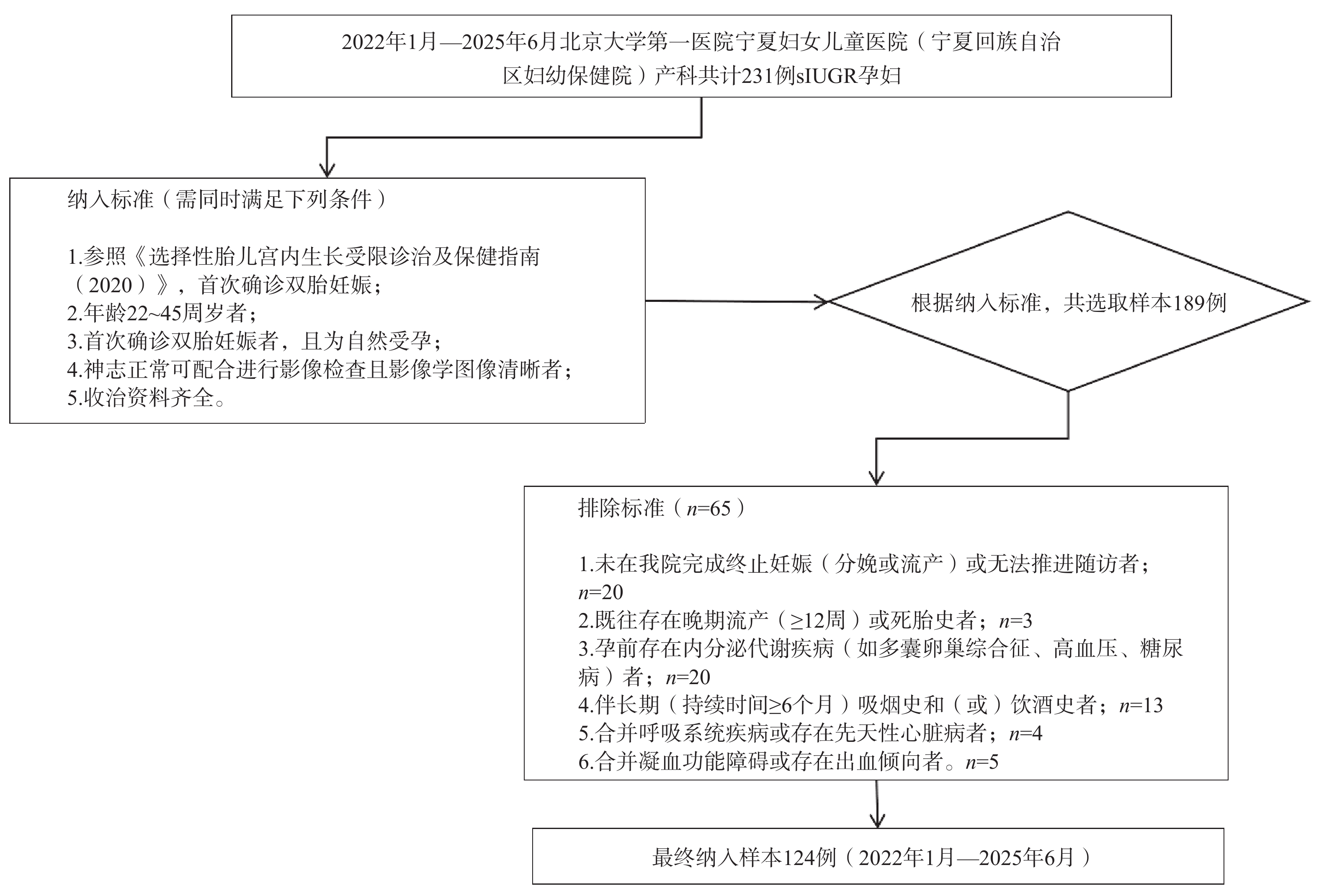
目的 研究双胎选择性胎儿生长受限(selective intrauterine fetal growth restriction,sIUGR)不同分型的类型临床特征及妊娠结局。 方法 连续纳入2022年1月—2025年6月北京大学第一医院宁夏妇女儿童医院(宁夏回族自治区妇幼保健院)收治的124例sIUGR孕妇进行回顾性研究,依据脐动脉(umbilical artery,UA)血流谱进行分型:Ⅰ型(正常,n = 67)、Ⅱ型(持续性缺失或反向,n = 36)、Ⅲ型(间断异常,n = 21),收集对比不同分型孕妇临床特征及妊娠结局,采取多因素Logistic回归分析出现sIUGR不良妊娠结局的相关因素。 结果 三组临床特征比较,孕妇年龄、孕前体重指数(body mass index,BMI)、产次、诊断时双胎估测体重(estimated fetal weight,EFW)差值及双胎儿脐带插入特征比较,差异有统计学意义(P < 0.05);三组孕妇妊娠结局比较,发现分娩孕周、小胎儿出生体重、两胎儿出生体重差值、脑室周围白质软化、小胎儿全身感染、呼吸衰竭、大胎儿肺气肿及小胎儿肺气胸比较,差异有统计学意义(P < 0.05);26例孕妇存在不良妊娠结局,占比20.97%,另98例孕妇妊娠结局良好,占比79.03%,且妊娠不良组年龄、诊断时双胎EFW差值、双胎儿脐带插入特征及sIUGR分型与妊娠良好组比较,差异有统计学意义(P < 0.05);多因素Logistic回归显示年龄、诊断时双胎EFW差值、双胎儿脐带插入特征中间型、不一致型及sIUGR分型Ⅱ型、Ⅲ型是sIUGR孕妇妊娠不良的危险因素(P < 0.05,OR > 1)。 结论 不同类型sIUGR孕妇其临床特征及妊娠结局不同,年龄、诊断时双胎EFW差值、双胎儿脐带插入特征及sIUGR分型影响sIUGR孕妇妊娠不良的关键因素。 -
关键词:
- 双胎选择性胎儿生长受限 /
- 分型研究 /
- 临床特征 /
- 妊娠结局
Abstract:Objective To study the clinical characteristics and pregnancy outcomes of different types of selective intrauterine fetal growth restriction ( sIUGR ) in twins. Methods A total of 124 pregnant women with sIUGR admitted to Ningxia Women and Children 's Hospital (Ningxia Maternal and Child Health Hospital) of Peking University First Hospital from January 2022 to June 2025 were consecutively enrolled for a retrospective study.The patients were divided according to the blood flow spectrum of umbilical artery (UA) blood flow patterns: Type I (normal, n = 67), Type II ( persistent absence or reversal, n = 36) and Type III (intermittent abnormality, n = 21). Clinical characteristics and pregnancy outcomes were collected and compared among the different types. Multivariate Logistic regression analysis was used to analyze related factors associated with adverse pregnancy outcomes in sIUGR. Results Comparison of clinical characteristics among the three groups showed statistically significant differences in maternal age, pre-pregnancy body mass index (BMI), parity, the estimated fetal weight (EFW) difference at diagnosis, and umbilical cord insertion characteristics of the twins(all P < 0.05). Comparison of pregnancy outcomes among the three groups showed statistically significant differences in gestational age at delivery, birth weight of the smaller fetus, the birth weight difference between the two fetuses, periventricular leukomalacia, systemic infection of the smaller twin, respiratory failure, pulmonary emphysema in the larger fetus, and pneumothorax of the smaller fetus (all P < 0.05). Adverse pregnancy outcomes occurred in 26 pregnant women (20.97%), while favorable outcomes were observed in 98 women (79.03%). Maternal age, EFW difference at diagnosis, twin umbilical cord insertion characteristics of the twins, and sIUGR type differed significantly between the adverse outcome group and the favorable outcome group(all P < 0.05). , Multivariate logistic regression analysis further revealed that maternal age, EFW difference at diagnosis, the intermediate and discordant types of twin umbilical cord insertion, and type II and type III sIUGR were risk factors for adverse pregnancy outcomes in pregnant women with sIUGR (all P < 0.05, OR > 1). Conclusion Pregnant women with different types of sIUGR exhibit distinct clinical characteristics and pregnancy outcomes. Maternal age, EFW difference at diagnosis, twin umbilical cord insertion characteristics of the twins, and sIUGR type are key factors influencing adverse pregnancy outcomes in pregnant women with sIUGR. -
表 1 不同分型临床特征比较[($\bar x \pm s $)/n(%)/M(P25,P75)]
Table 1. Comparison of clinical characteristics among different types [($\bar x \pm s $)/n(%)/M(P25,P75)]
sIUGR分型 Ⅰ型(n=67) Ⅱ型(n=36) Ⅲ型(n=21) χ2/t/F/H P 年龄(岁) 29.48 ± 3.11a 27.34 ± 2.71 27.43 ± 3.27c 7.460 0.001* 孕前BMI(kg/m2) 24.03 ± 1.79 23.82 ± 2.04 23.38 ± 2.45 1.240 0.293 生产史 有 44(65.67) 25(69.44) 15(71.43) 0.310 0.856 无 23(34.33) 11(30.56) 6(28.57) 产次(次) 2(2,3) 1(2,3)b 2(1,2)c 10.145 0.006* 家族史 有 9(13.43) 6(16.67) 4(19.05) 0.459 0.795 无 58(86.57) 30(83.33) 17(80.95) 诊断孕周(周) 24.41 ± 2.25 25.22 ± 2.87 24.52 ± 2.31 1.320 0.271 诊断时双胎EFW差值(%) 26.45 ± 7.92a 33.27 ± 7.84 31.46 ± 8.21c 25.332 <0.001* 双胎儿脐带插入特征 一致型 61(91.04) 30(83.33) 13(61.90) 5.738 0.011* 中间型 5(7.46) 4(11.11) 5(23.81) 不一致型 1(1.49) 2(5.56) 3(14.29) 子痫前期 有 9(13.43) 5(13.89) 3(14.29) 0.011 0.995 无 58(86.57) 31(86.11) 18(85.71) 妊娠期高血压 有 12(17.91) 7(19.44) 5(23.81) 0.357 0.837 无 55(82.09) 29(80.56) 16(76.19) 妊娠期糖尿病 有 14(20.90) 6(16.67) 5(23.81) 0.469 0.791 无 53(79.10) 30(83.33) 16(76.19) 妊娠期胆汁淤积症 有 8(11.94) 5(13.89) 4(19.05) 0.684 0.710 无 59(88.06) 31(86.11) 17(80.95) 未足月胎膜早破 有 5(7.46) 3(8.33) 1(4.76) 0.260 0.878 无 62(92.54) 33(91.67) 20(95.24) *P < 0.05;Ⅰ型与Ⅱ型比较,aP < 0.05;Ⅰ型与Ⅲ型比较,bP < 0.05;Ⅱ型与Ⅲ型比较,cP < 0.05。  下载: 导出CSV
表 2 不同分型妊娠结局比较[($\bar x \pm s $)/n(%)]
Table 2. Comparison of pregnancy outcomes among different types [($\bar x \pm s $)/n(%)]
sIUGR分型 Ⅰ型(n=67) Ⅱ型(n=36) Ⅲ型(n=21) χ2/t/F/H P 分娩孕周(周) 33.26 ± 3.21 31.52 ± 3.13 31.27 ± 2.73 10.376 <0.001* 胎儿出生体重(g) 大胎儿 1782.17 ± 362.281627.28 ± 311.371662.39 ± 211.762.980 0.055 小胎儿 1428.37 ± 340.411128.45 ± 187.621132.34 ± 183.3717.251 <0.001* 宫内死亡 大胎儿 1(1.49) 0(0.00) 0(0.00) 0.858 0.651 小胎儿 2(2.99) 3(8.33) 0(0.00) 2.793 0.247 两胎儿出生体重差值(%) 30.27 ± 3.21a 39.46 ± 3.45b 36.45 ± 2.47c 80.364 <0.001* 新生儿死亡 大胎儿 0(0.00) 2(5.56) 0(0.00) 4.969 0.083 小胎儿 2(2.99) 4(11.11) 1(4.76) 2.940 0.230 颅内出血 大胎儿 13(19.40) 7(19.44) 3(14.29) 0.304 0.859 小胎儿 27(40.30) 15(41.67) 8(38.10) 0.070 0.966 脑室周围白质软化 大胎儿 0(0.00)a 3(8.33) 2(9.52)c 6.173 0.046* 小胎儿 1(1.49)a 5(13.89) 7(33.33)c 17.899 <0.001* 脑室扩 大胎儿 1(1.49) 1(2.78) 2(9.52) 3.336 0.189 小胎儿 7(10.45) 4(11.11) 4(19.05) 1.158 0.560 全身感染 大胎儿 3(4.48) 2(5.56) 4(19.05) 5.261 0.072 小胎儿 7(10.45)a 5(13.89)b 8(38.10)c 9.223* 0.010* 呼吸衰竭 大胎儿 12(17.91)a 13(36.11)b 14(66.67)c 18.410 <0.001* 小胎儿 13(19.40)a 17(47.22)b 16(80.95)c 27.606 <0.001* 肺气肿 大胎儿 11(16.42)a 15(41.67) 13(61.90)c 17.799 <0.001* 小胎儿 21(31.34) 19(52.78) 11(52,38) 5.765 0.056 肺气胸 大胎儿 14(20.90) 12(33.33) 9(42.86) 4.460 0.108 小胎儿 25(37.31)a 22(61.11) 14(66.67)c 8.394 0.015* *P < 0.05;Ⅰ型与Ⅱ型比较,aP < 0.05,Ⅰ型与Ⅲ型比较,bP < 0.05,Ⅱ型与Ⅲ型比较,cP < 0.05。
下载: 导出CSV
表 3 两组一般资料比较[($\bar x \pm s $)/n(%)/M(P25,P75)]
Table 3. Comparison of general characteristics between the two groups [($\bar x \pm s $)/n(%)/M(P25,P75)]
变量 妊娠不良组(n=26) 妊娠良好组(n=98) χ2/t/Z P 年龄(岁) 29.82 ± 3.28 27.86 ± 2.57 3.254 0.002* 孕前BMI(kg/m2) 24.22 ± 2.14 22.62 ± 2.56 0.279 0.781 生产史 有 18(69.23) 78(79.59) 1.262 0.261 无 8(30.77) 20(20.41) 产次(次) 2(2,3) 2(1,3) −0.968 0.333 家族史 有 6(23.08) 15(15.31) 0.882 0.348 无 20(76.92) 83(84.69) 诊断孕周(周) 24.91 ± 2.82 24.53 ± 2.70 0.637 0.525 诊断时双胎EFW差值(%) 35.25 ± 3.29 28.47 ± 3.57 7.155 <0.001* 双胎儿脐带插入特征 一致型 7(26.92) 44(44.90) 2.034 0.362 中间型 10(38.46) 37(37.76) 不一致型 9(34.62) 17(17.35) 子痫前期 有 5(19.23) 13(13.27) 0.589 0.443 无 21(80.77) 85(86.73) 妊娠期高血压 有 7(26.92) 18(18.37) 0.934 0.334 无 19(73.08) 80(81.63) 妊娠期糖尿病 有 11(42.31) 25(25.51) 2.814 0.093 无 15(57.69) 73(74.49) 妊娠期胆汁淤积症 有 6(23.08) 14(14.29) 1.174 0.278 无 20(76.92) 84(85.71) 未足月胎膜早破 有 3(11.54) 7(7.14) 0.535 0.464 无 23(88.46) 92(92.86) sIUGR分型 Ⅰ型 8(30.77) 59(60.92) 8.020 0.018* Ⅱ型 10(38.46) 26(26.53) Ⅲ型 8(30.77) 13(13.27) *P < 0.05。
下载: 导出CSV
表 4 sIUGR孕妇妊娠不良的多因素Logistic回归分析
Table 4. Multivariate Logistic regression analysis of adverse pregnancy outcomes in pregnant women with sIUGR
变量 β S.E Z P OR 95%CI 年龄 0.276 0.108 2.561 0.010* 1.318 1.067~1.629 双胎儿脐带插入特征中间型 1.438 0.698 2.058 0.040* 4.211 1.071~16.555 双胎儿脐带插入特征不一致型 1.952 0.759 2.570 0.010* 7.044 1.590~31.210 诊断时双胎EFW差值 0.529 0.112 4.744 <0.001* 1.698 1.364~2.113 sIUGR分型Ⅱ型 1.916 0.663 2.891 0.004* 6.795 1.853~24.913 sIUGR分型Ⅲ型 2.315 0.798 2.901 0.004* 10.126 2.119~48.375 *P < 0.05。
下载: 导出CSV
-
[1] Bartin R, Colmant C, Claudet A, et al. Discordance in maximum velocities in the middle cerebral arteries of monochorionic twins: Beyond twin anemia-polycythemia sequence[J]. Am J Obstet Gynecol, 2025, 233(5): 488. e1-488. e14. [2] 吉婷, 董晋, 楚光华, 等. 选择性胎儿生长受限对妊娠结局的影响: 一项回顾性队列研究[J]. 中国妇幼健康研究, 2025, 36(11): 87-94. doi: 10.3969/j.issn.1673-5293.2025.11.013 [3] Jarry M A, Topalian N, Cosnard L, et al. Neonatal and two-year prognosis of eutrophic newborns from monochorionic diamniotic twin pregnancies complicated by selective intrauterine growth restriction[J]. Children (Basel), 2025, 12(5): 615. doi: 10.3390/children12050615 [4] 王佳倞, 耿力. 单绒毛膜双羊膜囊双胎选择性胎儿生长受限的临床分析[J]. 实用妇产科杂志, 2020, 36(4): 289-293. [5] Pedretti C, Fratelli N, Orabona R, et al. First-trimester ultrasound markers for prediction of adverse outcome in monochorionic diamniotic twin pregnancy[J]. Ultrasound Obstet & Gyne, 2025, 65(6): 723-728. doi: 10.1002/uog.29229 [6] 杨海波, 张波, 杨太珠, 等. 双胎不同类型选择性胎儿生长受限的妊娠结局分析[J]. 实用妇产科杂志, 2024, 40(6): 496-500. [7] 中国妇幼保健协会双胎妊娠专业委员会. 选择性胎儿宫内生长受限诊治及保健指南(2020)[J]. 中国实用妇科与产科杂志, 2020, 36(7): 618-625. doi: 10.19538/j.fk2020070112 [8] 李晓菲, 王莉, 吴青青. 妊娠11~13+6周超声筛查单绒毛膜双胎胎儿畸形[J]. 中国医学影像学杂志, 2026, 34(5): 577-582. [9] Qiu T, Cheng W, Chen Y, et al. Clinical outcome of monochorionic diamniotic twins with intrauterine growth restriction[J]. Am J Perinatol, 2024, 41(10): 1321-1328. doi: 10.1055/s-0042-1754394 [10] 邵肖梅, 叶鸿瑁, 丘小汕. 实用新生儿学[M]. 5版. 北京: 人民卫生出版社, 2019: 147. [11] 赵玉洁, 张英. 不同绒毛膜性的双胎选择性胎儿生长受限的临床特征及结局比较[J]. 安徽医科大学学报, 2023, 58(11): 1966-1970. doi: 10.19405/j.cnki.issn1000-1492.2023.11.028 [12] Huang X, Xiang H, Bao J, et al. The effects of intrauterine growth on physical and intellectual development of one-year-old infants: A study on monochorionic twins with selective intrauterine growth restriction[J]. J Obstet Gynaecol, 2023, 43(1): 2125300. doi: 10.1080/01443615.2022.2125300 [13] Meng X L, Yuan P B, Wang X J, et al. The proteome landscape of human placentas for monochorionic twins with selective intrauterine growth restriction[J]. Genom Proteom Bioinform, 2023, 21(6): 1246-1259. doi: 10.1016/j.gpb.2023.03.002 [14] Chen L, Zhou W, Zhang Y, et al. Natural evolution and risk factors for adverse outcome in selective intrauterine growth restriction under expectant management: A retrospective observational study[J]. Int J Gynecol Obstet, 2023, 162(2): 569-577. doi: 10.1002/ijgo.14679 [15] 谢璐璐, 邓颖, 靳晓丹, 等. 单绒毛膜双羊膜囊双胎并发选择性宫内生长受限的预后分析[J]. 医学临床研究, 2020, 37(12): 1776-1778. doi: 10.3969/ji.ssn.1671-7171.2020.12.004 [16] 张雅慧, 王丹, 刘云峰, 等. 选择性宫内生长受限中发育正常胎儿围产期特点及生后早期循环功能变化[J]. 中华围产医学杂志, 2024, 27(3): 188-195. doi: 10.3760/cma.j.cn113903-20231031-00294 [17] 张晗, 魏瑗, 赵扬玉. 基于多普勒超声的sIUGR预后评价指标研究现状与展望[J]. 现代妇产科进展, 2020, 29(11): 874-877. doi: 10.13283/j.cnki.xdfckjz.2020.11.015 [18] Wataganara T, Nawapun K, Watananirun K, et al. Early unfavorable outcomes of second-trimester selective feticide for complicated monochorionic twins: single-operator experiences[J]. Journal of perinatal medicine, 2025, 54(3): 543-549. [19] 胡晓雨, 邹刚. 双胎妊娠早产的早期预测与临床处理[J]. 中国实用妇科与产科杂志, 2025, 41(2): 161-166. doi: 10.19538/j.fk2025020107 [20] 高传芬, 张超学, 张英, 等. 脑胎盘血流比对单绒毛膜双胎选择性宫内生长受限的预测价值[J]. 中国超声医学杂志, 2022, 38(8): 891-894. doi: 10.3969/j.issn.1002-0101.2022.08.017 [21] 刘明敏, 刘俊, 杨淳玮, 等. 早中孕期超声指标对单绒毛膜双羊膜囊双胎发生选择性宫内生长受限的预测价值[J]. 中国超声医学杂志, 2024, 40(7): 787-791. doi: 10.3969/j.issn.1002-0101.2024.07.018 [22] Yao B, Liu Y, Jing D, et al. The value of ultrasound indicators in early pregnancy for predicting selective intrauterine growth restriction and twin-twin transfusion syndrome: A case‒control study[J]. BMC Pregnancy Childbirth, 2025, 25(1): 212. doi: 10.1186/s12884-025-07354-0 [23] 刘真, 杨慧霞, 孙瑜. 单绒毛膜性双胎选择性胎儿生长受限研究进展[J]. 中国妇产科临床杂志, 2020, 21(3): 329-331. doi: 10.13390/j.issn.1672-1861.2020.03.044 [24] 陈璐, 周微笑, 赵苇, 等. 双胎妊娠选择性胎儿生长受限不同分型的妊娠期分型转化及围产结局[J]. 中华妇产科杂志, 2023, 58(4): 259-269. doi: 10.3760/cma.j.cn112141-20221217-00766 -

 点击查看大图
计量
- 文章访问数: 3
- HTML全文浏览量: 4
- PDF下载量: 0
- 被引次数: 0
