




Epidemiological Characteristics of G6PD Deficiency in the Dai Population of Yunnan Province and a Pedigree Study on the Effects of X-Chromosome Inactivation on Female Phenotypes
-
摘要:
目的 统计云南省德宏州及西双版纳州傣族人群葡萄糖-6-磷酸脱氢酶(glucose-6-phosphate dehydrogenase,G6PD)缺乏症的分子流行病学特征、酶活性筛查效能及常见突变类型分布;分析携带c.487G > A突变的26个家系中女性杂合携带者的G6PD酶活性与X染色体失活(X-chromosome inactivation, XCI)状态的关系。 方法 2018年1月至2022年12月收集云南省德宏州及西双版纳州傣族人群样本 1596 份,其中德宏州1009 份,西双版纳州587份。采用二代基因测序技术对10个已知G6PD基因突变位点进行筛查;采用荧光斑点法检测G6PD酶活性。对不同性别、不同突变类型与酶活性改变进行统计分析。纳入26个携带G6PD基因c.487G > A突变的家系,共30个女性基因杂合突变携带者,对先证者及其家系成员进行Sanger测序以明确突变位点及遗传来源。采用荧光分析法检测外周血G6PD酶活性水平。使用基于雄激素受体(androgen receptor,AR)基因多态性以及位于X染色体短臂的另外3个多态性遗传标记(XpA、XpB和XpC)的酶切-PCR方法,来评估女性携带者的XCI,计算XCI失活比例,综合分析XCI偏移与G6PD酶活性表型之间的关系。结果 1596 份样本中共检出768份G6PD基因突变样本,总携带率为48.12%,其中男性携带率为40.89%,女性为53.73%。德宏州携带率为50.35%,西双版纳州为44.29%。德宏州常见致病突变为c.487G > A(9.12%)、c.1388G > A(5.35%)、c.392G > T(3.47%)和c.1376G > T(2.77%);西双版纳州常见致病突变为c.1388G > A(3.92%)、c.1376G > T(2.90%)、c.392G > T(1.70%)和c.487G > A(1.36%)。荧光斑点法筛查显示,两地区G6PD缺乏症总阳性率为14.53%,其中男性阳性率为19.66%,女性为10.57%,差异有统计学意义(P < 0.001)。德宏州阳性率为14.97%,男性显著高于女性(21.99% vs 9.71%,P < 0.001);西双版纳州阳性率为13.80%,男性与女性差异无统计学意义(15.85% vs 12.11%,P > 0.05)。26个家系中共有30个女性检测到c.487G > A杂合突变,女性携带者的G6PD酶活性水平存在明显个体差异,酶活性正常组和酶活性偏低组XCI偏移程度存在统计学差异,酶活性偏低组携带突变X染色体活性率明显高于正常组(P = 0.011)。结论 云南省德宏州及西双版纳州傣族人群G6PD基因突变携带率高,属于国内乃至国际较高水平,不同地区常见致病突变谱存在差异。女性G6PD杂合携带者的酶活性表型除了取决于基因突变类型以外,还受到XCI偏移情况的影响。 Abstract:Objective To investigate the epidemiological features and mutation spectrum of G6PD deficiency in the Dai population of Yunnan Province and to analyze the relationship between G6PD enzyme activity and X-chromosome inactivation (XCI) in female heterozygous from 26 families carrying the c.487G > A mutation. Methods A total of 1, 596 samples were collected from the Dai populations of Dehong and Xishuangbanna prefectures, Yunnan Province, from May 2018 to April 2025, including 1, 009 samples from Dehong Prefecture and 587 samples from Xishuangbanna Prefecture. Next-generation sequencing was employed to screen for 10 known G6PD gene mutation sites, and the fluorescent spot test was used to detect G6PD enzyme activity. Statistical analyses were performed to assess the associations of sex and mutation type with alterations in enzyme activity. Twenty-six families carrying the c.487G > A mutation were enrolled. G6PD mutations were identified by PCR and Sanger sequencing; enzyme activity was measured using a dried blood spot fluorescence assay, and XCI status was assessed by methylation-sensitive PCR with X-linked polymorphic markers. Results Among the 1, 596 screened individuals, 768 samples were found to carry G6PD mutations, with a carrier rate of 48.12%. G6PD deficiency was detected in 14.53% of the population. The most common mutation was c.487G > A, followed by c.1388G > A and c.1376G > T. Among 30 female carriers from 26 families, enzyme activity varied markedly, ranging from deficient to normal levels. XCI analysis showed that skewed XCI was associated with reduced G6PD enzyme activity, whereas carriers with random XCI generally maintained normal activity. The mutant X chromosome showed a higher activity rate in women with abnormal enzyme activity than in those with normal activity. Conclusion The Dai population of Dehong Prefecture and Xishuangbanna Prefecture, Yunnan Province, has a high carrier rate of G6PD mutations, with c.487G > A being the predominant variant. Phenotypic variability in female heterozygous carriers is influenced not only by genotype but also by XCI skewing. Integrating mutation analysis, enzyme activity testing, and XCI assessment may improve clinical evaluation and genetic counseling. -
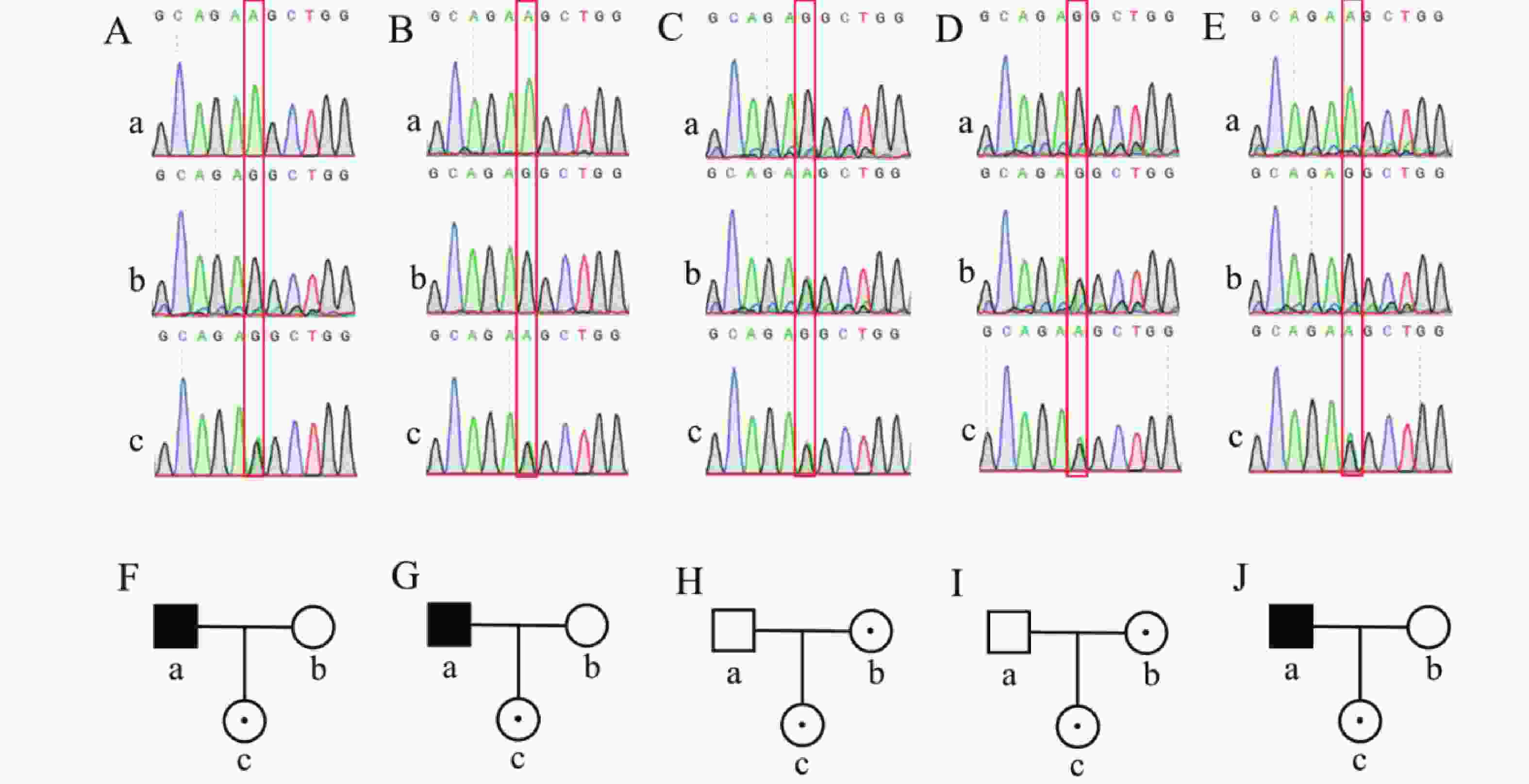
图 1 5个家系成员Sanger测序结果与G6PD突变家系图
A~E:家系一到家系五的Sanger测序结果;F~J:家系一到家系五的遗传家系图;a:父亲;b:母亲;c:女儿。
Figure 1. Sanger sequencing results of five families members and pedigree chart of the G6PD mutation family
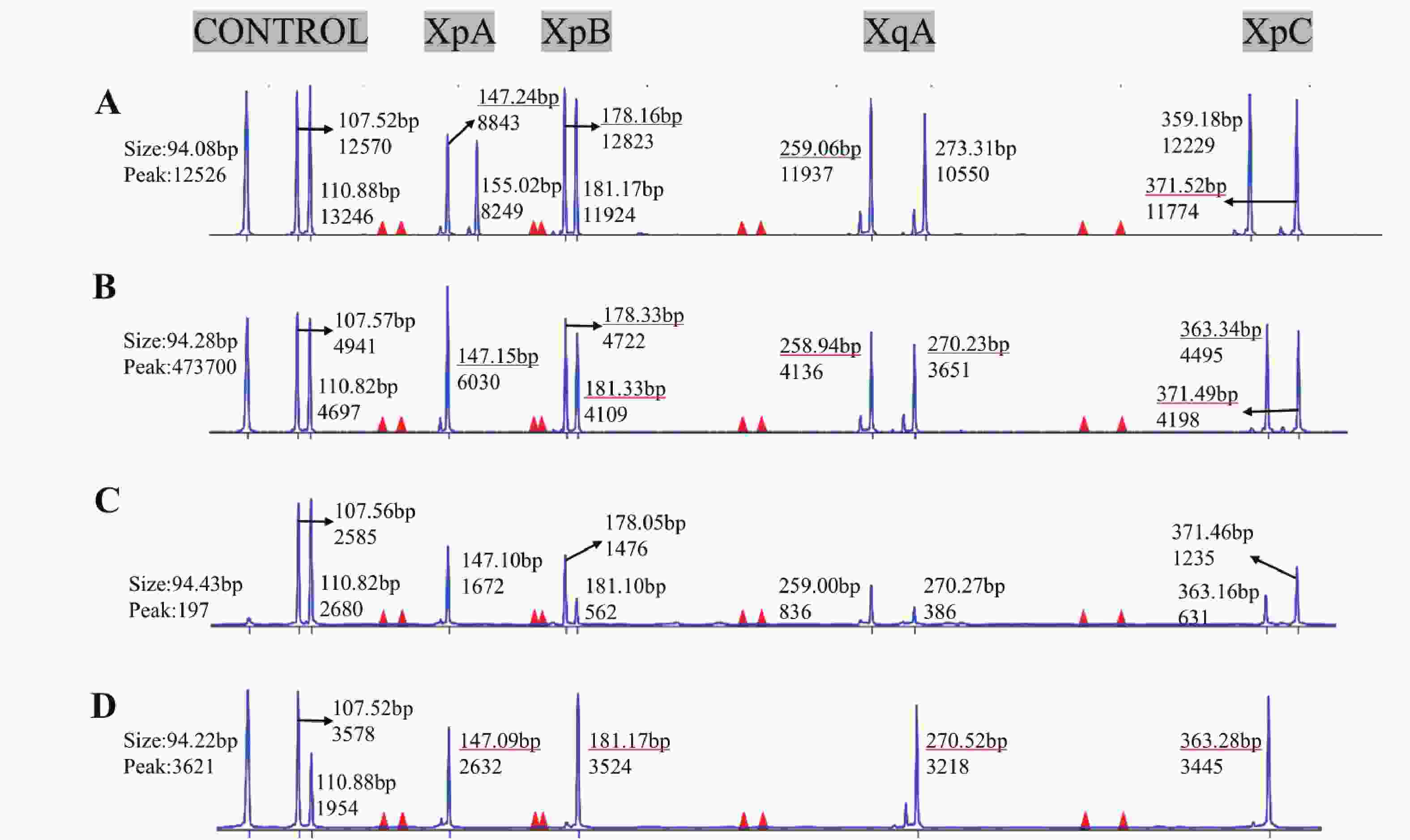
图 2 家系一XCI检测结果图
A:母亲未酶切DNA的PCR扩增结果;B:女儿未酶切DNA的PCR扩增结果;C:女儿酶切DNA的PCR扩增结果;D:父亲未酶切DNA的PCR扩增结果。
Figure 2. XCI analysis in family 1
表 1 家系成员基因型及酶活性检测结果(1)
Table 1. Genotypes and enzyme activity detection results of family members(1)
家系编号 家系成员 c.487G > A突变情况 G6PD酶活性(U/gHb) 酶活性结果 1 父亲 半合子突变 1.6 阳性 母亲 野生型 4.7 正常 女儿携带者 杂合突变 2.4 可疑 2 父亲 半合子突变 1.7 阳性 母亲 野生型 5.0 正常 女儿携带者 杂合突变 3.8 正常 3 父亲 野生型 4.6 正常 母亲 杂合突变 3.2 正常 女儿携带者 杂合突变 2.4 可疑 4 父亲 野生型 3.9 正常 母亲 杂合突变 3.8 正常 女儿携带者 杂合突变 3.3 正常 5 父亲 半合子突变 1.5 阳性 母亲 野生型 5.5 正常 女儿携带者 杂合突变 4.6 正常 6 父亲 野生型 5.7 正常 母亲 杂合突变 2.1 阳性 女儿携带者 杂合突变 2.5 可疑 7 母亲携带者 杂合突变 1.7 阳性 儿子 半合子突变 1.3 阳性 8 母亲携带者 杂合突变 2.7 可疑 儿子 野生型 4.6 正常 9 母亲携带者 杂合突变 3.2 正常 儿子 野生型 4.5 正常 10 母亲携带者 杂合突变 3 可疑 儿子 半合子突变 1.2 阳性  下载: 导出CSV
表 1 家系成员基因型及酶活性检测结果(2)
Table 1. Genotypes and enzyme activity detection results of family members(2)
家系编号 家系成员 c.487G > A突变情况 G6PD酶活性(U/gHb) 酶活性结果 11 母亲携带者 杂合突变 2.6 可疑 儿子 野生型 4.5 正常 12 母亲携带者 杂合突变 2.5 可疑 儿子 半合子突变 1.2 阳性 13 母亲携带者 杂合突变 3.2 正常 儿子 野生型 4.2 正常 14 母亲携带者 杂合突变 3 可疑 儿子 野生型 5.8 正常 15 母亲携带者 杂合突变 4.4 正常 儿子 半合子突变 1.3 阳性 16 母亲携带者 杂合突变 5.1 正常 儿子 半合子突变 1.6 阳性 17 母亲携带者 杂合突变 3.6 正常 儿子 半合子突变 1.7 阳性 18 母亲携带者 杂合突变 3.5 正常 儿子 半合子突变 1.3 阳性 19 母亲 杂合突变 4 正常 哥哥 半合子突变 1.4 阳性 小女儿携带者 杂合突变 4.4 正常 20 母亲携带者 杂合突变 2.6 可疑 儿子 半合子突变 1.4 阳性 21 母亲携带者 杂合突变 3.8 正常 儿子 半合子突变 2.5 可疑 22 父亲 半合子突变 1.5 阳性 女儿携带者 杂合突变 3.9 正常 23 父亲 半合子突变 1.9 阳性 女儿携带者 杂合突变 4.9 正常 24 父亲 半合子突变 1.7 阳性 女儿携带者 杂合突变 3.8 正常 25 父亲 半合子突变 1.9 阳性 女儿携带者 杂合突变 3.1 正常 26 父亲 半合子突变 1.8 阳性 姐姐 杂合突变 4.1 正常 小女儿携带者 杂合突变 3.5 正常
下载: 导出CSV
表 2 30个女性携带者的XCI结果(%)
Table 2. XCI results of 30 female carrier(%)
家系及成员 XpA XpB XqA XpC XCI均值 携带突变基因染色体的活性比例 X失活状态 1女儿 / 28.84 32.64 30.65 30.71 69.29 随机失活 2女儿 / / 34.28 38.64 36.46 36.46 随机失活 3女儿 / / 23.52 20.76 22.14 77.86 失活偏移 母亲 33.96 / 41.49 32.83 36.09 36.09 随机失活 4女儿 / / / 45.82 45.82 45.82 随机失活 母亲 31.07 31.67 31.37 68.63 随机失活 5女儿 / 34.05 37.56 37.89 36.50 36.50 随机失活 6女儿 / / 32.74 31.60 32.17 67.83 随机失活 母亲 / / 17.56 16.95 17.25 82.75 失活偏转 7母亲 / / 9.51 16.33 12.92 87.08 失活偏转 8母亲 / 47.29 41.08 / 44.18 55.82 随机失活 9母亲 / 45.5 53.86 41.02 47.44 52.56 随机失活 10母亲 / 40.28 44.06 / 42.17 57.83 随机失活 11母亲 / / 31.66 / 31.66 68.34 随机失活 12母亲 / / 46.10 / 46.10 53.90 随机失活 13母亲 / 30.87 25.17 31.70 29.25 29.25 随机失活 14母亲 / / 29.33 36.22 32.77 67.23 随机失活 15母亲 / 27.31 / 25.43 26.37 73.63 随机失活 16母亲 / / 32.08 30.01 31.04 68.96 随机失活 17母亲 / 29.73 32.23 / 30.98 69.02 随机失活 18母亲 / 35.85 34.09 32.88 34.27 65.73 随机失活 19女儿 / 37.52 34.18 38.94 35.85 35.85 随机失活 20母亲 / 29.17 26.97 24.28 26.81 73.19 随机失活 21母亲 / / 26.75 27.11 26.93 73.07 随机失活 22女儿 / / / 27.18 27.18 27.18 随机失活 23女儿 / 14.92 13.73 17.37 16.14 16.14 失活偏转 24女儿 / 35.09 39.16 / 37.12 62.88 随机失活 25女儿 / / 58.94 36.73 47.83 52.17 随机失活 26小女儿 / / 23.70 33.19 28.44 71.56 随机失活 大女儿 / / 45.98 46.92 46.45 53.55 随机失活
下载: 导出CSV
表 3 两组携带突变基因X染色体的活性比例比较[ M(min ~ max)]
Table 3. Comparison of the activity ratio of the mutant-carrying X chromosome between the two groups [Median (Minimum~Maximum)]
变量
异常组(n = 11)
正常组(n = 19)
W
P
携带突变基因染色体的活性比
0.683
(0.539~0.871)
0.526
(0.161~0.736)
163
0.011*
*P<0.05。
下载: 导出CSV
-
[1] Luzzatto L, Ally M, Notaro R. Glucose-6-phosphate dehydrogenase deficiency[J]. Blood, 2020, 136(11): 1225-1240. doi: 10.1182/blood.2019000944 [2] Belfield K D, Tichy E M. Review and drug therapy implications of glucose-6-phosphate dehydrogenase deficiency[J]. Am J Health Syst Pharm, 2018, 75(3): 97-104. doi: 10.2146/ajhp160961 [3] He M, Lin K, Huang Y, et al. Prevalence and molecular study of G6PD deficiency in the Dai and Jingpo ethnic groups in the Dehong prefecture of the Yunnan Province[J]. Hum Hered, 2018, 83(2): 55-64. doi: 10.1159/000489009 [4] Cappellini M D, Fiorelli G. Glucose-6-phosphate dehydrogenase deficiency[J]. Lancet, 2008, 371(9623): 1307-1317. [5] Migeon B R. X-linked diseases: Susceptible females[J]. Genet Med, 2020, 22(7): 1156-1174. [6] Chu C S, Bancone G, Nosten F, et al. Primaquine-induced haemolysis in females heterozygous for G6PD deficiency[J]. Malar J, 2018, 17(1): 101. doi: 10.1186/s12936-018-2248-y [7] Wang J, Xiao Q Z, Chen Y M, et al. DNA hypermethylation and X chromosome inactivation are major determinants of phenotypic variation in women heterozygous for G6PD mutations[J]. Blood Cells Mol Dis, 2014, 53(4): 241-245. doi: 10.1016/j.bcmd.2014.06.001 [8] Caylor R C. Nonrandom X chromosome inactivation detection[J]. Curr Protoc, 2023, 3(4): e748. doi: 10.1002/cpz1.748 [9] Domingo G J, Satyagraha A W, Anvikar A, et al. G6PD testing in support of treatment and elimination of malaria: Recommendations for evaluation of G6PD tests[J]. Malar J, 2013, 12: 391. doi: 10.1186/1475-2875-12-391 [10] 中华预防医学会出生缺陷预防与控制专业委员会新生儿筛查学组, 中国医师协会医学遗传医师分会临床生化遗传专业委员会, 中国医师协会医学遗传医师分会临床生化遗传专业委员会中国医师协会青春期医学专业委员会临床遗传学组. 葡萄糖-6-磷酸脱氢酶缺乏症新生儿筛查、诊断和治疗专家共识[J]. 中华儿科杂志, 2017, 55(6): 411-414. doi: 10.3760/cma.j.issn.0578-1310.2017.06.003 [11] Li Q, Yang F, Liu R, et al. Prevalence and molecular characterization of glucose-6-phosphate dehydrogenase deficiency at the China-Myanmar border[J]. PLoS One, 2015, 10(7): e0134593. doi: 10.1371/journal.pone.0134593 [12] Howes R E, Piel F B, Patil A P, et al. G6PD deficiency prevalence and estimates of affected populations in malaria endemic countries: A geostatistical model-based map[J]. PLoS Med, 2012, 9(11): e1001339. doi: 10.1371/journal.pmed.1001339 [13] Jiang W, Yu G, Liu P, et al. Structure and function of glucose-6-phosphate dehydrogenase-deficient variants in Chinese population[J]. Hum Genet, 2006, 119(5): 463-478. doi: 10.1007/s00439-005-0126-5 [14] Errigo A, Bitti A, Galistu F, et al. Relationship between glucose-6-phosphate dehydrogenase deficiency, X-chromosome inactivation and inflammatory markers[J]. Antioxidants (Basel), 2023, 12(2): 334. doi: 10.3390/antiox12020334 [15] Roper D, Layton M, Rees D, et al. Laboratory diagnosis of G6PD deficiency. A British society for haematology guideline[J]. Br J Haematol, 2020, 189(1): 24-38. doi: 10.1111/bjh.16366 [16] He W B, Du J, Xie P Y, et al. X-chromosome inactivation pattern of amniocytes predicts the risk of dystrophinopathy in fetal carriers of DMD mutations[J]. Prenatal Diagn, 2019, 39(8): 603-608. doi: 10.1002/pd.5473 [17] Tomofuji Y, Edahiro R, Sonehara K, et al. Quantification of escape from X chromosome inactivation with single-cell omics data reveals heterogeneity across cell types and tissues[J]. Cell Genomics, 2024, 4(8): 100625. doi: 10.1016/j.xgen.2024.100625 -

 点击查看大图
计量
- 文章访问数: 1
- HTML全文浏览量: 1
- PDF下载量: 0
- 被引次数: 0
